
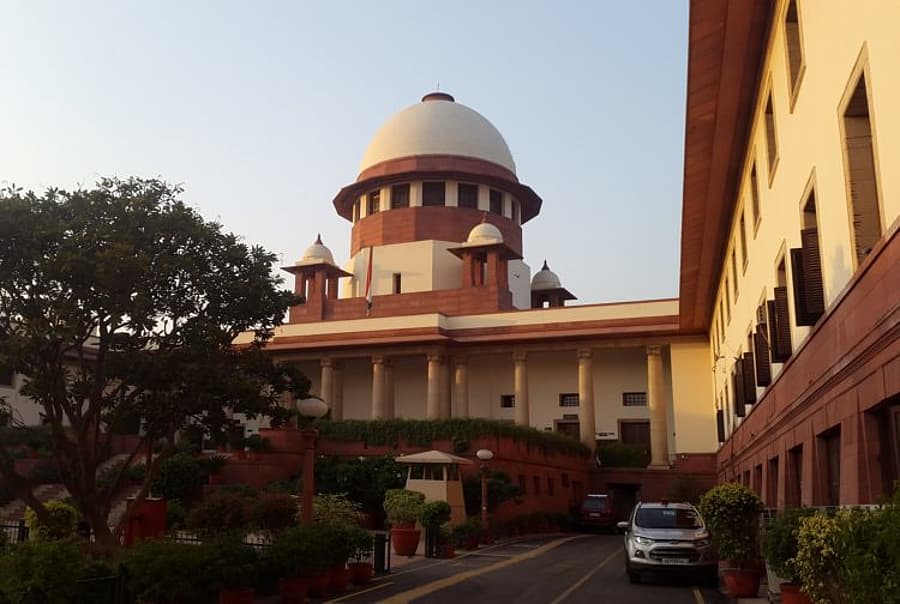
Supreme Court: Interim Protection for Journalist in SC/ST Act Case
Summary
- The Supreme Court granted interim protection to a journalist accused under the SC/ST Act.
- This protection came after the journalist accused ACP Vivek Bhagat of sexual harassment.
- Senior Advocate Indira Jaising argued the SC/ST case was vindictive and an abuse of the law.
- The Court ordered no coercive action against the journalist, whose molestation complaint remains unfiled as an FIR.
- CJI Surya Kant emphasized the need to protect the journalist from retaliatory legal measures.
Supreme Court Grants Interim Protection
This ruling establishes a precedent where the Supreme Court intervenes to protect individuals from potential retaliatory legal actions, specifically under the SC/ST Act, when such actions appear to be a response to a prior complaint of sexual harassment.
The Supreme Court of India recently intervened to provide crucial interim protection to a journalist facing charges under the Scheduled Castes and Scheduled Tribes (Prevention of Atrocities) Act. This significant development occurred on a Thursday, with a bench comprising Chief Justice of India (CJI) Surya Kant and Justice Joymalya Bagchi issuing the directive. The journalist had been accused of making casteist remarks against Assistant Commissioner of Police (ACP) Vivek Bhagat.
This legal action against the journalist followed closely on the heels of a serious allegation she made against the same police officer. Days prior to being booked, the journalist had publicly accused ACP Bhagat of sexually harassing her while she was engaged in covering the ongoing protests in Delhi. The Court's order specifically mandates that no coercive action be taken against the journalist at this time, providing a temporary shield against immediate arrest or other punitive measures. The bench was hearing a collection of petitions related to the Delhi protests when this matter was brought before them.
Allegations of Vindictive Prosecution
During the proceedings, Senior Advocate Indira Jaising, representing the journalist, presented a compelling argument that the case filed under the SC/ST Act was an act of vindictive prosecution. Jaising asserted that the charges of caste abuse were lodged in direct retaliation for her client's prior accusation of sexual harassment against the police officer. She characterized this situation as a clear misuse of the Scheduled Castes and Scheduled Tribes (Prevention of Atrocities) Act, a law designed to protect vulnerable communities from discrimination and atrocities.
Jaising further highlighted the severity of the alleged sexual harassment, stating that her client had been "very badly molested." She informed the Court of her willingness to disclose the name of the police officer involved. Moreover, the senior advocate pointed out a critical procedural failure: despite the journalist attempting to lodge a First Information Report (FIR) regarding the sexual harassment at the police station, no such report was officially registered. This omission strengthened the argument that the subsequent SC/ST case was a retaliatory measure rather than a legitimate legal complaint.
Court's Directive and Broader Implications
CJI Surya Kant explicitly addressed the need for the journalist's protection, stating, "That individual woman journalist about whom the allegations are there, and against whom the police official is stated to have gone to the High Court (for the registration of an SC/ST Act case) ...please see that there is no coercive action." This direct instruction underscores the Court's concern regarding the potential for a vindictive FIR India, particularly when a powerful legal instrument like the SC/ST Act is invoked under suspicious circumstances.
The Court's formal order further solidified this stance, declaring, "The journalist whose complaint with respect to the alleged molestation is pending consideration be protected from coercive action." This ruling establishes a precedent where the Supreme Court intervenes to protect individuals from potential retaliatory legal actions, specifically under the SC/ST Act, when such actions appear to be a response to a prior complaint of sexual harassment. This decision by CJI Surya Kant and Justice Joymalya Bagchi signals the judiciary's scrutiny of the application of protective laws, aiming to prevent their weaponization and ensure justice for those who report serious offenses.
Practical Implications
This ruling establishes a precedent where the the Supreme Court intervenes to protect individuals from potential retaliatory legal actions, specifically under the SC/ST Act, when such actions appear to be a response to a prior complaint of sexual harassment. Lawyers should note this as a potential defense strategy against seemingly vindictive charges and as an indicator of the Court's scrutiny of the application of protective laws.
Source
How does this affect you?
Get an AI analysis of this article grounded in your jurisdictions, practice areas, and any policy documents you've uploaded to Wansom.
Finish Reading the Full Story and the Expert Analysis.
Get the latest legal & regulatory intelligence in India
Wansom is AI and can make mistakes.