
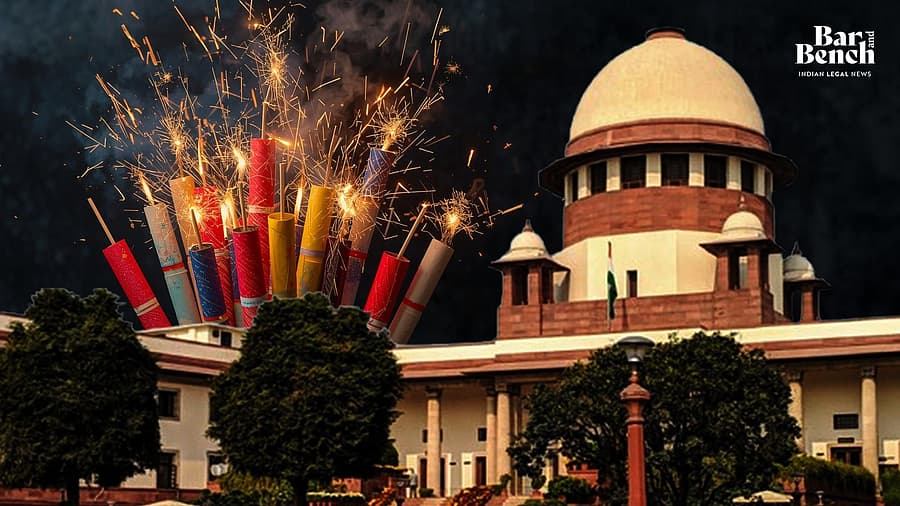
Supreme Court India: Urges Voluntary Firecracker Adoption
Summary
- The Supreme Court of India indicated it would not issue orders banning firecrackers in Delhi-NCR.
- The Court emphasized voluntary adoption of safer practices by citizens, acknowledging health hazards.
- A bench including CJI Surya Kant and Justice Joymalya Bagchi discussed balancing public health with religious sentiments.
- The Court's stance emerged during suo motu proceedings concerning air pollution from firecrackers, crop burning, and solid waste.
- Justice Bagchi questioned the religious basis for firecracker use, while the amicus curiae highlighted health risks to children.
What Happened
The Chief Justice further elaborated that if the citizenry is concerned and civil society is aware of these environmental and health issues, this would represent the most effective path forward.
The Supreme Court of India recently addressed the complex issue of firecracker use in the Delhi-National Capital Region (Delhi-NCR), indicating a preference for public awareness and voluntary action over strict judicial bans. A bench comprising Chief Justice of India (CJI) Surya Kant, Justice Joymalya Bagchi, and Justice V Mohana, deliberated on the ongoing challenge of air pollution, specifically considering the impact of firecrackers. The Court conveyed its disinclination to issue orders that would outright prohibit the use of firecrackers.
Instead of imposing a ban, the judicial body emphasized the importance of individuals recognizing the health hazards associated with firecrackers. The Court urged citizens to proactively adopt safer alternatives and practices. This approach underscores a deliberate effort to reconcile public health imperatives with deeply held religious sentiments, aiming for a solution that fosters societal awakening and voluntary compliance rather than mandatory restrictions. The discussions took place during suo motu proceedings initiated by the Court to tackle various sources of air pollution in the Delhi-NCR region.
Legal Context and Proceedings
The Supreme Court's deliberations formed part of broader suo motu proceedings it had initiated to address the severe air quality issues plaguing Delhi-NCR. Beyond firecrackers, these proceedings also encompass other significant contributors to pollution, such as crop residue burning and the management of solid waste. During the hearing, the Court sought to navigate the delicate balance between safeguarding public health and respecting religious practices, a tension highlighted by the amicus curiae.
Justice Joymalya Bagchi specifically questioned the religious necessity of bursting firecrackers, asking, "What is religious about bursting of crackers?" This query arose as the amicus curiae presented arguments detailing the substantial health risks posed by air pollution and the practical difficulties encountered in enforcing existing restrictions. The amicus curiae further articulated the need for the Court to weigh health concerns against religious sentiments, poignantly remarking that "Gods would be aghast if they knew that children were suffering and getting sick in their name." CJI Surya Kant, for his part, reiterated the Court's commitment to not infringe upon religious sentiments, while still advocating for a conscious shift in public behavior.
The Court's Approach to Public Health and Tradition
The Supreme Court articulated a clear philosophy centered on voluntary adoption and a balanced approach. CJI Surya Kant underscored that while the Court would refrain from harming religious sentiments, it was incumbent upon individuals to step forward and choose safer practices. He stated that the entire endeavor should involve a balancing approach, believing that such an approach would lead to an awakened society where people willingly participate in solutions.
The Chief Justice further elaborated that if the citizenry is concerned and civil society is aware of these environmental and health issues, this would represent the most effective path forward. This judicial stance suggests a preference for fostering an informed public conscience over imposing top-down mandates, particularly when cultural or religious practices are involved. The Court's emphasis on self-regulation and community awareness reflects a nuanced understanding of how to address widespread societal challenges that intersect with deeply ingrained traditions.
Practical Implications
Lawyers advising on environmental or public health compliance should note the Supreme Court's expressed preference for voluntary adoption and balancing religious sentiments over strict bans on firecrackers, signaling a potential judicial approach to similar issues where public health and cultural practices intersect.
Source
How does this affect you?
Get an AI analysis of this article grounded in your jurisdictions, practice areas, and any policy documents you've uploaded to Wansom.
Finish Reading the Full Story and the Expert Analysis.
Get the latest legal & regulatory intelligence in India
Wansom is AI and can make mistakes.