
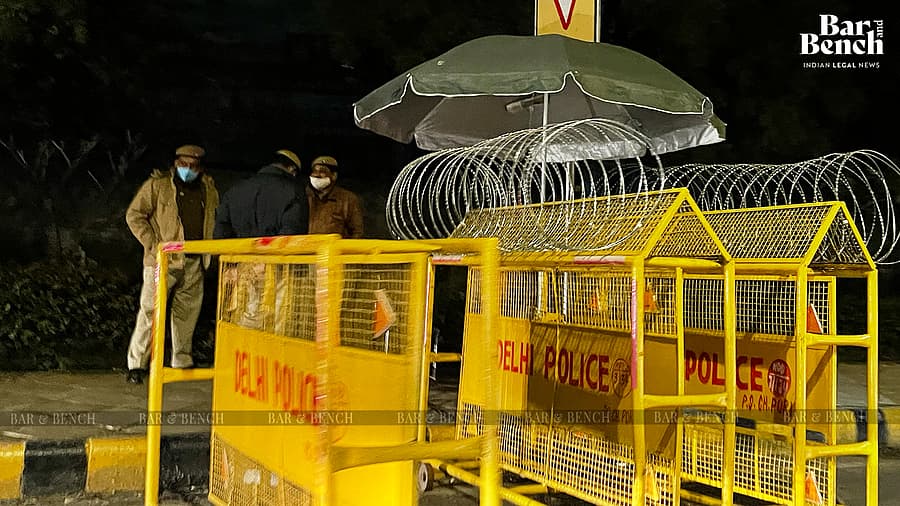
Supreme Court: Farhad Suri UP Police Raids — Local FIR, No Broad Guidelines
Summary
- Former Delhi Mayor Farhad Suri approached the Supreme Court regarding a midnight raid by Uttar Pradesh's Ghaziabad Police at his Delhi residence.
- The raid was reportedly conducted to find journalist Abhishek Upadhyay, who had reported on the Ram Mandir donation theft.
- Suri sought an FIR against the police officers and general guidelines for inter-state police operations.
- The Supreme Court, comprising CJI Surya Kant and Justices Joymalya Bagchi and V Mohana, declined to issue broad guidelines.
- The Court directed Suri to first approach the local police station to register his complaint and seek an FIR against the officers.
Unsanctioned Raid Prompts Supreme Court Appeal
The Court further advised that if the necessary action is not taken by the local police following his complaint, he would then be entitled to explore further legal remedies.
Former Delhi Mayor Farhad Suri recently brought a significant complaint before the Supreme Court of India, detailing an alleged procedural breach by law enforcement. Suri reported that a substantial team of Uttar Pradesh police, specifically from Ghaziabad, conducted an unscheduled raid at his Delhi residence during the late hours of the night. The stated objective of this inter-state operation was to locate journalist Abhishek Upadhyay, who had previously published reports concerning an alleged theft related to Ram Mandir donations. Suri's counsel highlighted that this Ghaziabad Police Delhi raid proceeded without adhering to critical legal protocols, specifically alleging the absence of a warrant and a failure to notify local police authorities in Delhi prior to the operation. This perceived disregard for established procedure formed the basis of Suri's appeal to the nation's highest court.
Supreme Court Directs Local Recourse, Declines Broad Guidelines
In his petition, Farhad Suri sought two distinct forms of intervention from the Supreme Court. Firstly, he requested a specific directive compelling the police to register a First Information Report (FIR) against the officers involved in the raid. Secondly, he pressed for the formulation of comprehensive guidelines to govern inter-state police raid procedure India, particularly concerning searches of residential premises. However, a bench comprising Chief Justice of India Surya Kant and Justices Joymalya Bagchi and V Mohana declined to issue such broad, "omnibus" directions. Instead, the Court explicitly granted Suri the liberty to approach the concerned police station with his complaint regarding the alleged misconduct. The bench underscored that the registration of an FIR against police officers could be effectively addressed through existing local mechanisms.
Affirming the Path for Grievance Redressal
The Supreme Court's ruling serves as a crucial clarification on the appropriate channels for individuals seeking redress for alleged procedural violations by law enforcement, particularly in cases involving inter-state police operations. The Court affirmed that while Farhad Suri possessed the right to seek an FIR against police officers, the initial step should involve utilizing the specific complaint mechanisms provided by law at the local level. The bench articulated that it was not denying Suri's entitlement to pursue a complaint but rather guiding him towards the established process. The Court further advised that if the necessary action is not taken by the local police following his complaint, he would then be entitled to explore further legal remedies. This decision reinforces the principle that individuals must exhaust local administrative and police complaint processes before seeking broader judicial directives on police procedures, thereby streamlining the judicial review process and upholding the hierarchy of legal recourse.
Practical Implications
This Supreme Court ruling clarifies that individuals facing alleged procedural violations during inter-state police raids must first exhaust local remedies by approaching the concerned police station for an FIR, rather than expecting immediate Supreme Court intervention for general guidelines on police operations. Lawyers should advise clients to follow established complaint mechanisms before seeking broader judicial directives on police procedures.
Source
How does this affect you?
Get an AI analysis of this article grounded in your jurisdictions, practice areas, and any policy documents you've uploaded to Wansom.
Finish Reading the Full Story and the Expert Analysis.
Get the latest legal & regulatory intelligence in India
Wansom is AI and can make mistakes.