
Supreme Court Fake Citations: NCLT Orders Set Aside in Pooja Ramesh Singh Case
Summary
- On July 2, 2026, the Supreme Court set aside NCLT and NCLAT orders in Pooja Ramesh Singh v. Jammu and Kashmir Bank Ltd (2026 INSC 668) due to citation errors.
- The Court found three non-existent citations, one misattributed citation, and two genuine citations with fabricated paragraphs.
- The bank stated its counsel did not cite the judgments; the Tribunal obtained them through its own research.
- The Supreme Court ruled that a decision based on fake or 'hallucinated' material is legally invalid.
- False references can appear authentic, and AI models can generate such text without verification, necessitating rigorous checking of all citation elements.
A Landmark Ruling on Citation Integrity
Therefore, lawyers must meticulously verify all citations in court documents, particularly those potentially generated or influenced by AI tools, to avoid adverse rulings and maintain professional integrity.
On July 2, 2026, the Supreme Court of India delivered a significant judgment in the case of Pooja Ramesh Singh v. Jammu and Kashmir Bank Ltd (2026 INSC 668), which saw the setting aside of orders previously issued by both the National Company Law Tribunal (NCLT) and the National Company Law Appellate Tribunal (NCLAT). This decision stemmed from a critical examination of six legal authorities that the NCLT had relied upon and which the NCLAT had subsequently referenced in its proceedings.
The Supreme Court's scrutiny revealed profound inaccuracies within these citations. Specifically, three of the cited authorities were found to be entirely non-existent, while another existing citation was erroneously linked to the wrong case. Furthermore, two genuinely existing citations contained paragraphs that were not present in their respective original judgments. These findings highlighted severe deficiencies in the verification process at the lower tribunal levels, leading to the Supreme Court's intervention regarding these `Supreme Court fake citations Pooja Ramesh Singh`.
The Legal Ramifications of Fabricated Material
In response to these alarming discoveries, the Jammu and Kashmir Bank Ltd submitted an affidavit, asserting that its legal counsel had not presented the problematic judgments to the Tribunal. Instead, the bank clarified that the Tribunal itself had independently sourced these materials through its own research efforts. This revelation underscored a critical procedural flaw, as the NCLT's own investigative work had introduced unverified and incorrect legal references into the judicial record.
The Supreme Court unequivocally declared that any judicial decision predicated upon fabricated or 'hallucinated' material holds no legal standing whatsoever. This pronouncement establishes a clear and stringent precedent, emphasizing that the foundation of a judgment must be built on verifiable and accurate legal sources. The presence of `NCLT NCLAT citation errors` of this magnitude directly undermined the legitimacy of the lower tribunals' rulings, necessitating their complete annulment.
The Deceptive Nature of False References
The case highlights a significant challenge in legal practice, particularly in an era where information can be generated rapidly, sometimes without proper vetting. A false legal reference can often mimic an authentic one with remarkable precision, featuring a familiar case name, a correct year, a volume number, and even a page number in all the expected positions. The accompanying text can also be crafted to sound entirely plausible, resembling language typically found in judicial pronouncements. This deceptive appearance makes `false legal citations India` a subtle yet dangerous pitfall for legal professionals.
Modern artificial intelligence models, for instance, possess the capability to produce extensive text that includes such seemingly accurate references without performing any actual verification of their existence or content. Consequently, the mere visual presence of a citation within a document offers no guarantee regarding the authenticity or accuracy of the underlying judgment. This underscores the critical need for robust `citation verification court documents` protocols, especially when dealing with materials that may have been influenced by automated generation.
Upholding Accuracy in Legal Documentation
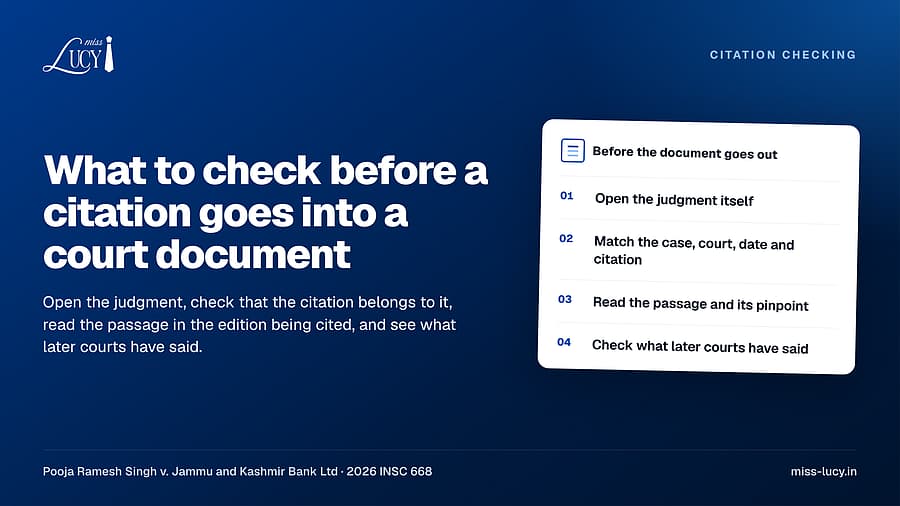
When a legal citation is incorporated into a court document, it serves a fundamental purpose: to precisely inform the court about the specific case that was decided, the judicial body responsible for the decision, the date on which the decision was rendered, and the exact location within the judgment where the relied-upon passage can be found. Each of these distinct components demands meticulous verification to ensure the integrity of the legal argument.
Even seemingly minor discrepancies can render a citation invalid and misleading. For instance, citing a correct case name alongside an incorrect reporter citation is still fundamentally erroneous. Similarly, providing an accurate citation but then attributing an invented paragraph to that judgment leaves the court with text it cannot locate or verify. Therefore, lawyers must meticulously verify all citations in court documents, particularly those potentially generated or influenced by AI tools, to avoid adverse rulings and maintain professional integrity.
Practical Implications
Lawyers must meticulously verify all citations in court documents, particularly those potentially generated or influenced by AI tools, to avoid adverse rulings and maintain professional integrity. The Supreme Court's decision in Pooja Ramesh Singh establishes a clear precedent that judgments based on unverified or 'hallucinated' material are invalid, underscoring the critical need for robust citation checking protocols.
Source
How does this affect you?
Get an AI analysis of this article grounded in your jurisdictions, practice areas, and any policy documents you've uploaded to Wansom.
Finish Reading the Full Story and the Expert Analysis.
Get the latest legal & regulatory intelligence in India
Wansom is AI and can make mistakes.