
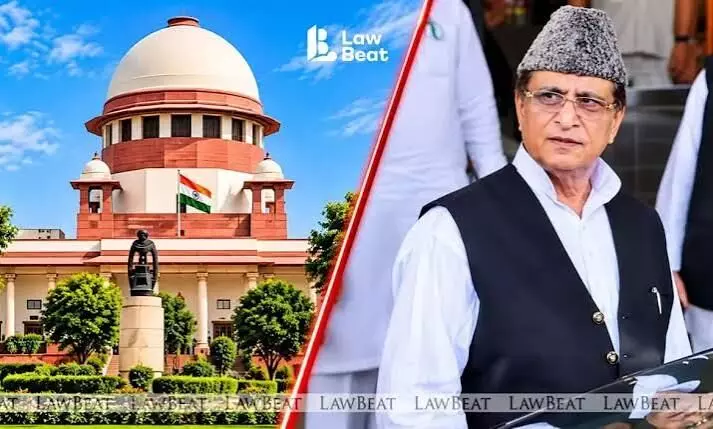
Supreme Court: Declines To Interfere With Azam Khan Interim Bail ED Challenge
Summary
- The Supreme Court declined to interfere with the interim bail granted to Mohd Azam Khan in a money laundering case.
- The Enforcement Directorate had challenged the bail, alleging the High Court incorrectly recorded facts regarding Khan's arrest.
- The Supreme Court ruled that the High Court's prima facie observations in an interim order would not be binding on the final bail decision.
- The Court noted the ED's objection that the factual record was inaccurate but still refused to disturb the interim relief.
- Khan's interim bail, initially granted by the Allahabad High Court for alleged procedural lapses by the ED, remains in effect.
Supreme Court Upholds Interim Bail
The Supreme Court emphasized that its non-interference stemmed from the interim nature of the order, clarifying that the High Court's preliminary views would not prejudice the final bail determination.
The Supreme Court of India recently declined to interfere with the interim bail granted to Samajwadi Party leader Mohd Azam Khan in a money laundering case. This decision came despite a challenge from the Enforcement Directorate (ED), which contended that the Allahabad High Court had inaccurately documented the facts surrounding Khan's arrest. The bench, comprising Justices MM Sundresh and PB Varale, emphasized that the High Court's preliminary observations, being prima facie in nature, would not influence the ultimate decision on regular bail.
The ED, represented by Additional Solicitor General (ASG) SV Raju, presented its objections to the Supreme Court. Raju asserted that the grounds for Khan's arrest had been duly provided to him, but he had refused to accept them. The ASG further stated that the agency possessed evidence, including video recordings and a panchnama, to substantiate its claims regarding the arrest procedure. Despite these submissions, the Supreme Court remained disinclined to revoke the interim relief, noting that such an order did not warrant its intervention at this stage.
High Court's Rationale for Bail
The interim bail for Mohd Azam Khan was initially granted by the Allahabad High Court. The High Court's decision was predicated on its prima facie finding that the Enforcement Directorate had failed to adhere to the mandatory procedural requirements outlined in Article 22(1) of the Constitution and Section 19 of the Prevention of Money Laundering Act (PMLA) during Khan's arrest. This procedural lapse was a key factor in the High Court's determination to grant temporary relief to the political leader.
Specifically, the Allahabad High Court bench, consisting of Justice Rajiv Gupta and Justice Devendra Singh, observed that the remand application filed by the Enforcement Directorate on November 1, 2026, lacked any averment regarding the video-graphing of Khan's arrest on October 31, 2026. This absence of documentation regarding a crucial procedural step contributed to the High Court's conclusion about the ED's alleged non-compliance with legal mandates.
Supreme Court's Stance on Interim Orders
The Supreme Court's decision to not intervene was rooted in its view that the order in question was merely interim. The bench explicitly stated that the High Court's preliminary observations, made at the interim stage, would not have a bearing on the final adjudication of the bail application. This clarification was intended to address concerns that the High Court's initial findings might prejudice the subsequent proceedings for regular bail.
While refusing to disturb the interim bail, the Supreme Court did acknowledge and record the ED's objection regarding the factual inaccuracies noted by the High Court. ASG Raju had pressed for this grievance to be formally noted, stating, 'Facts are wrongly recorded. It may be noted.' The Supreme Court acceded, recording in its order, 'We also take note of Ld ASG that recording is incorrect.' This ensures that the ED's concerns about the factual record are officially recognized, even if they did not lead to an immediate reversal of the interim bail.
Future Proceedings and Legal Precedent
A practical concern raised by ASG Raju was that the regular bail application would be heard by the same High Court bench that had issued the interim order. However, the Supreme Court dismissed this apprehension, remarking, 'We can't attribute motive to the court,' and reiterated its disinclination to intervene. This stance underscores the Supreme Court's reluctance to second-guess the motives of lower courts, particularly concerning interim judicial decisions.
Consequently, Mohd Azam Khan's interim bail remains in effect. The Supreme Court's ruling establishes a clear precedent that prima facie observations made by a High Court in an interim bail order are not binding on the final bail decision, even when factual discrepancies are alleged. This distinction is crucial for understanding the limited scope of interim relief and the judicial hierarchy's approach to challenges against such orders.
Practical Implications
This ruling clarifies that a High Court's prima facie observations in an interim bail order do not bind the final bail decision, even if factual inaccuracies are alleged. Lawyers should note the Supreme Court's reluctance to interfere with interim orders and ensure that factual records are meticulously accurate, as any noted objections may influence subsequent proceedings but not necessarily warrant immediate intervention.
Source
How does this affect you?
Get an AI analysis of this article grounded in your jurisdictions, practice areas, and any policy documents you've uploaded to Wansom.
Finish Reading the Full Story and the Expert Analysis.
Get the latest legal & regulatory intelligence in India
Wansom is AI and can make mistakes.