
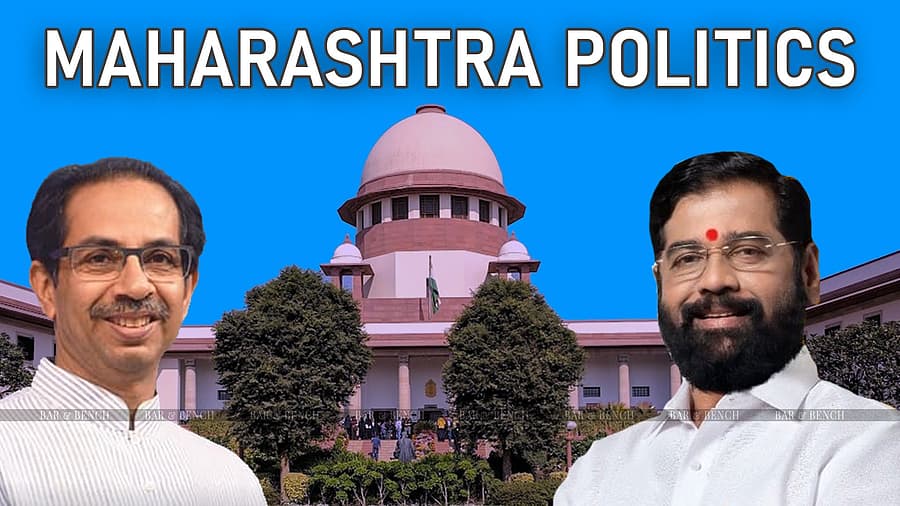
Supreme Court: Clear Criteria Needed to Determine Political Party Majority
Summary
- The Supreme Court has observed that there is a need for clear criteria to determine what constitutes a majority within a political party.
- The court's observations suggest a shift towards relying on legislative strength over organisational wing numbers in determining party majorities.
- The ECI recognized the Eknath Shinde-led faction as the real 'Shiv Sena' based on its legislative strength, sparking a dispute between the two factions.
- The Supreme Court has emphasized the need for clear criteria to prevent recurring disputes over party splits and defections.
- Lawyers advising clients on internal party disputes should note that the court's observations may impact their strategies for asserting majority claims.
What Happened
The court's bench, comprising Chief Justice Surya Kant and Justices Joymalya Bagchi and V Mohana, made these observations during a hearing of the plea filed by the Uddhav Thackeray-led faction.
The Supreme Court has intervened in a long-standing dispute within the Shiv Sena political party. The court's observations suggest that there is a need for clear criteria to determine what constitutes a majority within a political party. This comes after the Election Commission of India (ECI) recognized the Eknath Shinde-led faction as the real 'Shiv Sena' in February 2023, sparking a dispute between the two factions led by Uddhav Thackeray and Eknath Shinde.
The court's bench, comprising Chief Justice Surya Kant and Justices Joymalya Bagchi and V Mohana, made these observations during a hearing of the plea filed by the Uddhav Thackeray-led faction. The ECI had relied on the strength of the legislative wing of the party to arrive at its decision, rather than the test of its organisational wing.
Legal Context
The Shiv Sena dispute is not an isolated incident in Indian politics. Party splits and defections are common occurrences that often lead to disputes over recognition by the ECI. The court's observations suggest a shift towards relying on legislative strength over organisational wing numbers, which may impact lawyers' strategies for asserting majority claims.
The Supreme Court has emphasized the need for clear criteria to prevent recurring disputes. This is particularly relevant in cases where the legislature party splits (MLAs/ MPs within State assembly or parliament splitting or joining another party). The court's observations are a significant development in the legal context of Indian politics, highlighting the importance of legislative strength in determining party majorities.
Why It Matters
The Supreme Court's observations have far-reaching implications for lawyers advising clients on internal party disputes. The shift towards relying on legislative strength over organisational wing numbers may require a re-evaluation of strategies for asserting majority claims. This development is particularly relevant in the context of the Shiv Sena dispute, where the ECI recognized the Eknath Shinde-led faction as the real 'Shiv Sena' based on its legislative strength.
The court's emphasis on clear criteria for determining party majorities highlights the need for a more nuanced understanding of Indian political party law. This is essential for lawyers and politicians alike, as it will impact their approach to internal party disputes and recognition by the ECI.
Practical Implications
Lawyers advising clients on internal party disputes should note that the Supreme Court's observations suggest a shift towards relying on legislative strength over organisational wing numbers, which may impact their strategy for asserting majority claims.
Source
How does this affect your business?
Get an AI analysis of this article grounded in your jurisdictions, practice areas, and any policy documents you've uploaded to Wansom.
Wansom is AI and can make mistakes.