
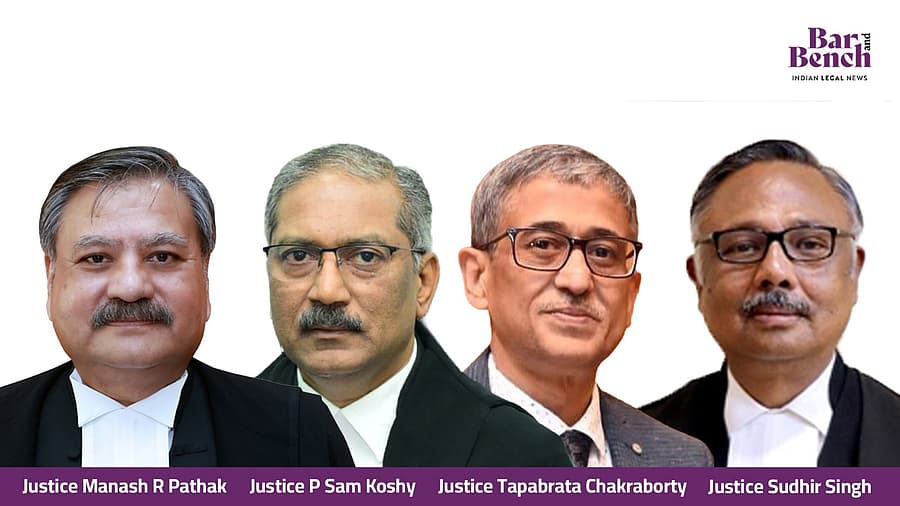
Supreme Court Collegium: Recommends 4 High Court Chief Justices
Summary
- The Supreme Court Collegium has recommended four High Court judges for elevation as Chief Justices.
- Justice Manash Ranjan Pathak is proposed to become Chief Justice of the Gujarat High Court.
- Justice P Sam Koshy has been recommended as the new Chief Justice for the Delhi High Court.
- Justice Tapabrata Chakraborty is slated to become Chief Justice of the Telangana High Court.
- Justice Sudhir Singh is recommended for the Chief Justice position at the Uttarakhand High Court.
Collegium's Latest Recommendations
The leadership of a Chief Justice profoundly shapes the administrative efficiency, case management strategies, and ultimately, the jurisprudential direction of a High Court.
The Supreme Court Collegium recently put forward its recommendations for the elevation of four distinguished High Court judges to the pivotal roles of Chief Justices across various High Courts. This significant development in India judicial appointments was formalized in a resolution issued on October 26. The Collegium's decision outlines a series of key leadership changes that will impact several state judiciaries.
Among the proposed appointments, Justice Manash Ranjan Pathak, currently serving as the Acting Chief Justice of the Gujarat High Court, has been recommended to assume the position of Chief Justice of the Gujarat High Court. Concurrently, Justice P Sam Koshy, who presently serves as the Acting Chief Justice of the Telangana High Court, is slated for elevation as the Chief Justice of the Delhi High Court. These recommendations signify a strategic reshuffling of judicial leadership to ensure robust functioning of the higher judiciary.
Further recommendations include Justice Tapabrata Chakraborty, a judge of the Calcutta High Court, who has been put forth for appointment as the Chief Justice of the Telangana High Court. Completing this quartet of recommendations, Justice Sudhir Singh, currently serving as the Acting Chief Justice of the Patna High Court, has been proposed for the role of Chief Justice of the Uttarakhand High Court. These nominations underscore the Collegium's ongoing role in shaping the leadership landscape of the nation's High Courts.
The Mechanism of Judicial Leadership Selection
The process for appointing Chief Justices to India's High Courts is a critical function overseen by the Supreme Court Collegium. This body, comprising the Chief Justice of India and the four senior-most judges of the Supreme Court, holds the constitutional mandate to recommend appointments and transfers of judges in the higher judiciary. Its resolutions, such as the one issued on October 26, represent the initial and most crucial step in filling these high-ranking judicial positions.
These recommendations are not merely administrative formalities; they are the result of extensive deliberations aimed at identifying suitable candidates based on their seniority, merit, and experience. Once the Collegium makes its recommendations, they are forwarded to the Union government for approval, following which the President of India issues the final warrants of appointment. This structured approach ensures a degree of independence and expertise in the selection of judicial leaders.
The Collegium's role in these India judicial appointments is fundamental to maintaining the integrity and efficiency of the High Courts. By proposing individuals for the Chief Justice roles, the Collegium directly influences the direction and character of justice delivery in the respective states. The recent recommendations for the Gujarat, Delhi, Telangana, and Uttarakhand High Courts exemplify this vital constitutional responsibility.
Impact on High Court Administration and Jurisprudence
The appointment of new Chief Justices carries substantial implications for the High Courts they are set to lead. The leadership of a Chief Justice profoundly shapes the administrative efficiency, case management strategies, and ultimately, the jurisprudential direction of a High Court. Lawyers practicing in the Gujarat High Court, Delhi High Court, Telangana High Court, and Uttarakhand High Court, in particular, should be keenly aware of these impending changes.
A new Chief Justice often brings a fresh perspective to court administration, which can lead to significant alterations in how cases are listed, allocated to benches, and prioritized. This can directly affect the pace of litigation and the experience of legal practitioners and litigants alike. Furthermore, the Chief Justice plays a crucial role in setting the tone for the court's judicial approach, influencing the interpretation of laws and the development of legal principles within their jurisdiction.
These appointments are therefore not just personnel changes but pivotal moments that can redefine the operational dynamics and legal philosophy of these important judicial institutions. The incoming Chief Justices for the Gujarat, Delhi, Telangana, and Uttarakhand High Courts will be instrumental in guiding their respective courts through current challenges and future developments, making these recommendations a matter of considerable importance for the legal community.
Practical Implications
Lawyers practicing in the Gujarat, Delhi, Telangana, and Uttarakhand High Courts should be aware of these impending changes in judicial leadership, as new Chief Justices can influence court administration, case listing, and potentially the judicial approach within their respective High Courts.
Source
How does this affect you?
Get an AI analysis of this article grounded in your jurisdictions, practice areas, and any policy documents you've uploaded to Wansom.
Finish Reading the Full Story and the Expert Analysis.
Wansom is AI and can make mistakes.