
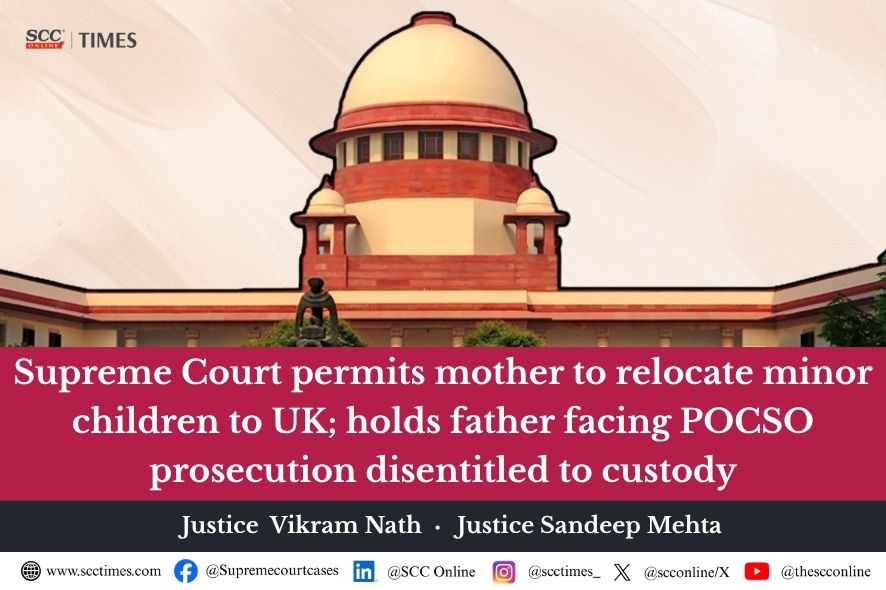
Supreme Court: Child Relocation to UK Allowed, Father Disentitled Due to POCSO
Summary
- The Supreme Court of India permitted a mother to relocate her minor children to the United Kingdom.
- The Court ruled that frequent changes in employment do not constitute a 'nomadic life' for the purpose of custody decisions.
- The father was deemed disentitled to custody due to a pending prosecution against him under the POCSO Act.
- This decision underscores the paramountcy of the child's best interest in international relocation and custody cases.
- A pending POCSO prosecution against a parent can lead to their disentitlement from child custody.
Supreme Court Upholds Mother's Right to Relocate Children to UK
The father was deemed disentitled to custody of the children due to a pending prosecution against him under the Protection of Children from Sexual Offences (POCSO) Act.
India's Supreme Court has issued a significant ruling, permitting a mother to relocate her minor children to the United Kingdom. This decision came after careful consideration of various factors, including the father's conduct and the children's welfare. The Court explicitly stated that a parent's frequent changes of employment should not be characterized as a 'nomadic life,' thereby dismissing one potential argument against the mother's stability or suitability for relocation.
The pivotal aspect of the judgment centered on the father's legal standing. The Supreme Court determined that the father was disentitled to custody of the children. This disentitlement was directly linked to a pending prosecution against him under the Protection of Children from Sexual Offences (POCSO) Act. While this ruling highlighted the severe implications of such allegations in child custody matters, recent Supreme Court rulings (September 2026) have introduced safeguards against the misuse of the POCSO Act in matrimonial and child custody disputes, clarifying that the mere registration of a case should not automatically lead to an inference of guilt or disentitlement to custody.
Legal Context: Child Custody, Relocation, and POCSO Act Implications
Cases involving India child custody relocation often hinge on the paramount principle of the 'best interest of the child.' Indian courts, including the Supreme Court, consistently prioritize the child's welfare over the individual rights or preferences of either parent. International parental relocation India disputes are particularly complex, requiring courts to balance a parent's right to move with the child's need for stability and continued relationship with both parents.
The presence of a POCSO prosecution against a parent introduces a critical dimension to custody proceedings. The POCSO Act is designed to protect children from sexual offenses, and any allegation or pending case under this statute is viewed with extreme gravity. This ruling underscores how a POCSO prosecution against a father can severely undermine his claims to custody, effectively leading to a POCSO Act custody disentitlement, as seen in this instance.
Why This Ruling Matters for Family Law
This Supreme Court child relocation UK POCSO ruling sets a crucial precedent for family law practitioners and parents navigating complex custody and relocation disputes in India. It unequivocally signals that serious criminal allegations, particularly those under the POCSO Act, will have a profound impact on a parent's ability to secure or retain custody. The Court's decision to disentitle the father from custody due to a pending POCSO prosecution against him reinforces the judiciary's commitment to safeguarding children.
Lawyers advising clients on international parental relocation India cases must now consider the nuances introduced by recent Supreme Court rulings (September 2026) regarding POCSO allegations in custody disputes. While a parent's criminal record or pending charges, especially under POCSO, remain serious, the Supreme Court has clarified that the mere registration of a POCSO case, particularly in matrimonial disputes, should not automatically lead to an inference of guilt or disentitlement to custody. This emphasizes a balanced approach where the best interest of the child is paramount, but safeguards against misuse are also in place.
Practical Implications
This ruling establishes a significant precedent for family law practitioners handling international child relocation cases in India, particularly where one parent faces serious criminal charges like those under POCSO. Lawyers should advise clients that a parent's involvement in such prosecutions can severely undermine their custody claims and influence relocation decisions, emphasizing the paramountcy of the child's best interests.
Source
Source: Original reporting via SCC Times
How does this affect you?
Get an AI analysis of this article grounded in your jurisdictions, practice areas, and any policy documents you've uploaded to Wansom.
Finish Reading the Full Story and the Expert Analysis.
Get the latest legal & regulatory intelligence in India
Wansom is AI and can make mistakes.