
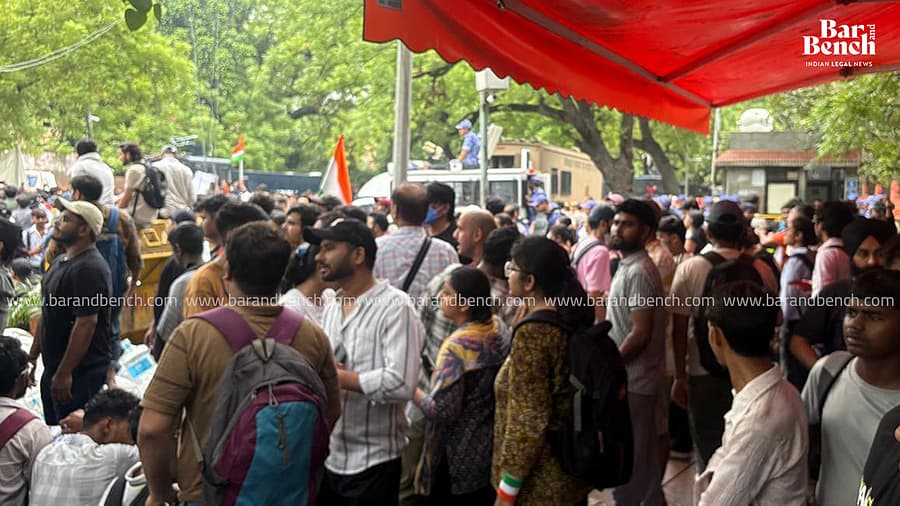
Supreme Court: Application to Reconstitute CJP Protest Panel Filed, Opposed
Summary
- An application has been filed in the Supreme Court seeking to reconstitute a high-powered committee investigating alleged police excesses during CJP-led protests.
- The original five-member committee, formed on August 18, is headed by retired Justice R Subhash Reddy and probes both police conduct and protestor actions.
- Senior Advocate Gopal Sankaranayanan presented the application, requesting a hearing next week.
- Solicitor General Tushar Mehta strongly opposed the application, questioning its motives and calling it "mischievous."
Judicial Review Sought for Protest Inquiry Panel
The outcome of this application could set a precedent for how future court-appointed investigative bodies are formed and challenged.
The Supreme Court is currently reviewing an application that seeks to alter the composition of a high-level inquiry committee, originally established by the court itself. This committee was tasked with investigating alleged police excesses during recent demonstrations led by the Cockroach Janata Party (CJP) at Jantar Mantar in Delhi. The application, which specifically requests the reconstitution of this panel, was brought before a Supreme Court Bench this morning.
The Bench presiding over the mention included Chief Justice of India Surya Kant, alongside Justices Joymalya Bagchi and V Mohana. Senior Advocate Gopal Sankaranayanan, representing the applicant, formally requested that the application be scheduled for a detailed hearing sometime next week. This move indicates a direct challenge to the existing structure of the court-appointed investigative body.
However, the application faced immediate and strong opposition from Solicitor General Tushar Mehta. He vocally questioned the motives behind the filing, suggesting it might be politically driven. Mehta characterized the application as "very mischievous" and argued that it should be heard concurrently with the main case to which the original committee pertains.
The Mandate and Members of the Original Committee
The inquiry committee at the heart of this legal challenge was initially constituted by the Supreme Court on August 18. This five-member panel, designed to be high-powered, was given a broad mandate: to thoroughly investigate claims of police misconduct against CJP protestors. Crucially, its scope also extended to examining counter-allegations, including injuries sustained by police personnel and property damage attributed to the protestors during the same events.
Retired Supreme Court Justice R Subhash Reddy was appointed to lead this significant investigative body. He is joined by a distinguished group of former legal and law enforcement officials. The other members include former Chief Justice of the Punjab and Haryana High Court, Ravi Shankar Jha; former Delhi High Court Justice Shalinder Kaur; former Director of the Central Bureau of Investigation (CBI), Rishi Kumar Shukla; and former Director General of Police (DGP) of Meghalaya, LR Bishnoi. The current application specifically targets the modification of this established composition, seeking a Justice R Subhash Reddy committee modification.
Why This Application Matters
The present Supreme Court application to reconstitute the CJP protest panel carries significant implications for the oversight of public demonstrations and the independence of judicial inquiries. The attempt to modify a committee already established by the apex court, especially one probing sensitive issues like police excesses and protest-related violence, highlights potential concerns regarding its impartiality or effectiveness. The Solicitor General Tushar Mehta opposition, labeling the application as "mischievous" and potentially "politically motivated," underscores the contentious nature of this legal maneuver.
The outcome of this application could set a precedent for how future court-appointed investigative bodies are formed and challenged. For legal professionals involved in public interest litigation, human rights, or criminal defense related to protests, the resolution of this matter will be particularly instructive. It will offer insights into the judiciary's stance on the composition and perceived independence of panels tasked with examining state actions and public grievances, especially concerning the Jantar Mantar protest violence inquiry.
Practical Implications
Lawyers involved in public interest litigation, human rights, or criminal defense related to protests should monitor this case closely. The outcome regarding the reconstitution of the inquiry panel could set a precedent for challenging the independence and composition of court-appointed investigative bodies, impacting future probes into police conduct or protest-related violence.
Source
How does this affect you?
Get an AI analysis of this article grounded in your jurisdictions, practice areas, and any policy documents you've uploaded to Wansom.
Wansom is AI and can make mistakes.