
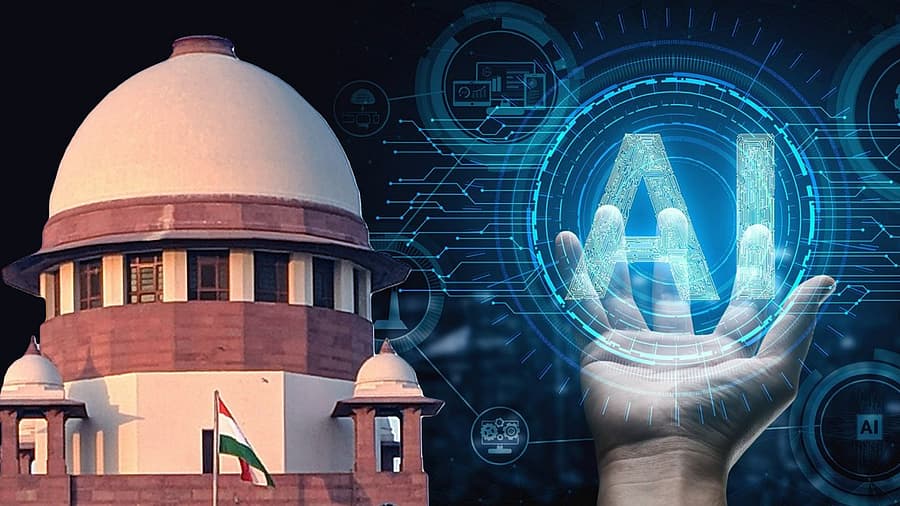
Supreme Court: AI Hallucinations Overturn Customs Penalty
Summary
- The Supreme Court of India set aside a ₹425.28 crore customs penalty imposed on a diamond trader.
- The penalty was invalidated because the adjudicating officer relied on non-existent cases, fake citations, and AI-generated legal propositions.
- Justices Dipankar Datta and Sheel Nagu ruled that such dubious material rendered the penalty order unsustainable.
- The original penalty was issued under Section 114 of the Customs Act, 1962, for alleged misdeclaration of diamonds.
- This decision highlights the critical need for verifying AI-generated legal research in administrative and judicial processes.
Landmark Ruling on AI-Generated Citations
The judgment effectively creates a new ground for challenging administrative orders, such as those issued under the Customs Act 1962 Section 114, where the adjudicating authority's findings are predicated on unverified or fake citations, particularly if these originate from AI-generated legal research.
The Indian Supreme Court recently delivered a significant verdict, overturning a substantial customs penalty of ₹425.28 crore imposed on a diamond trader. The apex court's decision stemmed from its finding that the adjudicating authority had relied on legal citations and propositions that were either non-existent or had been erroneously generated, or "hallucinated," by artificial intelligence. This ruling, in the case of Vijay Ghanshyam Gadiya v. Union of India and Another, underscores the critical need for verification of information, particularly when AI tools are employed in legal and administrative processes.
The penalty was originally levied against Vijay Ghanshyam Gadiya by the Additional Commissioner of Customs, Surat, on October 8, 2025. It was imposed under Section 114 of the Customs Act, 1962, following allegations that Gadiya had misdeclared a consignment of natural diamonds as lab-grown diamonds to benefit from a lower tariff rate. Gadiya subsequently challenged this order before the Gujarat High Court, but his appeal was dismissed on January 20, 2026, prompting him to escalate the matter to the Supreme Court.
The Court's Rationale and Legal Precedent
A bench comprising Justices Dipankar Datta and Sheel Nagu meticulously examined the basis of the penalty order. Their Lordships concluded that the adjudicating officer's reliance on dubious material, including fake citations and AI-generated legal research, rendered the entire penalty unsustainable. The Court explicitly stated that the use of AI in this context, leading to the incorporation of unreliable information, proved "fatal" to the validity of the order imposing the financial penalty.
Consequently, the Supreme Court not only set aside the original penalty order issued by the Additional Commissioner of Customs, Surat, but also invalidated the Gujarat High Court's judgment that had affirmed it. The case has now been remanded, indicating that the matter will be sent back to a lower authority for reconsideration, presumably without the flawed legal basis. This decision establishes a crucial precedent regarding the evidentiary standards required in administrative adjudications, particularly when modern technological tools are utilized.
Broader Implications for Administrative Orders and AI Use
This landmark Supreme Court AI hallucinations customs penalty ruling carries profound implications for the use of artificial intelligence in legal and administrative decision-making across India. It serves as a stark reminder that while AI tools can enhance efficiency, their output, especially in critical areas like legal research and citation, must be rigorously verified. The case highlights the potential for "AI hallucinations" – instances where AI models generate plausible but factually incorrect or non-existent information – to undermine the integrity of official orders.
The judgment effectively creates a new ground for challenging administrative orders, such as those issued under the Customs Act 1962 Section 114, where the adjudicating authority's findings are predicated on unverified or fake citations, particularly if these originate from AI-generated legal research. This ruling will likely compel government agencies and legal professionals to implement robust verification protocols for any AI-generated content used in official proceedings, ensuring the reliability of AI in administrative orders India. It underscores the judiciary's commitment to upholding due process and evidentiary integrity, even as technology evolves.
Practical Implications
This ruling establishes a precedent for challenging administrative orders (like customs penalties) where the adjudicating authority relies on unverified, AI-generated legal citations or 'hallucinations.' Lawyers should scrutinize the evidentiary basis of such orders and consider this ground for appeal, while compliance officers must ensure robust verification processes for any AI tools used in legal or regulatory decision-making to avoid similar vulnerabilities.
Source
How does this affect you?
Get an AI analysis of this article grounded in your jurisdictions, practice areas, and any policy documents you've uploaded to Wansom.
Finish Reading the Full Story and the Expert Analysis.
Wansom is AI and can make mistakes.