
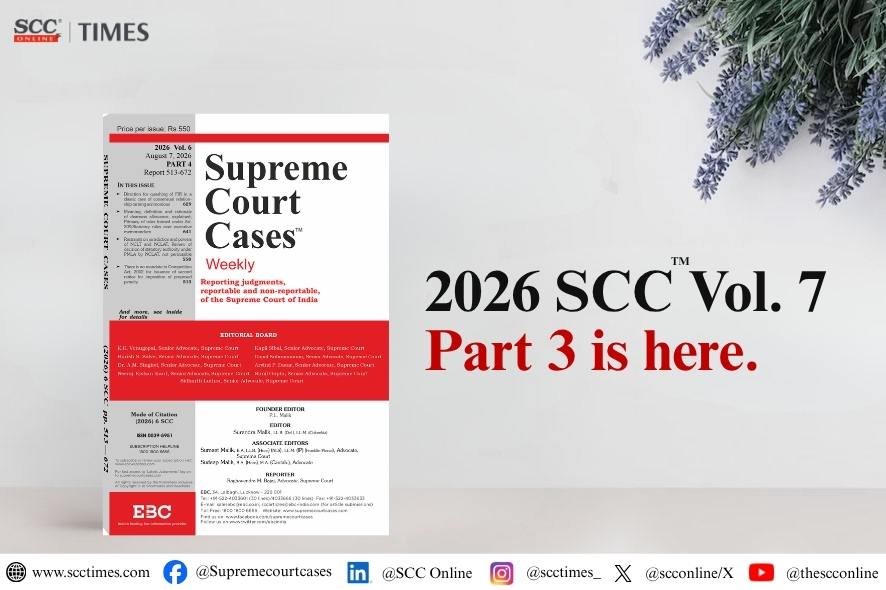
Supreme Court: 2026 SCC Vol. 7 Part 3 Rulings Clarify Key Laws
Summary
- The Supreme Court of India has released a new compilation of key judgments in 2026 SCC Vol. 7 Part 3.
- The volume includes significant rulings on constitutional law, specifically Article 21.
- Important decisions related to criminal law, focusing on bail, are also featured.
- Judgments concerning the Prevention of Money Laundering Act (PMLA) provide clarity on financial crime.
- The compilation also contains rulings impacting the functioning and procedures of arbitral tribunals.
What Happened
Lawyers and compliance officers should review these newly published Supreme Court rulings to update their understanding of key legal areas like constitutional rights, money laundering, criminal law, and arbitration, ensuring their advice and compliance frameworks reflect the latest judicial precedents.
The Supreme Court of India has recently released a new compilation of its significant judgments, published as 2026 SCC Vol. 7 Part 3. This latest volume features key rulings that address critical aspects of Indian jurisprudence, providing updated guidance across several fundamental legal domains. The collection highlights the Court's ongoing engagement with complex legal questions, shaping the interpretation and application of law throughout the country.
Among the prominent subjects covered in this volume are crucial decisions pertaining to constitutional law, particularly those impacting Article 21, which safeguards the right to life and personal liberty. Additionally, the compilation includes important pronouncements related to criminal law, with a specific focus on the principles governing bail. The Supreme Court has also weighed in on matters concerning the Prevention of Money Laundering Act (PMLA), offering clarity on the legal framework surrounding financial crimes. Furthermore, the volume contains significant judgments that influence the practice and procedure of arbitral tribunals, a vital component of alternative dispute resolution in India.
Legal Context and Key Areas
The inclusion of judgments concerning Article 21 underscores the Supreme Court's continuous role as the guardian of fundamental rights. These Indian Supreme Court Article 21 judgments are pivotal, as Article 21 is broadly interpreted to encompass a wide array of rights essential for human dignity and a meaningful existence, making any judicial pronouncement on it profoundly impactful on citizens' lives. The Constitution law India 2026 SCC rulings in this volume are expected to refine the contours of these protections, influencing future legal arguments and policy decisions.
In the realm of criminal justice, the Supreme Court's pronouncements on bail law are particularly noteworthy. Bail law Supreme Court India decisions often set precedents for lower courts, determining the conditions under which individuals accused of crimes can be released pending trial. These rulings, part of the broader Criminal law India Supreme Court 2026 landscape, are crucial for balancing individual liberty with the state's interest in maintaining law and order and ensuring justice. Similarly, the Supreme Court PMLA cases 2026 contained within this volume are vital for understanding the evolving legal framework designed to combat money laundering. These judgments provide essential interpretations of the Prevention of Money Laundering Act, affecting investigations, prosecutions, and the rights of those implicated in financial offenses.
Moreover, the volume addresses the intricate area of arbitration, with rulings concerning arbitral tribunals. Arbitral tribunal law India 2026 decisions from the apex court are instrumental in shaping the efficacy and enforceability of arbitration agreements and awards, which are increasingly preferred mechanisms for commercial dispute resolution. The Supreme Court's guidance in this field helps ensure consistency and predictability in the arbitration process, reinforcing India's position as an attractive hub for business and investment by providing a robust legal framework for dispute settlement.
Why It Matters
The release of 2026 SCC Vol. 7 Part 3 holds significant implications for legal practitioners, compliance officers, and anyone operating within the Indian legal system. These newly published Supreme Court rulings necessitate a thorough review by legal professionals to update their understanding of these key legal areas. Staying abreast of the latest judicial precedents is not merely a matter of academic interest but a professional imperative, ensuring that legal advice and compliance frameworks accurately reflect the current state of the law.
Lawyers and compliance officers should review these newly published Supreme Court rulings to update their understanding of key legal areas like constitutional rights, money laundering, criminal law, and arbitration, ensuring their advice and compliance frameworks reflect the latest judicial precedents. The dynamic nature of Indian law, particularly as interpreted by the Supreme Court, demands continuous engagement with new judgments to anticipate legal shifts and advise clients effectively. These rulings will undoubtedly serve as critical reference points for future litigation, legal scholarship, and policy development across the nation.
Practical Implications
Lawyers and compliance officers should review these newly published Supreme Court rulings to update their understanding of key legal areas like constitutional rights, money laundering, criminal law, and arbitration, ensuring their advice and compliance frameworks reflect the latest judicial precedents.
Source
How does this affect you?
Get an AI analysis of this article grounded in your jurisdictions, practice areas, and any policy documents you've uploaded to Wansom.
Finish Reading the Full Story and the Expert Analysis.
Get the latest legal & regulatory intelligence in India
Wansom is AI and can make mistakes.