
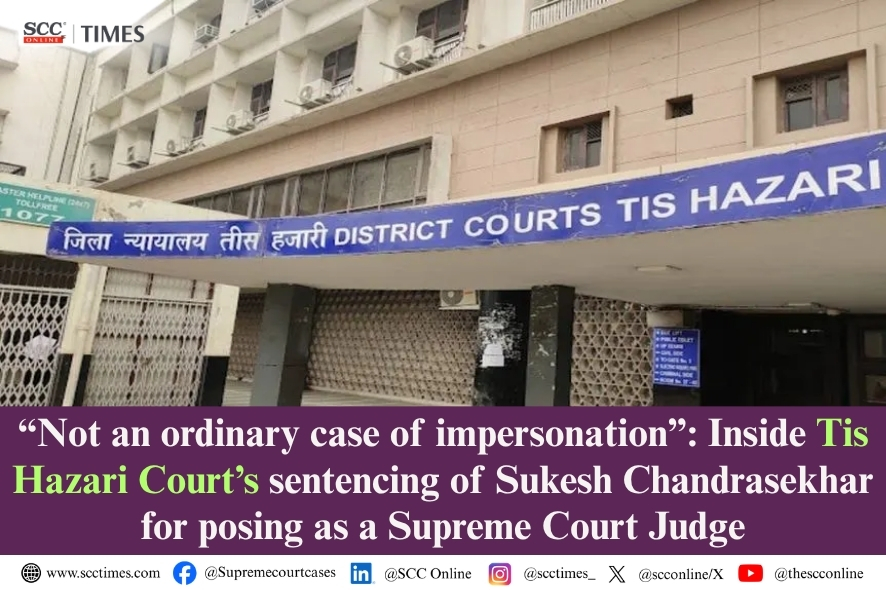
Tis Hazari Court: Sukesh Chandrasekhar Impersonation Conviction, 8-Year Sentence
Summary
- Sukesh Chandrasekhar was convicted by the Tis Hazari Court for impersonating a Supreme Court Judge.
- The impersonation was specifically carried out to influence bail proceedings.
- He was sentenced to 8 years’ consecutive rigorous imprisonment.
- The conviction was based on Sections 204, 224, and 351 of the Bharatiya Nyaya Sanhita (BNS).
- This case highlights the severe legal consequences for attempting to subvert judicial processes through deceit.
Tis Hazari Court Convicts Sukesh Chandrasekhar for Judicial Impersonation
The conviction of Sukesh Chandrasekhar for impersonating a Supreme Court Judge to influence bail proceedings sends an unequivocal message regarding the severe repercussions for such attempts to corrupt the administration of justice.
The Tis Hazari Court recently delivered a significant verdict, convicting Sukesh Chandrasekhar for a serious offense involving judicial impersonation. Chandrasekhar was found guilty of posing as a Supreme Court Judge, an act specifically undertaken with the intent to influence bail proceedings. This conviction underscores the judiciary's firm stance against attempts to subvert the legal process through deceit.
The court subsequently handed down a substantial sentence, ordering Chandrasekhar to serve eight years of rigorous imprisonment. This term was notably imposed consecutively, reflecting the gravity of the multiple offenses committed. The judgment by the Tis Hazari Court meticulously applied relevant provisions of the Indian Penal Code to address the complex nature of the crime, highlighting the severe consequences for such actions.
Legal Framework: IPC Sections 170, 189, and 507 Applied
The conviction of Sukesh Chandrasekhar by the Tis Hazari Court was predicated on the robust application of specific sections of the Bharatiya Nyaya Sanhita (BNS). The court found Chandrasekhar culpable under Sections 204, 224, and 351 of the BNS. Section 204 addresses the act of impersonating a public servant, which in this instance involved falsely representing oneself as a Supreme Court Judge. Such an act directly undermines the authority and integrity of the judicial system, creating a false sense of legitimacy to manipulate legal outcomes.
Furthermore, the inclusion of Section 224 indicates that the impersonation likely involved a threat of injury to a public servant, or at least the perception of such a threat, to achieve the illicit objective. This suggests that the attempt to influence bail was not merely a passive deception but involved a more coercive element. The application of Section 351, pertaining to criminal intimidation by an anonymous communication, points to the clandestine and potentially threatening nature of Chandrasekhar's actions, where the identity of the intimidator was obscured, yet the intent to instill fear or compel action remained clear. The imposition of consecutive sentences for these distinct yet interconnected offenses highlights the court's view of the cumulative harm caused by Chandrasekhar's conduct.
Significance of the Ruling on Judicial Integrity
This ruling from the Tis Hazari Court carries substantial weight, particularly in reinforcing the sanctity of the judicial process in India. The conviction of Sukesh Chandrasekhar for impersonating a Supreme Court Judge to influence bail proceedings sends an unequivocal message regarding the severe repercussions for such attempts to corrupt the administration of justice. The eight-year consecutive rigorous imprisonment serves as a potent deterrent against individuals who might contemplate similar schemes aimed at subverting legal outcomes, especially concerning critical aspects like bail.
The court's decision, applying BNS sections 204, 224, and 351, underscores the comprehensive legal framework available to address complex acts of judicial impersonation and intimidation. It reaffirms that the Indian legal system, through courts like the Tis Hazari Court, will vigorously prosecute and punish those who seek to exploit or undermine public trust in its institutions. This case sets a strong precedent, emphasizing the importance of maintaining the integrity of judicial offices and the severe penalties awaiting those who dare to compromise it. The conviction of Sukesh Chandrasekhar for impersonation to influence bail is a clear demonstration of the judiciary's commitment to upholding the rule of law.
Practical Implications
This conviction underscores the severe legal consequences for attempting to subvert judicial processes through impersonation, particularly when influencing bail. Lawyers should note the court's robust application of IPC sections 170, 189, and 507, setting a strong precedent for cases involving judicial integrity and the penalties for such offenses.
Source
Source: Original reporting via SCC Times
How does this affect you?
Get an AI analysis of this article grounded in your jurisdictions, practice areas, and any policy documents you've uploaded to Wansom.
Finish Reading the Full Story and the Expert Analysis.
Wansom is AI and can make mistakes.