
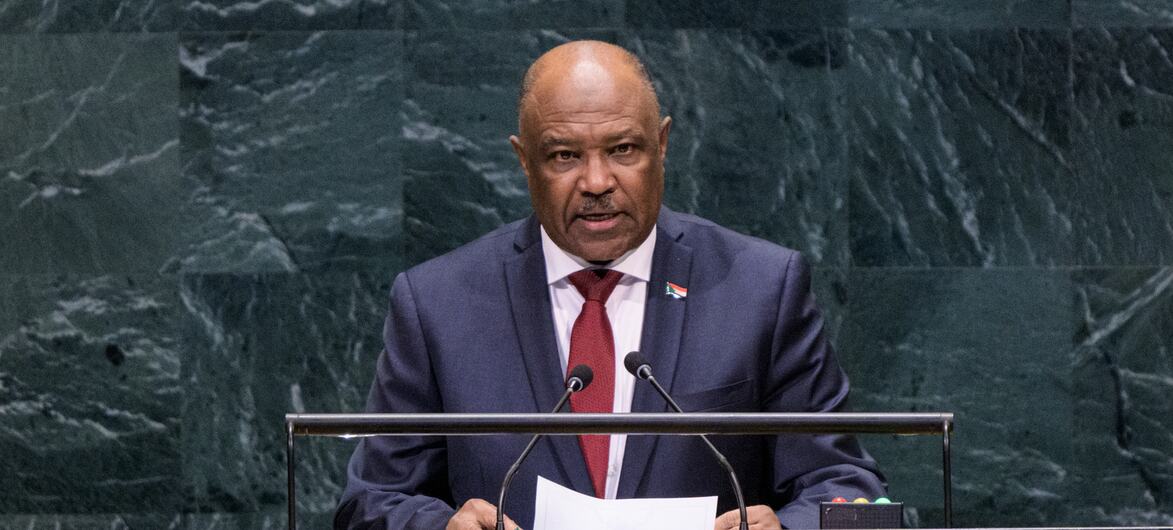
Sudan Foreign Minister: Rejects UN External Intervention, Demands Probe
Summary
- Sudan's Foreign Minister Mohieldin Salim Ahmed Ibrahim addressed the UN General Assembly, rejecting external intervention and calling for a halt to weapons flow into the country.
- The Minister's address occurred after de facto head of state Lt Gen Abdelfattah El Burhan's US visa application was rejected, a decision Salim called "deeply regrettable."
- Sudan accused the paramilitary Rapid Support Forces (RSF) of attacking civilians and medical facilities, and criticized the international community for failing to cut their supply routes.
- During the UN session, Sudan accused the UAE and Chad of supporting the RSF, while both countries denied the allegations, and the UAE counter-alleged SAF chemical weapon use.
- Darfur Governor Minni Minnawi supported a civilian-protecting truce but warned against its use to legitimize a parallel government or divide Sudan, noting over eight million displaced from Darfur.
Sudan's Diplomatic Stand at the UN
He firmly rejected what he characterized as external attempts to impose solutions on the country's internal strife.
Sudan's Foreign Minister Mohieldin Salim Ahmed Ibrahim recently addressed the United Nations General Assembly, delivering a strong message against foreign interference in the nation's ongoing conflict. His appearance came after the de facto head of state, Lieutenant General Abdelfattah El Burhan, who serves as both the Sudanese Armed Forces (SAF) Commander and Sovereignty Council President, was denied a US visa. Minister Salim expressed profound regret over this decision and urged the UN to formally investigate the incident.
During his address, Minister Salim called upon the international community to cease the flow of weapons, ammunition, and fighters into Sudan. He firmly rejected what he characterized as external attempts to impose solutions on the country's internal strife. While affirming Sudan's willingness to engage in any genuine and constructive efforts aimed at resolving the conflict, he simultaneously reiterated a categorical rejection of any imposition of solutions, dictates, or external agendas upon the Sudanese people.
Accusations and International Tensions
The Foreign Minister leveled serious accusations against the paramilitary Rapid Support Forces (RSF), citing their alleged attacks on civilians and medical facilities. He also criticized the international community for its perceived failure to disrupt cross-border supply routes supporting the RSF. Salim asserted that silence regarding the atrocities purportedly committed by the militia was not only shameful and unethical but also complicit, representing a betrayal of civilian victims.
The UN session also witnessed sharp exchanges between Sudan, the United Arab Emirates, and Chad. Sudan explicitly accused both the UAE and Chad of providing support to the RSF. In response, the UAE representative denied these allegations, instead calling for an immediate humanitarian truce and a nationwide arms embargo. Chad, for its part, denied any involvement and reaffirmed its neutrality. The UAE representative further cited international reports alleging the Sudanese Armed Forces had used chemical weapons, an accusation that Radio Dabanga noted it could not independently verify.
Calls for Accountability and Internal Dialogue
Beyond immediate cessation of external support, Minister Salim advocated for accountability for crimes committed in Darfur, Kordofan, and Blue Nile. He urged international pressure on countries accused of backing the RSF and expressed support for an inclusive, Sudanese-led dialogue, emphasizing that lasting peace must address the conflict's underlying causes. He also criticized international sanctions imposed on Sudan, arguing they had damaged the economy, undermined sovereignty, and exacerbated cycles of violence within the nation.
Adding another perspective, Darfur Governor Minni Minnawi voiced his support for a truce designed to protect civilians. However, he cautioned against any such agreement being used to legitimize a parallel government or to facilitate the division of Sudan. Following a meeting with UN envoy Pekka Haavisto, Minnawi highlighted the dire humanitarian situation, noting that over eight million people from Darfur are now either displaced internally or living as refugees. He accused the RSF of obstructing aid delivery and restricting civilian movement, calling for their forces to vacate civilian homes and withdraw from urban areas. Minnawi underscored that any enduring peace must safeguard a unified Sudan and also criticized the absence of Lieutenant General El Burhan from Sudan's UN address.
Source
How does this affect you?
Get an AI analysis of this article grounded in your jurisdictions, practice areas, and any policy documents you've uploaded to Wansom.
Finish Reading the Full Story and the Expert Analysis.
Get the latest legal & regulatory intelligence in Sudan
Wansom is AI and can make mistakes.