
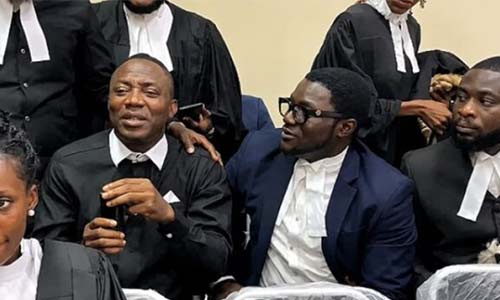
Federal High Court Abuja: Sowore Subpoena Amendment for INEC Chairman
Summary
- The Federal High Court in Abuja directed Omoyele Sowore's counsel to serve all parties with an application to amend a subpoena.
- The subpoena was originally issued to Professor Joash Amupitan, the Chairman of the Independent National Electoral Commission (INEC).
- This directive followed objections raised by unspecified parties in the alleged cyberbullying case.
- Omoyele Sowore is an activist and the African Action Congress (AAC) presidential candidate.
- The court's order emphasizes the strict procedural requirement for formally notifying all parties of significant legal filings.
Court Mandates Service in Sowore Subpoena Case
The court's decision underscores the strict adherence to procedural rules expected from all litigants, ensuring that every party has adequate notice and opportunity to respond to significant legal filings, such as an application for a Sowore subpoena amendment for the INEC Chairman.
The Federal High Court in Abuja has issued a directive requiring the legal representatives for activist and African Action Congress (AAC) presidential candidate, Omoyele Sowore, to formally notify all involved parties regarding an application to modify a subpoena. This application seeks to amend and regularize a subpoena previously issued to Professor Joash Amupitan, who serves as the Chairman of the Independent National Electoral Commission (INEC). The court's instruction came in response to objections raised by undisclosed parties involved in the ongoing legal proceedings.
The subpoena in question pertains to an alleged cyberbullying case, where Mr. Sowore is a central figure. The necessity for this amendment highlights procedural steps often encountered in complex litigation, particularly when seeking testimony or documents from high-profile individuals or public officials. The court's decision underscores the strict adherence to procedural rules expected from all litigants, ensuring that every party has adequate notice and opportunity to respond to significant legal filings, such as an application for a Sowore subpoena amendment for the INEC Chairman.
Procedural Rigor in Nigerian Courts
This directive from the Federal High Court Abuja regarding the subpoena amendment for the INEC Chairman, Prof. Joash Amupitan, illustrates a fundamental principle of Nigeria's legal system: the meticulous requirement for proper service of court documents. In Nigerian cyberbullying case procedure, as in all civil and criminal matters, all parties must be formally served with any application that could affect their rights or obligations. This ensures fairness, transparency, and prevents any party from being ambushed by unforeseen legal maneuvers.
Failure to properly serve all parties with an application, especially one as critical as an Omoyele Sowore cyberbullying subpoena amendment, can lead to significant procedural objections. Such objections can cause delays in proceedings, as seen in this instance, and may even result in the application being struck out if the procedural defect is not remedied. The court's insistence on serving all parties before proceeding with the application to amend the subpoena for the INEC Chairman reinforces the judiciary's commitment to due process and the right to a fair hearing for everyone involved.
Implications for High-Profile Litigation
The court's order for Mr. Sowore's counsel to serve all parties with the application to amend the subpoena for Professor Joash Amupitan carries significant implications, particularly given the high-profile nature of the individuals and institutions involved. Cases featuring prominent political figures like Omoyele Sowore and key public officials such as the INEC Chairman often attract considerable public and media scrutiny. In such contexts, strict adherence to procedural rules becomes even more critical to maintain the integrity and perceived fairness of the judicial process.
This incident serves as a reminder to legal practitioners that even seemingly minor procedural steps, like ensuring proper service of an INEC Chairman subpoena application, can have substantial impacts on the trajectory and timeline of a case. The need to amend and regularize the subpoena itself, followed by the court's directive for comprehensive service, highlights the complexities inherent in legal proceedings and the absolute necessity for legal teams to navigate these intricacies with precision and diligence to avoid unnecessary delays and ensure the smooth administration of justice.
Practical Implications
This case highlights the strict procedural requirement for formally serving all parties when seeking to amend a subpoena in Nigerian courts. Lawyers must ensure meticulous adherence to service rules for such applications to prevent procedural objections and delays, especially in high-profile cases involving public officials.
Source
How does this affect you?
Get an AI analysis of this article grounded in your jurisdictions, practice areas, and any policy documents you've uploaded to Wansom.
Finish Reading the Full Story and the Expert Analysis.
Get the latest legal & regulatory intelligence in Nigeria
Wansom is AI and can make mistakes.