
South Africa's Illicit Economy Costs R68 Billion in Tax Revenue Annually, Industry Study Finds
Two Different Sources of Numbers, and Why That Distinction Matters
This story blends figures from two genuinely different kinds of source, and conflating them, treating an industry body's commissioned economic modelling as if it carries the same evidentiary weight as an official SARS or National Treasury figure, would understate how much interpretation sits behind the headline numbers.
Source one: CGCSA's commissioned research. The R68 billion annual tax revenue figure, along with the R280 billion total illicit economy estimate, the R126 billion GDP impact figure, and the estimate of more than 87,000 jobs displaced, all trace to a study by economic consultancy ECMX, commissioned by the CGCSA, an industry association representing consumer goods manufacturers and retailers. This is advocacy-adjacent research: a private economic consultancy's modelling, commissioned by a body with a direct interest in the policy outcome (stronger enforcement against illicit trade that undercuts its members). That doesn't make the figures wrong, but it does mean they should be reported as CGCSA/ECMX's estimate, not as an official government statistic — a distinction the original framing blurs by presenting the R68 billion figure without attribution to its actual source.
We also found a minor internal inconsistency worth flagging: CGCSA's own communications describe the underlying research as covering 11 key sectors in some statements (including the original press materials for the 6 August 2026 seminar) and 12 sectors in coverage of the fuller ECMX report published in early September 2026. This may reflect the difference between an initial estimate and a more complete published study, but we could not fully reconcile the two sector counts from available sourcing.
One correction to a specific figure: multiple independent outlets (IOL, TimesLive) consistently report more than 87,000 jobs displaced, not 88,000. We use the verified 87,000 figure throughout this piece.
One figure the original framing omits: beyond the R126 billion GDP impact, the ECMX study separately found that compliant businesses forfeit an additional R193 billion in formal production because of illicit trade, a distinct figure from the R126bn GDP number, worth including for completeness.
Source two: SARS itself, a government agency. Separately and independently, SARS Commissioner Johnstone Makhubu and his predecessor Edward Kieswetter have made their own statements and estimates about the illicit economy's scale, based on SARS's own data and enforcement experience. These carry different evidentiary weight — they're official statements from the tax authority, not a commissioned industry study — and are worth reporting distinctly for that reason.
The Scale of South Africa's Illicit Economy, by Category
Per the ECMX study commissioned by CGCSA, the black market it examined was valued at R280 billion annually. Within that: illegal mining was estimated at R60 billion; illegal gambling at R55 billion; and tobacco and alcohol combined accounted for R85 billion, the two largest single categories. The study examined illicit trade across a set of sectors including alcohol, tobacco, clothing and textiles, food, fuel, mining, pharmaceuticals, cosmetics and personal care, and toys and games, a broader set of categories than "cigarettes, alcohol, clothing, fuel, and pharmaceutical products" alone, and the R126 billion GDP impact figure reflects the full multi-sector study, not just those five named categories.
Illicit alcohol carries a documented public health risk beyond the revenue question. Counterfeit or illicitly produced alcohol can contain methanol, industrial-grade ethanol, acetone, lead, and arsenic — substances used to increase volume or cut production costs — with exposure capable of causing severe health effects including blindness and death. The Drinks Federation of South Africa has reported a 55% increase in the illicit alcohol market between 2017 and 2024; we relied on the original reporting for this specific statistic and did not independently locate the underlying Drinks Federation publication.
Illicit fuel carries its own consumer-facing warning: experts cited in the original reporting flagged that motorists should treat unusually large discounts on diesel as a potential indicator of illicit sourcing, given the fuel sector's prominence among the categories studied.
SARS's Own Figures Are Larger and From a Different Source
Important correction to the original framing: Edward Kieswetter's parliamentary briefing took place in February 2026, while he was still the sitting SARS Commissioner, his term did not end until 30 April 2026, with Makhubu formally taking over on 1 May 2026. Describing Kieswetter as "former SARS Commissioner" at the time of that February briefing is inaccurate; he should be identified as the Commissioner at the time, with his subsequent departure noted separately.
At that February 2026 briefing, Kieswetter told Parliament that South Africa's illicit economy had grown from roughly 5% of GDP to between 12% and 15% over the preceding 15 to 20 years, which he estimated placed its total value between R800 billion and R1.2 trillion, substantially larger than CGCSA/ECMX's R280 billion figure, though the two are not measuring identical things (Kieswetter's figure describes the full illicit economy across all sectors; CGCSA's study is scoped to the sectors most relevant to consumer goods). Kieswetter separately estimated the state could be losing between R200 billion and R300 billion in tax revenue annually, again, several multiples larger than CGCSA's R68 billion figure, underscoring that these are different studies measuring different scopes, not competing estimates of the same thing.
Dr Ngobani Johnstone Makhubu, appointed SARS Commissioner for a five-year term effective 1 May 2026, has continued the same public emphasis on illicit trade since taking office. In May 2026, he said SARS needs greater funding, technology, and inter-agency cooperation, specifically flagging that border-scanning infrastructure alone would cost R3.6 billion, based on a per-unit scanner cost of roughly R180 million.
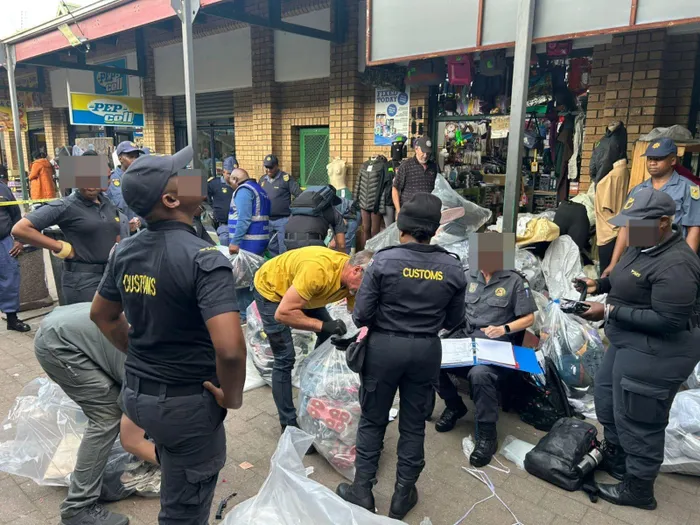
SARS's enforcement record under Makhubu includes two operations worth distinguishing clearly, since the original framing's placement could suggest they were connected: SARS has used cargo profiling and data-driven risk systems to intercept suspected drug consignments at the Port of Durban; separately, in a Kempton Park, Gauteng raid conducted with SAPS's Directorate for Priority Crime Investigation, authorities seized roughly 26,000 litres of ethanol that would have attracted approximately R9.1 million in duties and taxes had it entered the legitimate market — an inland operation unrelated to the Durban port case.
The Proposed Response: An Industry Anti-Crime Platform
CGCSA CEO Zinhle Tyikwe used the Johannesburg seminar to call for a more coordinated response, better intelligence sharing, aligned industry action, and resilience against increasingly sophisticated criminal networks she described as operating across provinces and exploiting technology to facilitate illicit trade, counterfeiting, extortion, cargo theft, cybercrime, commercial crime, financial fraud, and attacks on infrastructure.
The seminar's discussions are expected to result in a proposed Industry Anti-Crime Platform, building on existing work through Business Against Crime South Africa (BACSA) and the Government-Business Partnership. Tyikwe framed this as institutionalising collaboration already underway rather than creating something entirely new: "The proposed Anti-Crime Platform can provide that foundation by bringing together business, government and law enforcement around prevention, disruption, enforcement and measurable outcomes."
This is a proposed industry initiative, not a government programme with legal force. It should not be conflated with President Ramaphosa's separately announced national illicit economy disruption programme, which is a government-side initiative bringing together state agencies and private-sector stakeholders, a distinct effort referenced in coverage of the underlying ECMX study but not detailed in the original framing of this piece.
Compliance Implications / What This Means for Your Business
Who must act, and what specifically changes: Nothing changes legally. This is advocacy research and ongoing enforcement activity, not a new law or regulation. Businesses in the consumer goods, alcohol, tobacco, fuel, and pharmaceutical sectors already operate under existing customs, excise, and tax compliance obligations.
Financial and operational exposure: For legitimate businesses in the affected sectors, the practical takeaway is competitive rather than regulatory: illicit operators undercut compliant businesses on price precisely because they avoid the tax, wage, and regulatory costs legitimate operators carry. Supply chain security, particularly around cargo theft and counterfeit infiltration, which Tyikwe specifically flagged as rising costs of doing business — is a live operational risk independent of any government action.
Realistic timeline: No filing deadlines or compliance dates apply. The Industry Anti-Crime Platform is still at the proposal stage following the August seminar; no launch date has been published. The national illicit economy disruption programme's implementing detail and timeline were not found in available sourcing.
What remains uncertain or pending: The 11-versus-12-sector discrepancy in CGCSA's own figures is unresolved. Whether the Industry Anti-Crime Platform will be formally established, and on what timeline, is unconfirmed. The relationship between CGCSA's proposed platform and the government's own disruption programme, whether they will operate jointly, separately, or in some formal partnership, was not detailed in available sourcing.
Frequently Asked Questions
Is the R68 billion figure an official government statistic? No. It comes from a study by economic consultancy ECMX, commissioned by the Consumer Goods Council of South Africa, an industry body. It should be treated as an industry-commissioned estimate, not an official SARS or National Treasury figure, though SARS has separately produced its own, larger estimates of illicit-economy tax losses.
Why do SARS's figures (R200–300 billion in lost tax revenue) differ so much from CGCSA's R68 billion? They're measuring different scopes. CGCSA's study focuses on 11–12 sectors most relevant to consumer goods. Kieswetter's February 2026 estimate describes the entire illicit economy across all sectors, which is a substantially broader measure, the two numbers aren't competing estimates of the same underlying activity.
Was Edward Kieswetter a "former" SARS Commissioner when he gave the R200–300 billion estimate? No. That estimate was given at a parliamentary briefing in February 2026, when Kieswetter was still the sitting SARS Commissioner. His term ended 30 April 2026, and Johnstone Makhubu took over 1 May 2026.
Were the drug interception at Durban port and the R9.1 million ethanol seizure part of the same operation? No. They're separate SARS enforcement actions in different locations, the drug interceptions used cargo profiling at the Port of Durban, while the ethanol seizure was a Kempton Park, Gauteng warehouse raid conducted jointly with SAPS.
Is the Industry Anti-Crime Platform an existing organisation or a new proposal? It's a proposal discussed at CGCSA's August 2026 Crime Risk Seminar, intended to build on and formalise existing collaboration through Business Against Crime South Africa and the Government-Business Partnership. It has not been confirmed as formally established.
How many jobs does the study say illicit trade has displaced? More than 87,000, per the ECMX study — not 88,000, a figure that appears to be a minor rounding error relative to the consistently reported source figure.
Citations
- 1.CGCSA's own release on the 6 August 2026 Crime Risk Seminar and the R68 billion/11-sector figure: cgcsa.co.za.
- 2.The fuller ECMX study findings (R280bn illicit economy, R126bn GDP impact, R193bn forfeited formal production, 87,000+ jobs displaced, 12-sector scope), published early September 2026: IOL, "South Africa's R280bn illicit economy costs 87,000 jobs, tax revenue and growth"; TimesLIVE, "Illicit trade wipes out jobs, costs R68bn in annual tax revenue, states report".
- 3.Kieswetter's February 2026 parliamentary briefing figures and his sitting-Commissioner status at that time, corroborated via Vutivi Business, "SMEs buckle under illicit trade pressure as economy hits R1.2tn".
- 4.Makhubu's appointment date, term, and full name: SARS official media release, "Appointment of Dr Ngobani Johnstone Makhubu as SARS Commissioner"; The Presidency, "President Ramaphosa appoints new SARS Commissioner".
- 5.Makhubu's R3.6 billion border-scanning comments (May 2026): eNCA, "Funding SARS a priority - Commissioner Johnstone Makhubu".
- 6.The Kempton Park ethanol seizure (R9.1 million, 26,000 litres): SARS/SAnews, "SARS, SAPS deal blow to illicit alcohol trade"; IOL.
- 7.President Ramaphosa's national illicit economy disruption programme announcement, referenced in State of the Nation Address coverage via IOL's report on the ECMX study above; we did not access the SONA text directly.
Finish Reading the Full Story and the Expert Analysis.
Get the latest legal & regulatory intelligence in South Africa
Wansom is AI and can make mistakes.