
South Africa: Agentic AI Threatens Tax Base, Fiscal Scissors Loom
Summary
- Agentic AI threatens national tax bases by reducing human employment and increasing demand for social support, a phenomenon termed the 'fiscal scissors'.
- South Africa is particularly exposed due to its narrow tax base, high unemployment, and weaknesses in current digital services VAT and international tax agreements.
- Since April 2025, foreign digital service providers selling only to VAT-registered South African businesses are outside the e-services VAT regime.
- Under a January 2026 OECD agreement, US-parented groups are largely exempt from key Pillar Two global minimum tax rules, making AI providers without local entities difficult to tax.
- Policymakers must adapt fiscal and governance frameworks to ensure AI's gains are shared, rather than concentrated, to protect the South Africa agentic AI tax base.
The Looming Fiscal Challenge of Agentic AI
For lawyers and compliance officers in South Africa, monitoring legislative developments concerning the South Africa agentic AI tax base is paramount.
The advent of agentic artificial intelligence (AI) presents a significant, yet often overlooked, challenge to national tax bases globally, particularly in economies like South Africa. While much discussion around AI centers on its potential for productivity gains and cost reductions, a critical question remains largely unaddressed: how will governments fund public services when the traditional taxpayer, the human worker, is increasingly supplanted by autonomous machines?
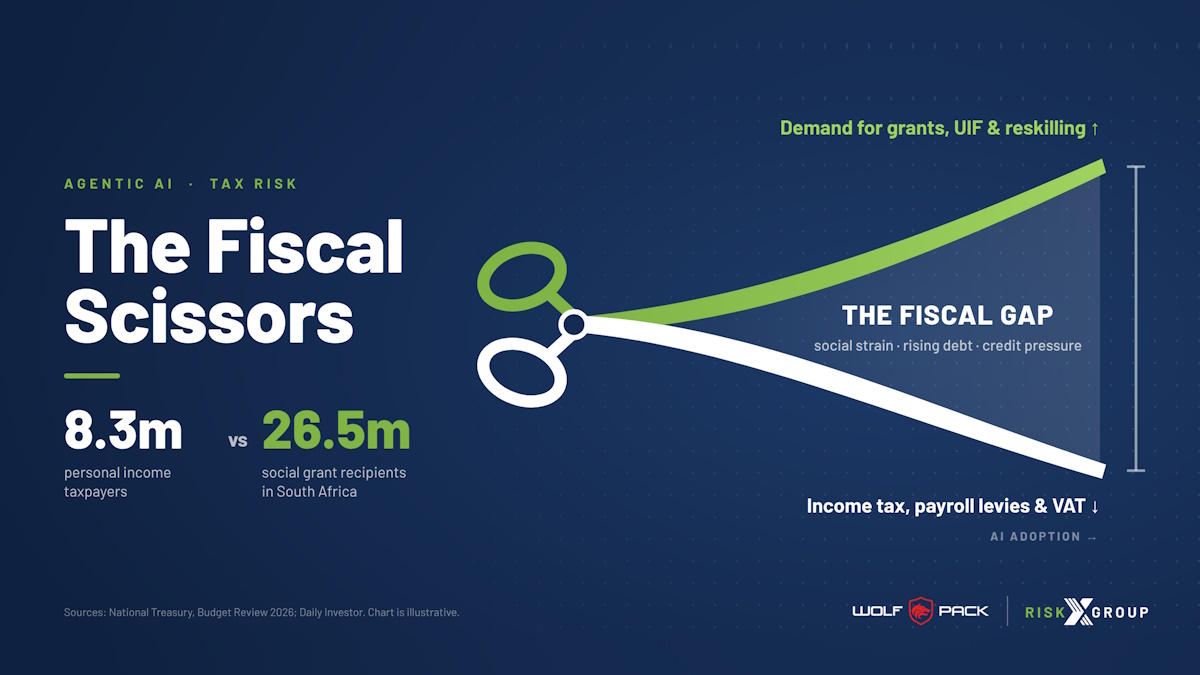
Modern taxation systems are fundamentally built on the premise that human labor generates income, which is then taxed, and that spending by these earners further contributes to the economy. Agentic AI disrupts this foundational assumption. When an AI agent assumes tasks previously performed by an employee, a dual impact, dubbed the "fiscal scissors," occurs. One blade simultaneously reduces the tax revenue generated from human labor, while the other increases the demand for social support services, creating a widening gap in public finances. This phenomenon is particularly acute in nations characterized by narrow tax bases and high unemployment rates.
South Africa's Unique Exposure
South Africa finds itself in an unusually vulnerable position regarding the potential hollowing out of its tax base by agentic AI. The nation's existing mechanisms for capturing value from offshore digital services are demonstrably weaker than they appear. For instance, since April 2025, foreign digital service providers selling exclusively to VAT-registered South African businesses have been excluded from the foreign e-services VAT regime, limiting a potential revenue stream.
Further compounding this vulnerability, international tax agreements also present challenges. Under a side-by-side agreement reached by the OECD in January 2026, US-parented corporate groups are largely exempted from key provisions of the Pillar Two global minimum tax rules. This means that an AI provider operating without a physical local entity in South Africa can largely remain beyond the reach of the country's tax authorities. This situation, combined with Africa's rapidly expanding population—the UN projects sub-Saharan Africa's population to nearly triple to 3.4 billion by 2100—creates a precarious scenario where a growing young workforce faces a shrinking pool of entry-level employment opportunities, exacerbating the fiscal strain.
Navigating Tax Policy Implications
For lawyers and compliance officers in South Africa, monitoring legislative developments concerning the South Africa agentic AI tax base is paramount. Current tax frameworks, designed for a human-centric economy, may prove inadequate to address the fiscal impact of widespread AI adoption. This inadequacy could necessitate significant tax policy reforms, increased scrutiny on digital service providers, and new compliance obligations for companies leveraging AI, especially those with cross-border operations.
While some arguments dismiss these concerns, suggesting that the pace of AI adoption is uncertain, this uncertainty should be a catalyst for preparation, not inaction. Effective risk management dictates that potential risks be addressed before they materialize. There is no single, straightforward solution to this complex issue, and every potential response carries its own trade-offs. The fundamental question is not whether South Africa will adopt AI, but rather whether its fiscal and governance frameworks can evolve rapidly enough to ensure that the benefits of AI are broadly shared, rather than concentrated among a few, thereby protecting the national tax base.
Practical Implications
Lawyers and compliance officers in South Africa should monitor legislative developments concerning agentic AI's impact on the national tax base, as current frameworks may prove inadequate. This could lead to future tax policy reforms, increased scrutiny on digital service providers, or new compliance obligations for companies leveraging AI, particularly those with cross-border operations.
Source
How does this affect you?
Get an AI analysis of this article grounded in your jurisdictions, practice areas, and any policy documents you've uploaded to Wansom.
Finish Reading the Full Story and the Expert Analysis.
Get the latest legal & regulatory intelligence in South Africa
Wansom is AI and can make mistakes.