
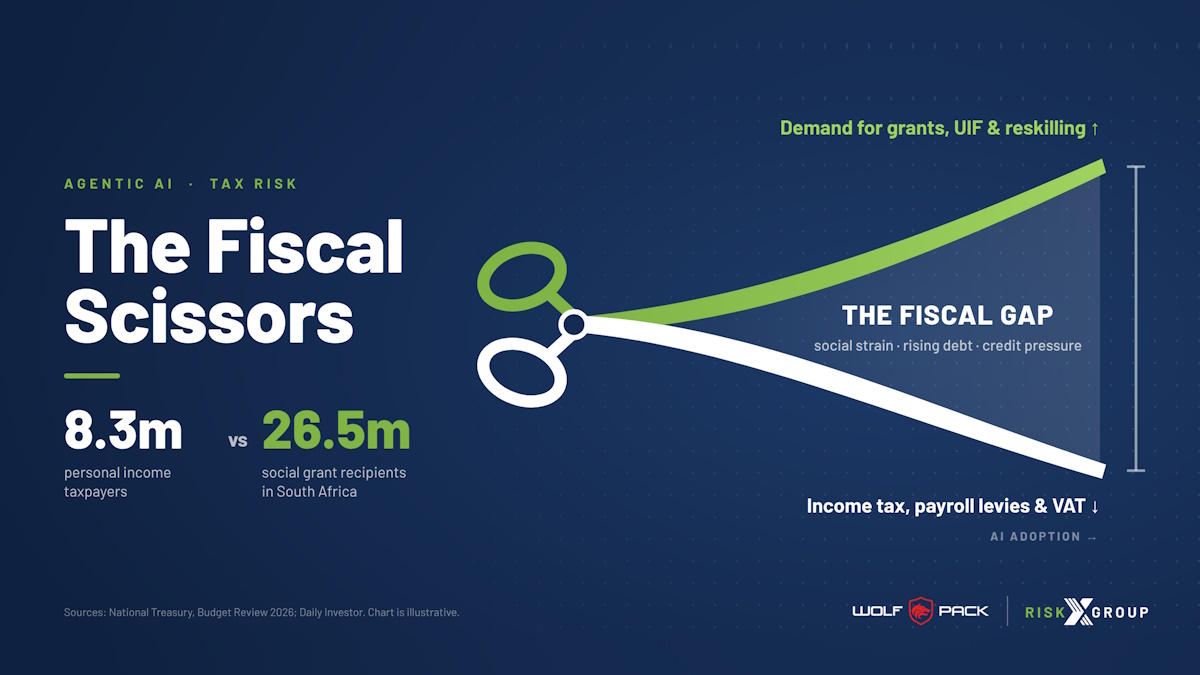
South Africa: Agentic AI's Impact on Tax Base Examined
Johan van Zyl, Chief Operating Officer of Risk X Group, issued a warning on November 27, 2026, via Wolfpack Information Risk (Pty) Ltd, about the potential for agentic AI to significantly erode South Africa's tax base and simultaneously increase demand for social support, coining this phenomenon the "fiscal scissors."
This analysis is crucial for South African legal professionals as it flags a looming structural challenge to the nation's fiscal stability, impacting future legislative and regulatory frameworks concerning taxation, social welfare, and employment law. It suggests a fundamental shift in the economic landscape that current legal and tax structures are ill-equipped to handle, potentially leading to widespread economic and social disruption if not proactively addressed by policymakers.
The discussion implicitly touches upon South Africa's existing tax legislation, such as the Income Tax Act and the Value-Added Tax Act, as well as social security frameworks and labor laws, all of which are predicated on human employment and income generation. The "fiscal scissors" concept suggests these foundational legal instruments may become increasingly inadequate in an AI-driven economy, necessitating potential reforms or new legislation to address revenue generation and social safety nets. The excerpt does not mention specific court cases or rulings, as it is a forward-looking analysis of a potential future economic challenge.
Key parties involved in this discussion are Johan van Zyl (Chief Operating Officer, Risk X Group), Wolfpack Information Risk (Pty) Ltd (the issuer of the analysis), and implicitly, the South African government, the South African Revenue Service (SARS), and policymakers who will ultimately be tasked with formulating responses to these predicted challenges. The broader South African populace and businesses are also key stakeholders, as they will be directly affected by any shifts in tax policy or social support structures.
Attorneys should closely monitor policy discussions and legislative proposals related to AI's economic impact, particularly concerning tax reform, social welfare adjustments, and labor law amendments. Businesses, especially those adopting agentic AI, should anticipate potential new taxes or regulatory burdens aimed at addressing the "fiscal scissors" effect and consider their long-term fiscal strategies in light of these predictions, engaging with industry bodies to contribute to policy formulation.
How does this affect you?
Get an AI analysis of this article grounded in your jurisdictions, practice areas, and any policy documents you've uploaded to Wansom.
Finish Reading the Full Story and the Expert Analysis.
Get the latest legal & regulatory intelligence in South Africa
Wansom is AI and can make mistakes.