
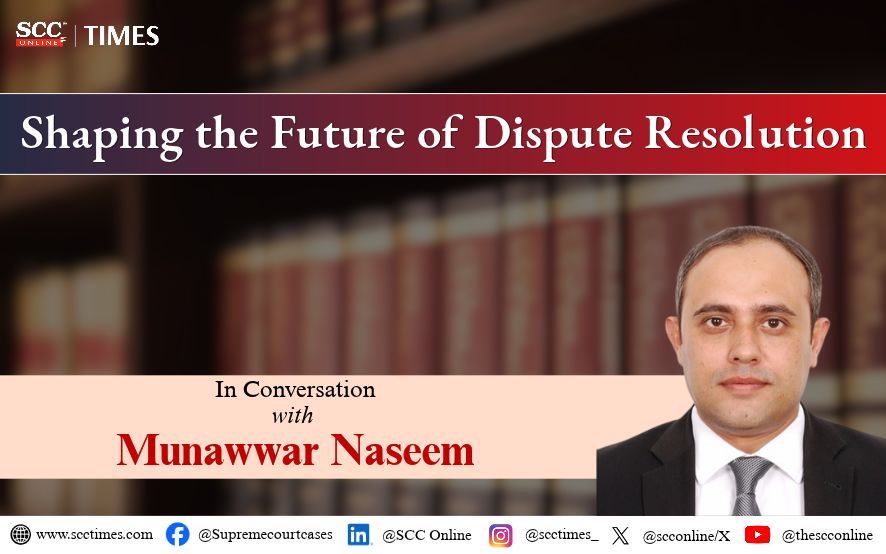
Shaping the Future of Dispute Resolution: In Conversation with Munawwar Naseem
What Happened
1. To begin with, could you tell us about your journey into the legal profession and what inspired you to pursue a career in law? My father was a criminal trial lawyer in Patna, and while growing up, I often watched him leaf through volumes of criminal law journals, make notes, and pace thoughtfully as he worked through a case. I also saw him meet people who had little voice of their own, including those who had been falsely implicated. Through his work, I came to understand how a lawyer could protect a persons liberty and even change the course of a life. Equally influential was his commitment to practising law ethically — not only in his professional conduct, but also in the way he treated people and approached his work. Those observations quietly shaped me, although my path to law was not a straight one. My first ambition was to become a doctor. When that did not work out, I tried to join the Army while pursuing my LLB, but that opportunity did not materialise either. As I became more engaged with my legal studies, however, I realised that law was a natural fit for me rather than simply an alternative to my earlier ambitions. My temperament also suited the profession. I am an empathetic listener, and I find it easy to connect with people. These qualities helped me grow into the role of a lawyer, where understanding a persons circumstances is often as important as understanding the law. 2. Many law students aspire to build careers in dispute resolution without fully understanding the realities of the profession. What are some common misconceptions you would like to dispel? One common misconception is that there is a standard career path in dispute resolution — that your progress should mirror someone elses or that everyone should reach the same milestones at the same stage. There is no uniform trajectory. Lawyers differ in their opportunities, experiences, temperament and even in how they approach the same case. Constant comparison can therefore create unrealistic expectations and unnecessary anxiety. Another misconception is that an interest in law necessarily translates into an aptitude for dispute resolution. The work demands a particular combination of skills and temperament: careful listening, sound judgment, clear communication and the ability to manage uncertainty. It is not merely about enjoying an argument; it is about understanding a dispute and helping someone navigate it. Determining whether you are suited to that work is an important part of your early years in the profession. Perhaps the biggest misconception is that, with time, you become settled. Experience certainly helps, but the profession rarely becomes settled in the conventional sense. New challenges, disruptions and testing situations will always arise. What gradually settles is your mindset: You learn to respond with greater discipline, perspective, and composure. For students, I would say that the aim should not be to replicate someone elses career or to expect uncertainty to disappear. Instead, it should be to develop the habits that sustain you through uncertainty: hard work, discipline, common sense and a willingness to keep learning. Equally important is the ability to work well with others. Ultimately, dispute resolution is a team effort, not merely an exercise in individual ability, and learning to listen, collaborate and contribute to a shared purpose is essential. Another misconception is that experience means you should no longer need guidance. Whenever I feel underconfident or overconfident about a matter, I turn to a senior colleague as a sounding board. Their perspective helps me assess the situation objectively and respond with greater balance. The law requires lifelong learning, and fluctuations in a lawyers confidence must never compromise a clients liberty, property or reputation. 3. How important are internships, moot courts, legal research, and professional networking in securing opportunities at premier law firms? What
Source
How does this affect you?
Get an AI analysis of this article grounded in your jurisdictions, practice areas, and any policy documents you've uploaded to Wansom.
Finish Reading the Full Story and the Expert Analysis.
Get the latest legal & regulatory intelligence in India
Wansom is AI and can make mistakes.