
Nakul Dewan: AI Cognitive Offloading Risks Legal Practice
Summary
- Senior Advocate Nakul Dewan warned against lawyers' "cognitive offloading" to AI, where technology replaces critical thinking.
- He stated that over-reliance on AI risks failure during high-stakes cross-examinations if lawyers lack thorough case knowledge.
- Dewan emphasized that AI should enhance, not substitute, a lawyer's own brainwork and understanding of case files.
- Panelists at GHAC Arbitration Week 2026 agreed that generative AI tools must remain secondary to human intellect.
- AI is best utilized as a productivity tool for tasks like document searching, similar to how Microsoft Word functioned decades ago.
A Warning Against Cognitive Offloading
The message is clear: while embracing technological advancements, the core tenets of legal expertise and thorough preparation must never be compromised.
Senior Advocate and King's Counsel Nakul Dewan recently issued a stark warning to legal professionals regarding the increasing reliance on artificial intelligence (AI) in their practice. Speaking at the GHAC Arbitration Week 2026, Dewan highlighted the severe risks faced by lawyers who allow technology to replace their fundamental critical thinking abilities. He specifically coined the term 'cognitive off-loading' to describe this dangerous trend, where legal practitioners delegate core intellectual tasks entirely to AI tools.
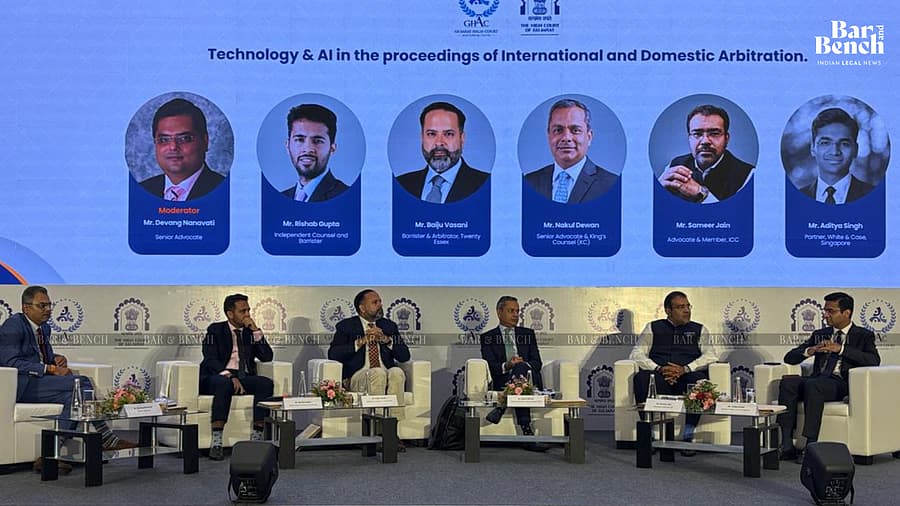
Dewan's intervention came during a panel discussion titled "Technology & AI in the proceedings of International and Domestic Arbitration," where he underscored that while AI can be a valuable asset, it must not become a substitute for a lawyer's own brainwork. He stressed that the proper application of AI should be to enhance, rather than supplant, human critical thinking. This perspective is crucial for maintaining the integrity and effectiveness of legal representation, particularly in high-stakes environments.
The Perils of Over-Reliance in High-Stakes Litigation
The primary concern articulated by Nakul Dewan centers on the potential for catastrophic failure when lawyers depend solely on AI, especially during critical phases like cross-examination. He cautioned that legal counsel who do not possess a deep, personal understanding of their case files, instead relying entirely on AI-generated insights, are ill-equipped to handle unexpected challenges that inevitably arise in court. Such a dependency leaves them vulnerable to being caught off guard, potentially compromising their client's position.
Dewan firmly asserted the non-negotiable importance of lawyers having an exhaustive knowledge of their case materials. This foundational understanding is what enables them to adapt, strategize, and respond effectively to unforeseen developments, a capability that AI, in its current form, cannot replicate. The warning serves as a critical reminder for legal practitioners in India and globally about the ethical and practical pitfalls of allowing AI to diminish their active engagement with the intricacies of a case.
Defining AI's Proper Role in Legal Practice
The broader consensus among panelists at the GHAC Arbitration Week 2026 echoed Nakul Dewan's sentiment: generative AI tools must always remain secondary to human intellect. Barrister Rishabh Gupta, a co-panelist, further clarified AI's appropriate function, characterizing it primarily as an efficiency aid. He drew a parallel between AI's current role and that of Microsoft Word two decades ago, emphasizing its utility in streamlining tasks such as sifting through vast quantities of documents.
Gupta's perspective reinforces the idea that AI should be viewed as a productivity enhancer, designed to assist lawyers with laborious, data-intensive processes, thereby freeing up their time for more complex analytical and strategic work. The discussion, moderated by Senior Advocate Devang Nanavati and featuring other distinguished panelists including Twenty Essex Barrister Baiju Vasani, ICC Indian Chair Sameer Jain, and White & Case Partner Aditya Singh, also touched upon the necessity of establishing clear transparency standards for AI's use in legal contexts.
Upholding Professional Standards in the AI Era
The insights shared by Nakul Dewan and his fellow panelists at the GHAC Arbitration Week 2026 carry significant implications for the future of legal practice, particularly in India. The emphasis on avoiding 'cognitive offloading' to AI tools underscores a fundamental ethical responsibility for lawyers: to maintain their critical thinking and intellectual autonomy. This is not merely a matter of efficiency but of professional competence and client protection.
The debate highlights the imperative for legal professionals to integrate AI responsibly, ensuring that these powerful tools serve as aids to human judgment rather than replacements for it. Failure to do so risks not only professional negligence but also a degradation of the quality of legal services, especially in high-stakes arbitration and litigation where nuanced human insight remains paramount. The message is clear: while embracing technological advancements, the core tenets of legal expertise and thorough preparation must never be compromised.
Practical Implications
This article serves as a critical warning for lawyers and compliance officers in India regarding the ethical and practical pitfalls of over-relying on AI, particularly in high-stakes legal proceedings like arbitration. It underscores the necessity of maintaining human critical thinking and oversight when integrating AI tools, advising against 'cognitive offloading' to prevent professional negligence and ensure robust client representation.
Source
How does this affect you?
Get an AI analysis of this article grounded in your jurisdictions, practice areas, and any policy documents you've uploaded to Wansom.
Finish Reading the Full Story and the Expert Analysis.
Wansom is AI and can make mistakes.