
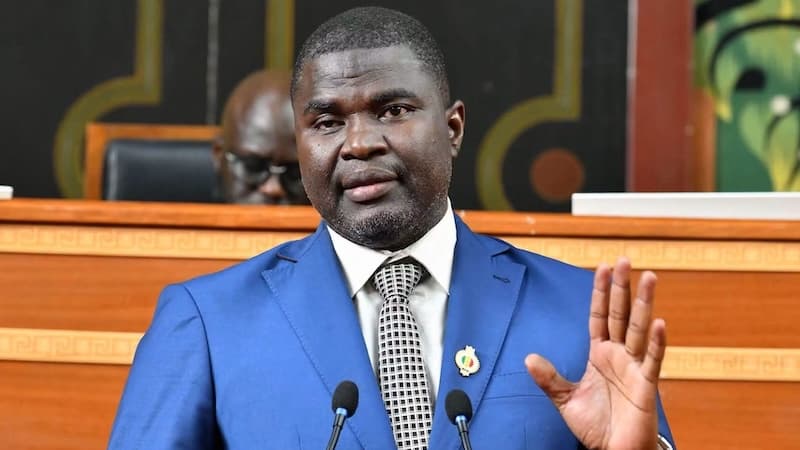
Senegal National Assembly: Inquiry Rules Block ASER Kosmos Probes
Summary
- Deputy Amadou Ba argues against parliamentary inquiries into the ASER and Kosmos cases, citing ongoing judicial and administrative investigations.
- The ASER case involves 37 billion FCFA and is handled by the Pool judiciaire financier, while the Kosmos case involves an alleged 50 billion FCFA and is with the Inspection générale d’État.
- Ba's legal challenge is based on the Constitution and National Assembly rules, which prohibit commissions when legal proceedings are active or a final judgment exists.
- National Assembly President Ousmane Sonko defends the principle of impartial inquiry, rejecting claims of political targeting.
- The debate occurs amid government tensions, with an extraordinary Assembly session scheduled for August 10, 2026, to discuss other key issues.
Legislative Oversight Challenged
The core of Amadou Ba's argument against the Senegal parliamentary inquiry ASER Kosmos rests on constitutional provisions and the internal regulations of the National Assembly.
A significant legal and political debate has emerged in Senegal regarding the scope of parliamentary inquiry commissions, specifically concerning the ASER and Kosmos cases. Deputy Amadou Ba has vocally opposed the establishment of these commissions by the National Assembly, asserting that such legislative investigations are inappropriate when the matters are already under the purview of judicial or administrative bodies.
Ba's objection centers on two high-profile financial cases. The ASER case, involving an amount of 37 billion FCFA, is currently being handled by the Pool judiciaire financier. Separately, the Kosmos case, which involves an alleged sum of 50 billion FCFA, has been referred to the Inspection générale d’État (IGE), an administrative control body directly attached to the presidency. Public hearings related to these parliamentary inquiries have been ongoing since Monday, fueling the controversy.
Legal Basis for the Inquiry Block
The core of Amadou Ba's argument against the Senegal parliamentary inquiry ASER Kosmos rests on constitutional provisions and the internal regulations of the National Assembly. He contends that deputies are legally precluded from investigating facts that are already the subject of ongoing judicial proceedings. This interpretation creates a direct legal obstacle for individuals like Deputy Thierno Alassane Sall, who had previously filed a complaint in the ASER case and was questioned for over six hours by the gendarmerie's research section in June.
Reinforcing this position, the National Assembly itself issued an explanatory note on Friday, clarifying its own rules. This note explicitly states that the creation of an inquiry commission is prohibited when legal proceedings are underway or when a definitive judgment has already been rendered. This highlights a critical tension between legislative oversight and the principle of judicial independence, particularly when a judicial investigation, such as the one by the Pool judiciaire financier for ASER, or an administrative review by the IGE for Kosmos, is active.
Political Tensions and Future Implications
The dispute over the ASER Kosmos judicial investigation and the parliamentary inquiry unfolds amidst palpable internal tensions within the government. Amadou Ba has characterized the criticisms leveled against the commissions as a concerted 'offensive against the majority,' orchestrated by 'the system' and 'false neutrals,' while simultaneously declaring that 'the transparency machine has been launched.' This suggests a deeper political struggle underlying the procedural debate.
Conversely, Ousmane Sonko, the President of the National Assembly, has defended the fundamental principle of an inquiry commission, emphasizing that it should be impartial and spare no one, including members of his own Pastef party. He has explicitly rejected any notion that the inquiry is designed to target specific individuals or to settle political scores. The National Assembly is scheduled to convene an extraordinary session on August 10, 2026, at Sonko's convocation, to address other significant matters, including the management of tax exemptions and the procedures for issuing fishing licenses. This broader context suggests that some Pastef deputies may be using these sensitive cases to exert pressure on President Bassirou Diomaye Faye and Oil Minister Abdourahmane Diouf, further complicating the political landscape.
Practical Implications
Lawyers and compliance officers in Senegal should monitor the legal interpretation and application of parliamentary rules regarding inquiry commissions, particularly when matters are already under judicial or administrative investigation. This case highlights a potential precedent for challenging the scope of legislative oversight when concurrent legal proceedings are active, impacting how clients might navigate multi-pronged scrutiny.
Source
How does this affect you?
Get an AI analysis of this article grounded in your jurisdictions, practice areas, and any policy documents you've uploaded to Wansom.
Finish Reading the Full Story and the Expert Analysis.
Get the latest legal & regulatory intelligence in Senegal
Wansom is AI and can make mistakes.