
Sénégal: Nouveaux Codes Travail Sécurité Sociale Publiés, Facing Opposition
Summary
- New Labor and Social Security Codes are now officially in force in Senegal.
- These reforms were promulgated on September 3, 2026, as Law n°2026-18 and Law n°2026-19.
- The codes were published in the Official Journal on September 18, 2026, making them legally binding.
- A major union, the FSDT, has declared a 72-hour strike in strong opposition to the new legislation.
- Union anger over the new codes continues unabated following their publication.
What Happened
The immediate aftermath of the Sénégal nouveaux Codes Travail Sécurité sociale publiés has been marked by pronounced discontent from organized labor.
The legal landscape governing employment and social protections in Senegal has undergone a significant transformation with the official entry into force of new legislative frameworks. The Sénégal nouveaux Codes Travail Sécurité sociale publiés mark a pivotal moment for employers, employees, and legal practitioners across the nation. These comprehensive reforms, comprising the new Labor Code and the new Social Security Code, were formally promulgated on September 3, 2026, setting the stage for their implementation.
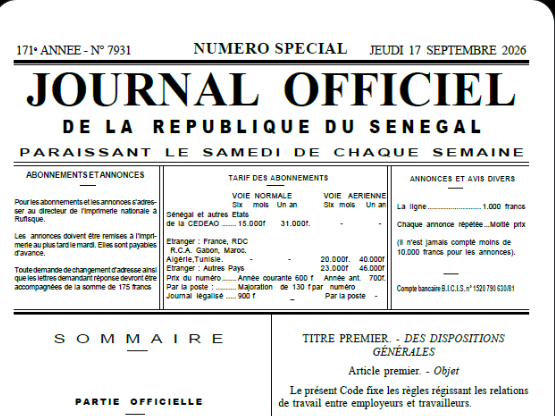
Following their promulgation, these crucial legislative texts were subsequently made public through their official publication in the Journal officiel on September 18, 2026. This publication rendered the new codes fully effective, establishing the updated legal parameters for labor relations and social welfare contributions throughout Senegal. The swift progression from promulgation to official publication underscores the government's intent to rapidly implement these far-reaching changes.
However, the introduction of these new codes has not been met with universal approval. Immediately following their public release, significant opposition emerged from key labor organizations. Notably, the FSDT, a prominent union federation, has voiced strong disapproval, signaling a period of potential industrial unrest.
Legal Framework and Implementation
The legislative package consists of two distinct but interconnected laws: Loi n°2026-18 Sénégal, which establishes the new Labor Code, and Loi n°2026-19 Sénégal, which introduces the new Social Security Code. These statutes represent a comprehensive overhaul of existing regulations, aiming to modernize and streamline the legal provisions governing employment contracts, working conditions, and social benefits. The Réforme Code du Travail Sénégal is expected to impact various aspects of employer-employee relationships, from hiring practices to termination procedures, while the Réforme Sécurité Sociale Sénégal will redefine contributions, benefits, and the administration of social protection schemes.
The formal publication of these codes in the Journal Officiel Sénégal Codes is a critical step in the legislative process, making them legally binding and accessible to all citizens and entities operating within the country. This act signifies that all previous, conflicting legislation in these areas is superseded, and all parties are now expected to adhere to the new provisions. Legal professionals and businesses must therefore undertake a thorough review of their current practices and contractual agreements to ensure full compliance with the updated Droit du travail Sénégal 2026.
The implementation of such extensive reforms necessitates a period of adjustment for all stakeholders. Employers will need to update internal policies, revise employment contracts, and potentially re-evaluate their social contribution strategies. Employees, in turn, will need to understand their new rights and obligations under the revised framework. The clarity provided by the official publication is essential for navigating these changes, though the immediate reaction suggests that the path to full acceptance and smooth implementation may be fraught with challenges.
Union Opposition and Future Outlook
The immediate aftermath of the Sénégal nouveaux Codes Travail Sécurité sociale publiés has been marked by pronounced discontent from organized labor. The FSDT has taken a firm stance against the reforms, declaring a 72-hour strike in response to what it perceives as unfavorable changes. This decisive action highlights the depth of union anger, which, according to reports, has shown no signs of subsiding since the codes' promulgation and publication. Such a significant industrial action could lead to widespread disruptions across various sectors.
The ongoing opposition from powerful union bodies like the FSDT indicates that the government may face considerable hurdles in fully implementing these new codes without further contention. The declared strike is not merely a symbolic gesture but a concrete manifestation of the labor movement's resolve to challenge aspects of the Réforme Code du Travail Sénégal and the Réforme Sécurité Sociale Sénégal. This situation underscores the importance for businesses and legal advisors to closely monitor developments and prepare for potential escalations or negotiations.
The sustained "colère syndicale" (union anger) suggests that the debate surrounding these reforms is far from over. While the codes are legally in force, their practical application and acceptance within the Senegalese workforce will depend heavily on how these grievances are addressed. Stakeholders must be prepared for a dynamic environment where legal compliance intersects with ongoing industrial relations challenges, shaping the future of Droit du travail Sénégal 2026.
Practical Implications
Lawyers and compliance officers in Senegal must immediately review the newly published Labour and Social Security Codes to understand their impact on employment contracts, social contributions, and dispute resolution. They should advise clients on necessary compliance adjustments and prepare for potential industrial action or legal challenges stemming from union opposition to these reforms.
Source
How does this affect you?
Get an AI analysis of this article grounded in your jurisdictions, practice areas, and any policy documents you've uploaded to Wansom.
Finish Reading the Full Story and the Expert Analysis.
Get the latest legal & regulatory intelligence in Senegal
Wansom is AI and can make mistakes.