
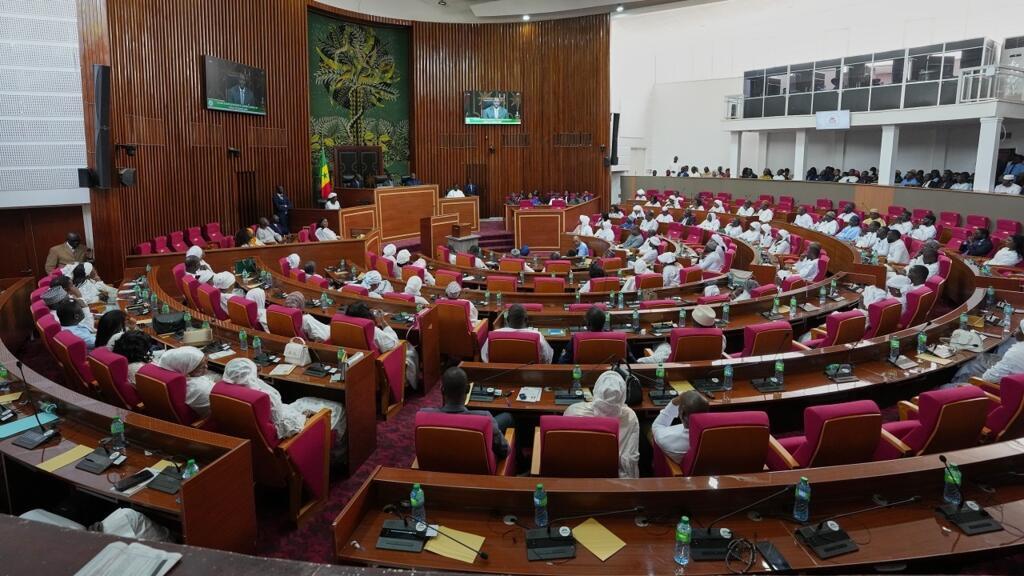
Assemblée Nationale Sénégal: Rejet de la Loi Finances Rectificative 2026
Summary
- Senegal's National Assembly rejected the government's 2026 rectifying finance law.
- The rejection, initiated by Pastef deputies, cited concerns over the budget's sincerity, an overestimated 7.6% GDP deficit, and unclear debt sustainability.
- Minister of Economy, Finance and Planning, Cheikh Diba, labeled the opposition's stance as a "pretext."
- This legislative decision threatens the final approval of a $2.2 billion loan from the International Monetary Fund.
- The government had stated the revised budget was necessary to settle debts with private companies and ensure fuel for power plants.
Legislative Rejection of Budget Proposal
This legislative action could jeopardize a substantial $2.2 billion loan from the International Monetary Fund, introducing significant fiscal uncertainty for the nation.
The National Assembly of Senegal recently rejected the government's proposed rectifying finance law for 2026, a move that sends the administration back to the drawing board to revise its fiscal plan. This significant legislative decision was made not through a debate on the merits of the budget itself, but rather by adopting a preliminary question, effectively halting further discussion. The vote on this preliminary question saw 109 deputies in favor of rejection, 20 against, and 3 abstentions, indicating a clear legislative stance against the government's initial proposal.
The preliminary question that led to the budget's rejection was put forward by Amadou Ba, a deputy representing the Pastef party. This procedural maneuver meant that the substance of the rectifying budget was not debated, but its passage was nevertheless blocked. The government now faces the task of amending its financial blueprint to address the concerns raised by the legislative body.
Opposition's Concerns and Government's Response
Deputies from the Pastef party were vocal in their opposition, casting doubt on the accuracy and reliability of the government's revenue and expenditure projections within the corrected budget. They specifically argued that the proposed financial framework lacked sincerity, a critical assessment of the government's fiscal transparency. A key point of contention for these legislators was the projected budget deficit, which was set at 7.6% of the Gross Domestic Product; Pastef members contended this figure was an overestimation.
Furthermore, the opposition highlighted a perceived lack of clarity regarding the sustainability of the nation's debt, expressing concerns that the budget did not adequately address this crucial financial aspect. In response to Pastef's position, Cheikh Diba, the Minister of Economy, Finance and Planning, dismissed their arguments, characterizing them as mere pretexts rather than substantive criticisms.
Fiscal Implications and International Aid
The rejection of the rectifying budget carries substantial implications, most notably for Senegal's access to international financial support. Reports indicate that this legislative setback could jeopardize the final approval of a significant $2.2 billion loan from the International Monetary Fund (FMI). This legislative action could jeopardize a substantial $2.2 billion loan from the International Monetary Fund, introducing significant fiscal uncertainty for the nation.
The Senegalese government had articulated a clear need for the revised budget, stating it was essential for several critical purposes. These included settling outstanding debts owed to various private companies and electricity suppliers, which are vital for the nation's economic functioning. Additionally, the budget was intended to ensure the continued supply of fuel to power plants, a fundamental requirement for maintaining stable electricity provision across the country. The inability to pass this budget could therefore have cascading effects on both public and private sectors, impacting operational stability and financial commitments.
Practical Implications
The rejection of Senegal's rectifying budget for 2026, and the potential loss of the associated IMF loan, signals significant fiscal uncertainty. Lawyers advising clients with government contracts, public sector dependencies, or investments in Senegal should assess potential impacts on payment schedules, project viability, and overall economic stability, which could necessitate contract renegotiations or re-evaluation of investment risks.
Source
How does this affect you?
Get an AI analysis of this article grounded in your jurisdictions, practice areas, and any policy documents you've uploaded to Wansom.
Wansom is AI and can make mistakes.