
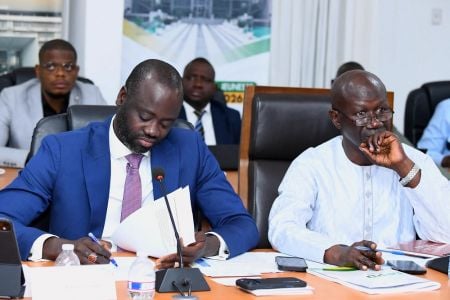
Sénégal: Budget 2027 Rejeté Par la Commission des Finances
Summary
- The parliamentary commission rejected the 2027 budget for the Ministry of Economy, the state's common charges, and the initial finance bill project.
- Deputies cited missing documents, contradictions in budget materials, and contested the 2027 framework which relied on a previously rejected rectifying finance law.
- The Ministry of Economy's proposed budget amounted to 1,170 billion FCFA in commitment authorizations and 1,119 billion FCFA in payment credits.
- This rejection follows the November 3, 2026, rejection of the 2026 rectifying finance law, which was voted down by 109 votes.
- The Finance Commission President had requested the government withdraw the 2027 budget and revise it based on the 2026 initial finance law, a request the Ministry disputed.
Legislative Setback for 2027 Budget
The rejection of the Bassirou Sarr budget 2027, along with the associated charges communes rejetées Sénégal and the loi de finances initiale 2027 Sénégal, introduces considerable uncertainty into the nation's financial planning.
The proposed budget for the Ministry of Economy for the year 2027, alongside the state's common charges, encountered a significant hurdle as it was rejected by the relevant parliamentary commission. This decision also encompassed the broader initial finance bill project for 2027, signaling a major legislative disagreement over the nation's financial blueprint. The rejection followed a thorough review where deputies raised concerns regarding the foundational documents and the underlying assumptions used to formulate the financial projections.
During the commission's deliberations, parliamentarians specifically highlighted that essential documents required for a comprehensive examination were not provided. Furthermore, they pointed out inconsistencies and contradictions evident within the submitted budgetary materials. The framework established for the 2027 budget was also challenged, primarily because its projections were based on a rectifying finance law that had previously been rejected. Bassirou Sarr, the Minister in charge of the Budget, had presented his department's budget, which proposed 1,170 billion FCFA in commitment authorizations and 1,119 billion FCFA in payment credits. The state's common charges were estimated at 913.97 billion FCFA for commitment authorizations and 289.29 billion FCFA for payment credits.
Context of Prior Rejection
This recent rejection of the Sénégal budget 2027 by the commission is not an isolated incident but rather follows a precedent set by the earlier rejection of the 2026 rectifying finance law. That previous legislative measure was decisively voted down on November 3, 2026, with 109 votes against, 20 votes in favor, and 3 abstentions, underscoring a pattern of parliamentary scrutiny and dissent regarding governmental financial proposals.
In the wake of the 2026 rectifying law's rejection, the President of the Commission des Finances Sénégal had formally requested that the government withdraw the initial finance bill project for 2027. The President's directive was for the government to revise its forecasts, basing them instead on the initial finance law of 2026. However, the Ministère Économie budget Sénégal contested this demand, asserting that the rejection of a rectifying law did not provide sufficient justification for withdrawing the budget intended for the subsequent fiscal year.
Implications for National Financial Planning
The rejection of the Bassirou Sarr budget 2027, along with the associated charges communes rejetées Sénégal and the loi de finances initiale 2027 Sénégal, introduces considerable uncertainty into the nation's financial planning. This repeated legislative pushback on key budgetary documents suggests a significant disconnect between the executive and legislative branches regarding fiscal policy and transparency. The parliament's insistence on robust documentation and consistent financial projections highlights a demand for greater accountability and clarity in public spending.
This situation could lead to delays in the finalization of the national budget, potentially impacting government projects and economic stability. The ongoing disagreements, particularly concerning the foundational assumptions for future budgets, underscore the challenges in achieving consensus on critical financial legislation. The need for the government to revisit and revise its proposals based on parliamentary feedback will be crucial for moving forward.
Practical Implications
This rejection signals significant legislative instability regarding Senegal's national financial planning for 2027, following the prior rejection of the 2026 rectifying finance law. Lawyers advising clients on government contracts, public-private partnerships, or investments in Senegal should monitor these developments closely for potential delays in government projects, shifts in budgetary allocations, or increased uncertainty in the economic outlook, which could impact financial forecasts and project viability.
Source
How does this affect you?
Get an AI analysis of this article grounded in your jurisdictions, practice areas, and any policy documents you've uploaded to Wansom.
Finish Reading the Full Story and the Expert Analysis.
Get the latest legal & regulatory intelligence in Senegal
Wansom is AI and can make mistakes.