
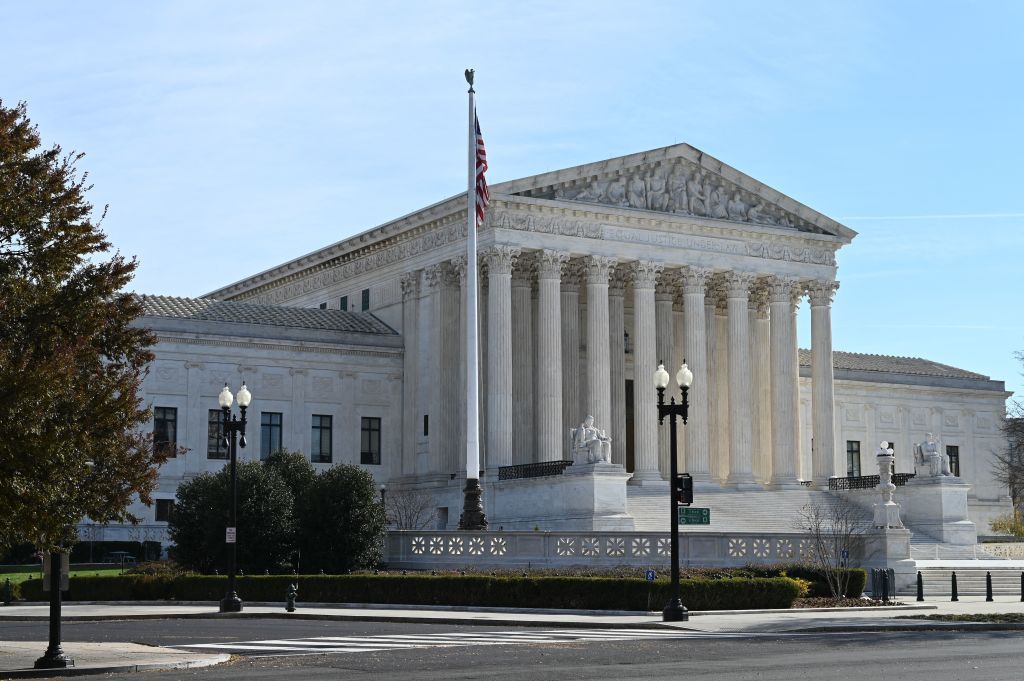
SCOTUSblog Supreme Court Case Forecasts: New Project Predicts Outcomes
Summary
- The Supreme Court's third oral argument session for the 2026-27 term begins on Monday, November 30, with cases like Crowther v. Board of Regents of the University System of Georgia and Wassily v. Blanche, while Viramontes v. Cook County, Jouppi v. Alaska, and Department of Homeland Security v. D.V.D. are scheduled for early December.
- SCOTUSblog, in partnership with Good Judgment Inc., runs a project allowing individuals to forecast case outcomes and compares these predictions to AI models.
- The three most accurate forecasters will be named on SCOTUSblog in July and receive merchandise.
- St. Mary Catholic Parish v. Roy, argued November 3, questions if the Universal Preschool Program faces strict scrutiny for free exercise claims, with 81.75% of forecasters predicting yes.
- Nielsen v. Watanabe, argued November 9, concerns whether the 9th Circuit erred in recognizing a Bivens cause of action, with 81.26% of forecasters predicting an error.
Upcoming Arguments and Key Cases
Lawyers should closely monitor these proceedings and the subsequent SCOTUSblog Supreme Court case forecasts to anticipate shifts in legal precedent, particularly regarding constitutional rights and federal liability, which will directly impact client advice and litigation strategies.
The Supreme Court is set to commence its third round of oral arguments for the 2026-27 term on Monday, November 30. This session will feature several high-profile cases that legal professionals will be closely watching, as their outcomes could significantly influence future legal interpretations and precedents. Among the cases scheduled for argument in early December are Jouppi v. Alaska on December 1, Viramontes v. Cook County on December 2, and Department of Homeland Security v. D.V.D. on December 9.
Of particular note, Viramontes v. Cook County is slated for liveblog coverage, indicating its perceived importance within the legal community. These arguments represent a critical juncture in the Supreme Court 2026-27 term cases, offering insights into the Court's current leanings and potential shifts in constitutional and statutory law. Lawyers should closely monitor these proceedings and the subsequent SCOTUSblog Supreme Court case forecasts to anticipate shifts in legal precedent, particularly regarding constitutional rights and federal liability, which will directly impact client advice and litigation strategies.
The Forecasting Initiative
In an innovative collaboration, SCOTUSblog and Good Judgment Inc. have launched a unique SCOTUSblog forecast project designed to engage both seasoned Supreme Court observers and the general public. This initiative provides a platform for individuals to predict the outcomes of the term's most significant cases, fostering a deeper understanding of the judicial process. A key aspect of this project involves comparing the collective wisdom of human forecasters against the predictions generated by advanced artificial intelligence models.
The project not only serves as an educational tool but also introduces a competitive element. In July, SCOTUSblog will publicly recognize the three most accurate forecasters, whose names will be featured on the platform. These top predictors will also be awarded exclusive merchandise, celebrating their analytical prowess. This ongoing comparison between human and machine predictions offers valuable insights into the complexities of judicial decision-making and the potential for predictive analytics in legal forecasting.
October Session Cases and Predictions
While attention now turns to the upcoming November arguments, two pivotal cases from the October session remain open for public forecasting until their respective decision days. One such case is St. Mary Catholic Parish v. Roy, which was argued before the Court on November 3. The central question in this dispute revolves around whether the Universal Preschool Program should be subjected to strict scrutiny when considering free exercise clause claims brought by parishes against the state. Current predictions from the forecasting project indicate a strong consensus, with 81.75% of participants anticipating an affirmative ruling, while 18.25% foresee a negative outcome.
Another significant case from the October session is Nielsen v. Watanabe, argued on November 9. This case addresses whether the U.S. Court of Appeals for the 9th Circuit made an error in recognizing Watanabe's cause of action under the precedent established in Bivens v. Six Unknown Named Agents of the Federal Bureau of Narcotics. The Bivens doctrine allows for private lawsuits against federal officials for constitutional violations. Forecasts for Nielsen v. Watanabe mirror the high agreement seen in St. Mary Catholic Parish v. Roy, with 81.26% of forecasters predicting that the Supreme Court will find the 9th Circuit erred, and 18.74% expecting the Court to uphold the lower court's recognition of the cause of action. These SCOTUSblog Supreme Court case forecasts provide a preliminary gauge of expert opinion on these complex legal issues.
Practical Implications
Lawyers should closely monitor these Supreme Court case forecasts and eventual rulings to anticipate shifts in legal precedent, particularly regarding constitutional rights and federal liability, which will directly impact client advice and litigation strategies.
Source
How does this affect you?
Get an AI analysis of this article grounded in your jurisdictions, practice areas, and any policy documents you've uploaded to Wansom.
Finish Reading the Full Story and the Expert Analysis.
Get the latest legal & regulatory intelligence in United States
Wansom is AI and can make mistakes.