
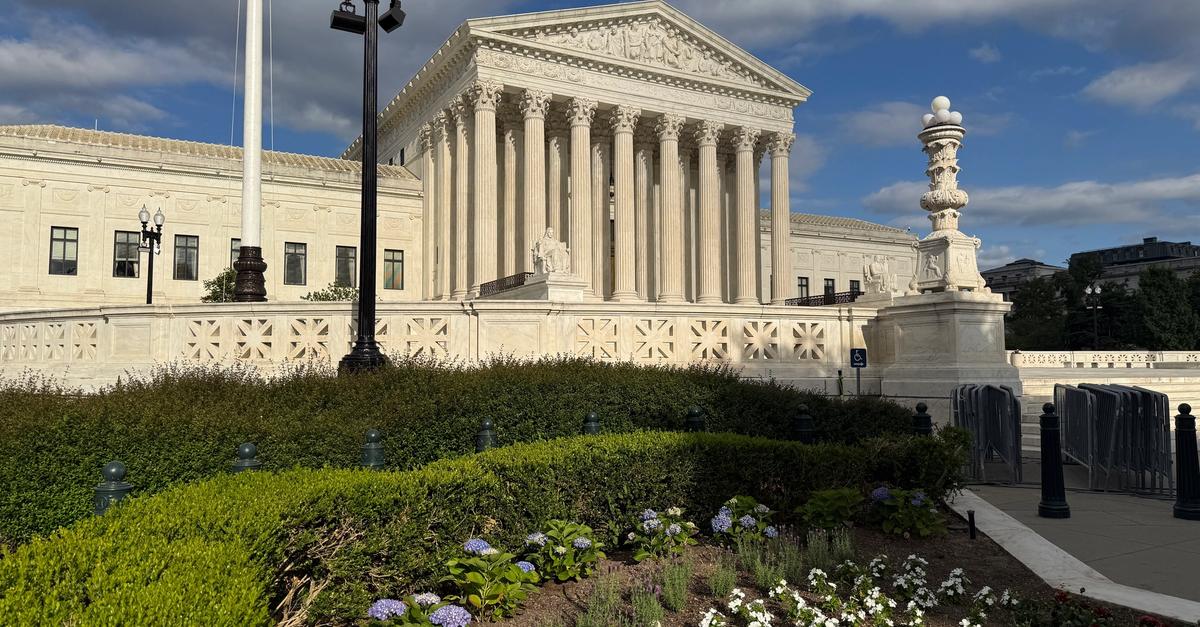
SCOTUS: Pauses Missouri Congressional Map Ahead of Elections
Summary
- The Supreme Court paused a federal judge's ruling that would have allowed Missouri to use a new congressional map (HB 1) expected to aid Republicans.
- The Court's brief, unsigned order granted a request from referendum organizers challenging the map.
- This decision means Missouri will likely use its 2022 congressional map for the upcoming November elections.
- The new map, encouraged by President Trump, faced a petition drive with over 300,000 signatures, which was ultimately rejected by Secretary of State Denny Hoskins.
- Justice Kavanaugh had previously declined to overturn a Missouri Supreme Court ruling that had barred the use of the new map.
Supreme Court Halts Missouri Map
The U.S. Supreme Court has intervened in Missouri's electoral landscape, issuing an order on Thursday morning that temporarily prevents the state from implementing a new congressional map.
The U.S. Supreme Court has intervened in Missouri's electoral landscape, issuing an order on Thursday morning that temporarily prevents the state from implementing a new congressional map. This decision effectively pauses a federal judge's ruling that would have allowed the use of the map, which was widely anticipated to benefit Republicans by securing an additional seat in the U.S. House of Representatives for the upcoming elections. The high court's action came in response to a request from organizers behind a referendum effort against the new map, ensuring that litigation surrounding the dispute can proceed without the map being put into immediate effect.
The brief, unsigned order from the justices notably included no public dissents, signaling a unified front on the procedural pause. This intervention carries significant weight given the proximity of election deadlines; the cutoff for dispatching ballots to military and overseas voters was just nine days away. Consequently, the Supreme Court's directive means Missouri is now expected to utilize the congressional map adopted in 2022 for the November general elections, a different configuration than the one used for the state's primary election held on August 4.
Background of the Redistricting Dispute
The contentious redistricting process began last year when Missouri adopted the new map, officially known as HB 1, a move reportedly encouraged by then-President Donald Trump. This legislative effort aimed to redraw district lines in a manner that would enhance Republican representation in Congress. However, the map immediately faced opposition from various groups.
Among the opponents was Richard von Glahn, who, along with others, spearheaded a petition drive to challenge the HB 1 congressional map. They successfully gathered over 300,000 signatures, exceeding the threshold required to place the new map before voters in a referendum scheduled for November 2026. Despite this significant public effort, Missouri's top election official, Secretary of State Denny Hoskins, ultimately rejected the petition on August 4, 2026, which was the final day permitted for such a decision.
Prior Judicial Interventions
Before reaching the Supreme Court's emergency docket, the Missouri HB 1 congressional map had been the subject of several lower court rulings. Chief U.S. District Judge Stephen Clark had issued a ruling that would have permitted the state to use the new map, a decision that the Supreme Court's recent order has now put on hold. This federal court action was part of a broader legal battle over the state's electoral boundaries.
Adding another layer to the complex legal landscape, Justice Brett Kavanaugh, who is responsible for handling emergency appeals originating from Missouri, had previously declined to disturb a separate ruling by the Missouri Supreme Court. That state high court decision had explicitly barred Missouri from using the new map, setting up a direct conflict with the federal judge's subsequent ruling and highlighting the intricate judicial path this redistricting challenge Missouri has navigated.
Implications for Future Elections
The Supreme Court's decision to pause the Missouri election map injunction underscores its active role in state-level redistricting disputes, particularly when appeals arise close to critical election deadlines. This ruling ensures that the state will proceed with a previously established map for the upcoming general election, thereby avoiding potential confusion and disruption that could have resulted from implementing a new, contested map at the eleventh hour.
The immediate impact is that the 2022 map will govern the November elections, a different outcome than if the HB 1 map had been allowed to proceed. This development in the SCOTUS redistricting challenge Missouri highlights the judiciary's power to shape electoral outcomes and provides a significant data point for legal practitioners observing the Supreme Court's engagement with gerrymandering lawsuits and emergency appeals.
Practical Implications
This ruling underscores the Supreme Court's active role in state-level redistricting disputes, particularly regarding emergency appeals close to election deadlines. Lawyers advising on election law or constitutional challenges should note the Court's willingness to pause state-approved maps, impacting electoral outcomes and potentially setting precedent for future gerrymandering cases.
Source
How does this affect you?
Get an AI analysis of this article grounded in your jurisdictions, practice areas, and any policy documents you've uploaded to Wansom.
Finish Reading the Full Story and the Expert Analysis.
Get the latest legal & regulatory intelligence in United States
Wansom is AI and can make mistakes.