
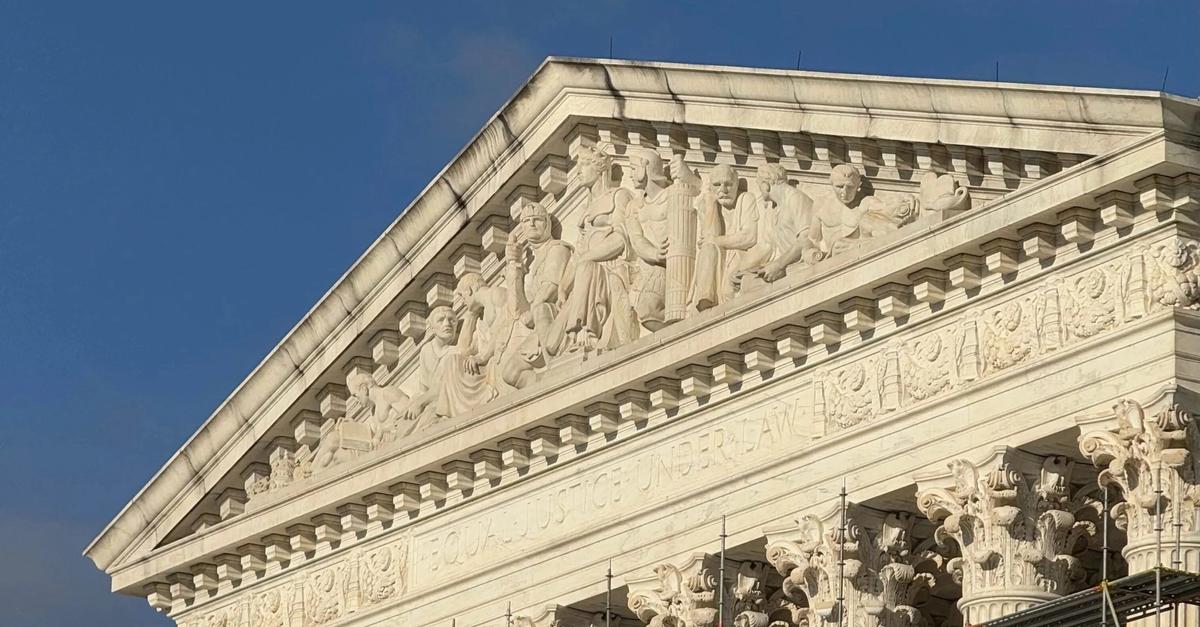
SCOTUS: Trump Seeks Halt to Mail-In Voting Rule on Interim Docket
Summary
- The Trump administration has asked the Supreme Court to temporarily pause an order blocking parts of a U.S. Postal Service rule on mail-in ballots.
- Justice Brett Kavanaugh denied a Michigan group's request to put a proof-of-citizenship voting proposal on the November ballot, without explanation or full court referral.
- The Supreme Court's `Trump v. Slaughter` ruling, which expanded presidential firing power over independent agencies, led a former official to drop his lawsuit challenging his removal.
- The IRS and Treasury Department announced plans to revoke tax-exempt status for private schools that discriminate based on race, citing a 2023 Supreme Court ruling.
- The Supreme Court is scheduled to release its third and final summer order list today at 9:30 a.m. EDT.
Urgent Election Appeals Reach High Court's Interim Docket
Justice Kavanaugh's decision was rendered without referring the appeal to the full court, and he offered no explanation for his ruling.
The Supreme Court's interim docket has recently seen a flurry of activity, including a significant request from the Trump administration concerning mail-in voting. On Thursday, the administration formally asked the nation's highest court to temporarily halt an existing order that prevents the government from implementing specific provisions of a U.S. Postal Service rule pertaining to mail-in ballots. This move represents a new addition to the court's expedited review process for urgent matters.
Simultaneously, another election-related dispute landed on the interim docket. Two Republican organizations petitioned the Supreme Court to overturn a decision by the U.S. Court of Appeals for the 4th Circuit. That lower court ruling prohibits political parties and joint fundraising committees from securing preferential broadcast advertising rates for political ads. In response, Democratic candidates, who had initially challenged the groups' access to these lower rates, urged the Supreme Court on Thursday to uphold the 4th Circuit's original judgment.
Michigan Voting Rights Dispute Denied by Justice Kavanaugh
In a separate interim docket dispute, a Michigan-based advocacy group sought Supreme Court intervention to compel Michigan election officials to include its proposal on the upcoming November ballot. The group's initiative aimed to mandate proof of citizenship for voting in the state. However, Justice Brett Kavanaugh denied this request on Thursday.
Justice Kavanaugh's decision was rendered without referring the appeal to the full court, and he offered no explanation for his ruling. The group, Americans for Citizen Voting, had filed its emergency appeal with the Supreme Court just days before Michigan ballots were scheduled to be finalized on Friday. The Michigan Board of State Canvassers had previously invalidated the proposal after determining it lacked a sufficient number of valid signatures to qualify for the ballot.
Shifting Precedent and Agency Independence
Beyond the interim docket, recent Supreme Court decisions continue to reshape the landscape of federal power. In June, the high court expanded presidential firing authority through its ruling in `Trump v. Slaughter`. This landmark decision affirmed that the president possesses broad discretion over approximately two dozen multi-member agencies, even those Congress had intended to operate independently.
This expanded authority has had immediate repercussions. On Wednesday, Moshe Marvit announced he was withdrawing his lawsuit challenging President Donald Trump's attempt to remove him from the Federal Mine Safety and Health Review Commission. Marvit cited the `Trump v. Slaughter` decision, acknowledging that while he disagrees with the high court's conclusion, it effectively means the agency is no longer independent. His case marks him as one of a growing number of former independent agency leaders who have abandoned their legal challenges following the Supreme Court's reversal of 91 years of precedent that had previously provided them with firing protections.
Federal Agencies Target Race-Conscious Policies
In a significant policy development, the Internal Revenue Service (IRS) and the Treasury Department jointly announced plans on Thursday to revoke the tax-exempt status of any private school found to discriminate based on race, color, or national or ethnic origin across its educational, admissions, scholarship, athletic, or other institutional policies. This initiative represents an escalation of the Trump administration's prior efforts to prohibit schools from considering race in admissions and other aspects of campus life.
The administration contends that such considerations violate the law, particularly in light of a 2023 Supreme Court ruling that banned race-conscious admissions practices. The proposed policy is subject to an extensive public-comment period and would not take effect until May 2027 at the earliest. Meanwhile, the court is also set to release its third and final summer order list today at 9:30 a.m. EDT.
Source
How does this affect you?
Get an AI analysis of this article grounded in your jurisdictions, practice areas, and any policy documents you've uploaded to Wansom.
Finish Reading the Full Story and the Expert Analysis.
Wansom is AI and can make mistakes.