
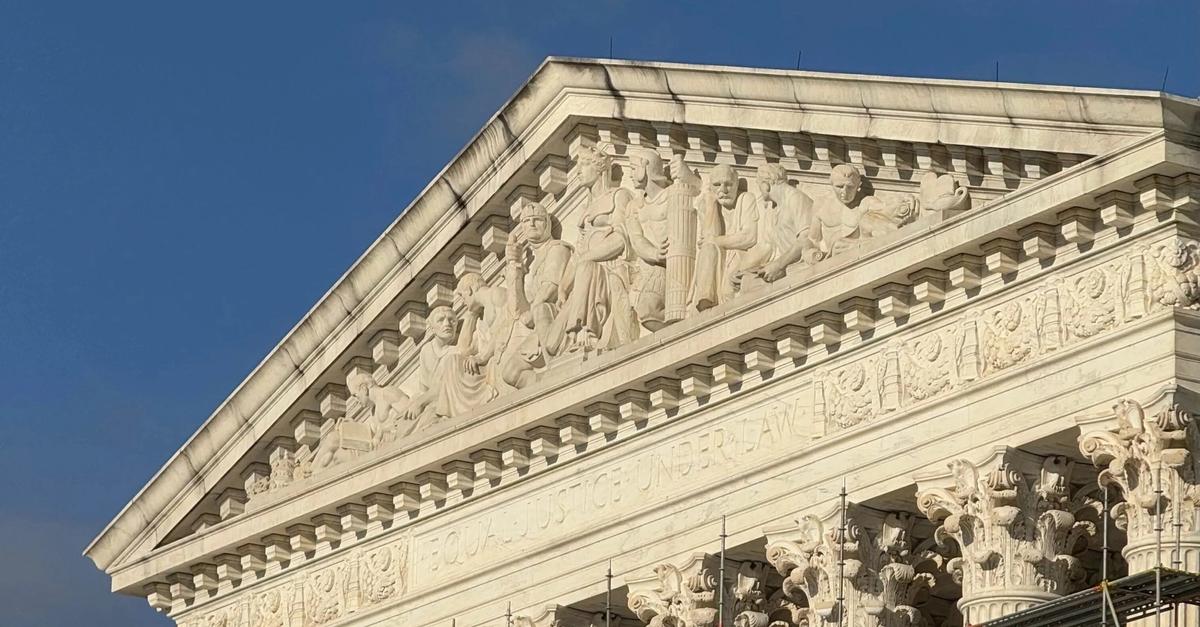
SCOTUS: Authorizes Trump Administration's Big Bend Border Wall Construction
Summary
- The Supreme Court permitted the Trump administration to resume border wall construction in the Big Bend region of southwestern Texas.
- Justice Ketanji Brown Jackson dissented from the border wall decision without providing an explanation.
- The Court heard oral arguments in *Nielsen v. Watanabe* regarding federal official liability and *Hoffmann v. WBI Energy Transmission, Inc.* concerning 'just compensation' for land acquisition.
- Over 200 cases were denied review, and the U.S. solicitor general was asked for input on a terrorism victims' lawsuit.
- An upcoming case, *Department of Labor v. Sun Valley Orchards, LLC*, will address the executive branch's role in adjudicating employment agreements for temporary immigrant workers.
Court Permits Border Wall Construction
The Supreme Court recently concluded a busy Monday by authorizing the Trump administration to proceed with its border wall construction efforts in the Big Bend region of southwestern Texas.
The Supreme Court recently concluded a busy Monday by authorizing the Trump administration to proceed with its border wall construction efforts in the Big Bend region of southwestern Texas. This decision, issued as part of the Court's interim docket, marks a significant development for the federal infrastructure project and the ongoing debate surrounding border security. The ruling specifically granted the administration's request to resume building activities in this sensitive area, which has been a focal point of contention due to its unique ecological and geographical characteristics.
Justice Ketanji Brown Jackson registered her disagreement with the majority's decision, indicating her preference to deny the request. Her dissent, offered without a public explanation, highlights the division within the Court on this matter and the complex legal and policy considerations at play regarding the Supreme Court border wall Texas project.
A Day of Diverse Legal Proceedings
Beyond the border wall ruling, the Supreme Court's Monday schedule was packed with a variety of other legal matters. The justices heard oral arguments in two distinct cases, delving into complex questions of federal liability and property rights. One case, *Nielsen v. Watanabe*, explored the circumstances under which federal officials can be held accountable for constitutional violations, a critical area of law concerning government power and individual protections.
Simultaneously, the Court considered *Hoffmann v. WBI Energy Transmission, Inc.*, which centered on the appropriate standard for determining 'just compensation' for landowners whose property is acquired for pipeline projects. This case specifically questioned whether state law, which often mandates higher payments, or the constitutional minimum should govern such compensation. The Court also issued an order list that day, denying review in more than 200 cases, including high-profile disputes related to the George Floyd protests in Minneapolis, actor Randy Quaid, and the sons of former baseball player Roberto Clemente. Furthermore, the Court requested the United States solicitor general to provide the government's perspective on a case involving U.S. terrorism victims seeking to sue 21 pharmaceutical and medical-device companies under the Antiterrorism Act for allegedly aiding Iraqi terrorists.
Implications for Federal Projects and Future Rulings
The Supreme Court's decision to allow the resumption of SCOTUS border wall Big Bend construction carries substantial implications for federal infrastructure projects, particularly those involving land acquisition and environmental considerations in the Texas region. This ruling underscores the ongoing legal complexities surrounding such large-scale government undertakings and the balance between national security objectives and local impacts, which often involve eminent domain proceedings and environmental assessments. Lawyers advising clients on federal infrastructure projects, especially those in the Big Bend area, should take note of this development as it signals the Court's stance on the continuation of these projects.
Looking ahead, the Court's calendar includes another significant oral argument in *Department of Labor v. Sun Valley Orchards, LLC*, scheduled for the following day. This case will examine whether the Constitution permits the executive branch, rather than the judiciary, to adjudicate an employer's compliance with employment agreements for temporary immigrant workers, further illustrating the Court's engagement with the separation of powers. The Supreme Court Building was also slated for closure on Wednesday in observance of Veterans Day, reflecting the broader context of the Court's operations and national holidays.
Practical Implications
Lawyers advising clients on federal infrastructure projects, particularly those involving land acquisition or environmental concerns in the Big Bend region of Texas, should note the Supreme Court's decision allowing border wall construction to resume. Additionally, practitioners in constitutional law and eminent domain should monitor the outcomes of *Nielsen v. Watanabe* and *Hoffmann v. WBI Energy Transmission* for potential precedent-setting rulings on federal official liability and 'just compensation' standards.
Source
How does this affect you?
Get an AI analysis of this article grounded in your jurisdictions, practice areas, and any policy documents you've uploaded to Wansom.
Finish Reading the Full Story and the Expert Analysis.
Get the latest legal & regulatory intelligence in United States
Wansom is AI and can make mistakes.