
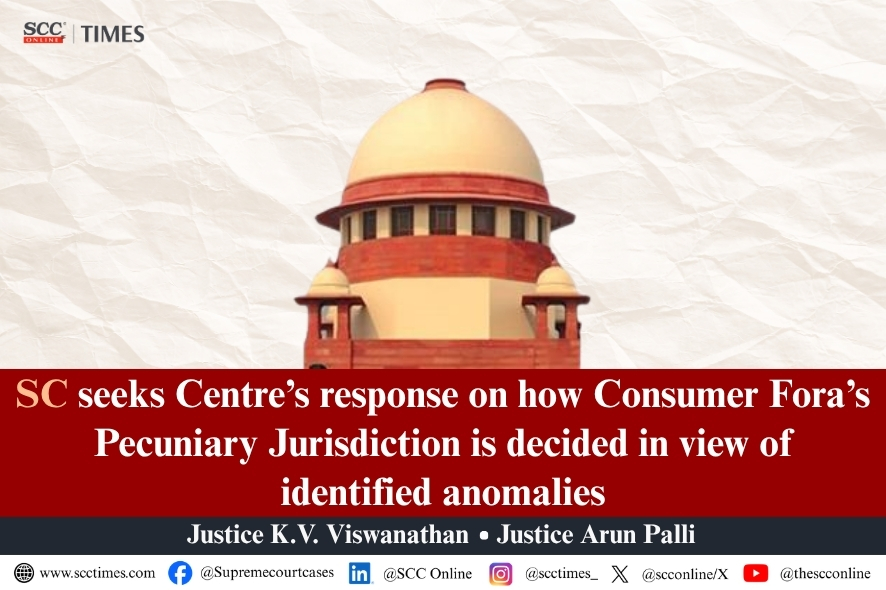
SC Seeks Centre: Clarify Consumer Forum Pecuniary Jurisdiction Basis
Summary
- The Supreme Court has requested the Central Government to clarify the process for determining the pecuniary jurisdiction of Consumer Fora.
- This directive was issued due to identified anomalies in the current system of setting financial limits for consumer courts.
- The apex court acknowledged that establishing the basis for pecuniary jurisdiction falls within the purview of the legislative body.
Supreme Court's Directive
The Supreme Court's inquiry signals a commitment to refining the mechanisms of consumer justice, ensuring that the system remains robust, accessible, and fair for all stakeholders.
The Supreme Court of India has recently directed the Central Government to provide clarity on the methodology used to determine the pecuniary jurisdiction of various Consumer Fora across the nation. This significant intervention by the apex court comes in response to identified inconsistencies and irregularities in how these financial limits are currently established for consumer dispute resolution bodies. The Court's inquiry underscores a recognition of potential issues impacting the accessibility and efficiency of consumer justice.
In its directive, the Supreme Court explicitly acknowledged that the fundamental authority to establish the basis for pecuniary jurisdiction rests squarely with the legislative branch. This acceptance highlights the Court's respect for the separation of powers, indicating that while it seeks clarification and resolution for existing anomalies, it views the ultimate solution as a matter for law-making bodies to address. The Centre's forthcoming response is therefore crucial for understanding the current framework and any potential future reforms.
Understanding Pecuniary Jurisdiction and its Anomalies
Pecuniary jurisdiction refers to the financial limit up to which a particular court or forum is competent to entertain a case. In the context of consumer protection in India, this determines which level of Consumer Forum – District, State, or National – a consumer must approach based on the value of the goods or services in dispute, or the compensation claimed. The Supreme Court's concern over "identified anomalies" in this determination suggests that there may be ambiguities, overlaps, or inconsistencies in the existing framework, potentially leading to confusion for consumers and legal practitioners alike.
Such anomalies could manifest in various ways, including unclear valuation methods for claims, differing interpretations of pecuniary limits across states, or situations where the financial thresholds do not align with the economic realities of consumer disputes. Effective and clear determination of pecuniary jurisdiction for consumer courts is vital for ensuring that consumer grievances are addressed efficiently and without undue procedural hurdles. When these limits are unclear or inconsistent, it can lead to cases being filed in the wrong forum, resulting in delays, increased costs, and ultimately, a denial of timely justice for consumers. The Supreme Court's call for the Centre's response aims to address these systemic issues, which fall under the broader umbrella of Consumer forum jurisdiction anomalies in India.
Implications for Consumer Justice
The Supreme Court's proactive stance in seeking the Centre's response on the India Supreme Court consumer jurisdiction issue carries significant implications for the landscape of consumer protection law. A clear and consistent framework for pecuniary jurisdiction is fundamental to the effective functioning of the Consumer Protection Act. Ambiguities can lead to forum shopping, jurisdictional challenges, and prolonged litigation, undermining the very purpose of these specialized tribunals, which are designed for speedy and inexpensive redressal.
The Central Government's response regarding consumer law will be closely watched, as it could pave the way for legislative amendments or comprehensive guidelines to standardize the determination of pecuniary limits. Such clarification would not only benefit consumers by simplifying the process of filing complaints but also provide much-needed certainty for businesses and legal professionals navigating consumer disputes. Ultimately, the Supreme Court's inquiry signals a commitment to refining the mechanisms of consumer justice, ensuring that the system remains robust, accessible, and fair for all stakeholders. The outcome of this dialogue between the judiciary and the executive could significantly reshape how consumer disputes are handled nationwide.
Practical Implications
The Supreme Court's inquiry into the determination of pecuniary jurisdiction for Consumer Fora, prompted by identified anomalies, signals potential future legislative or judicial clarification. Lawyers and compliance officers should closely monitor the Centre's response and any subsequent Supreme Court directives, as these could significantly impact case filing strategies, forum selection, and the overall handling of consumer disputes in India.
Source
Source: Original reporting via SCC Times
How does this affect you?
Get an AI analysis of this article grounded in your jurisdictions, practice areas, and any policy documents you've uploaded to Wansom.
Wansom is AI and can make mistakes.