
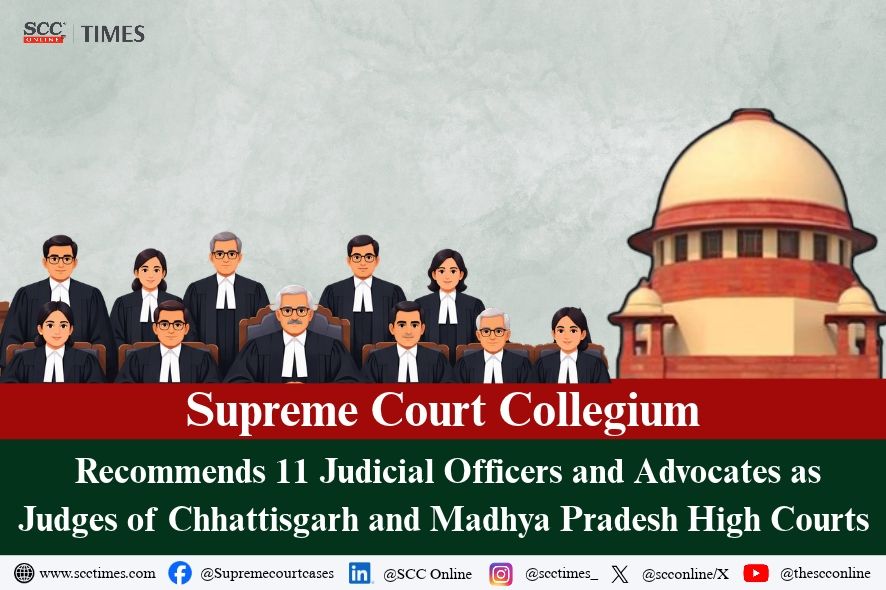
SC Collegium Approves 11 Chhattisgarh, Madhya Pradesh Judges
Summary
- The Supreme Court Collegium has recommended 11 individuals for appointment as judges to the Chhattisgarh and Madhya Pradesh High Courts.
- Six names were proposed for the Chhattisgarh High Court, while five were recommended for the Madhya Pradesh High Court.
- As of October 6, 2026, the Chhattisgarh High Court had 9 vacancies and the Madhya Pradesh High Court had 15 vacancies.
- These recommendations aim to address existing judicial vacancies and strengthen the judicial capacity of both High Courts.
- The appointments are crucial for enhancing the efficiency of judicial functioning and the administration of justice in India.
Key Judicial Appointments Recommended
The proposed eleven appointments, while not fully eliminating all existing vacancies, represent a substantial move towards alleviating the judicial workload and strengthening the bench in these High Courts.
The Supreme Court Collegium, in its meeting held on October 30, 2026, approved the proposal for the appointment of eleven individuals as judges to the High Courts of Chhattisgarh and Madhya Pradesh, marking a significant step in addressing judicial vacancies in these crucial state judiciaries. These recommendations encompass both judicial officers and advocates, reflecting the diverse pool from which India's judiciary draws its talent. The Collegium's decision aims to bolster the judicial strength in two key regions.
Specifically, the recommendations include six names designated for the Chhattisgarh High Court. Concurrently, five candidates have been proposed for appointment as judges to the Madhya Pradesh High Court. This collective effort by the SC Collegium to recommend judges for these High Courts underscores the ongoing process of judicial appointments in India, ensuring the continuous functioning and capacity of the higher judiciary.
Addressing High Court Vacancies
These recommendations by the SC Collegium for Chhattisgarh and Madhya Pradesh judges come at a time when both High Courts face a notable number of vacant positions. As of October 6, 2026, the Chhattisgarh High Court was operating with nine unfilled judicial posts, indicating a clear need for new appointments to maintain its operational efficiency. Similarly, the Madhya Pradesh High Court reported an even larger deficit, with fifteen judicial vacancies recorded on the same date.
The proposed eleven appointments, while not fully eliminating all existing vacancies, represent a substantial move towards alleviating the judicial workload and strengthening the bench in these High Courts. The Supreme Court Collegium recommendations are vital for ensuring that the judicial system can effectively handle its caseload and provide timely justice to citizens. Filling these positions is a critical component of maintaining judicial integrity and accessibility across the nation.
The Role of the SC Collegium
The Supreme Court Collegium plays a pivotal role in the system of judicial appointments in India, particularly for the higher judiciary, including High Court judges. This body, comprising the Chief Justice of India and the four senior-most Supreme Court judges, is responsible for initiating and finalizing recommendations for appointments and transfers of judges. Its recommendations for the Chhattisgarh High Court appointments and Madhya Pradesh High Court appointments are a crucial stage in the process, preceding the formal notification by the President of India.
The Collegium's deliberations consider various factors, including merit, experience, and regional representation, to ensure that suitable candidates are chosen for these esteemed positions. The current set of recommendations for the SC Collegium Chhattisgarh Madhya Pradesh judges highlights its ongoing function in ensuring that High Courts are adequately staffed with qualified legal professionals, thereby upholding the constitutional mandate of an independent and robust judiciary. This mechanism is central to the framework of judicial governance in the country.
Implications for Judicial Functioning
The successful appointment of these eleven judicial officers and advocates as judges will have significant implications for the functioning of both the Chhattisgarh and Madhya Pradesh High Courts. A reduction in judicial vacancies typically leads to an improved judge-to-case ratio, which can, in turn, contribute to a more efficient disposal of cases and a potential decrease in the accumulation of backlogs. This enhancement in judicial capacity is essential for upholding the rule of law and ensuring public confidence in the justice delivery system.
While these specific recommendations do not present direct, actionable legal or compliance implications for legal professionals or compliance officers, they are fundamental to the operational health of the judiciary. The consistent process of judicial appointments in India, driven by Supreme Court Collegium recommendations, is a continuous effort to ensure that the High Courts can meet the demands placed upon them, thereby impacting the broader legal landscape and the administration of justice for all citizens.
Practical Implications
This news concerns the composition of the Chhattisgarh and Madhya Pradesh High Courts. While crucial for the functioning of the judiciary and potentially impacting case backlogs, it does not present a direct, actionable legal or compliance implication for lawyers or compliance officers.
Source
How does this affect you?
Get an AI analysis of this article grounded in your jurisdictions, practice areas, and any policy documents you've uploaded to Wansom.
Finish Reading the Full Story and the Expert Analysis.
Wansom is AI and can make mistakes.