
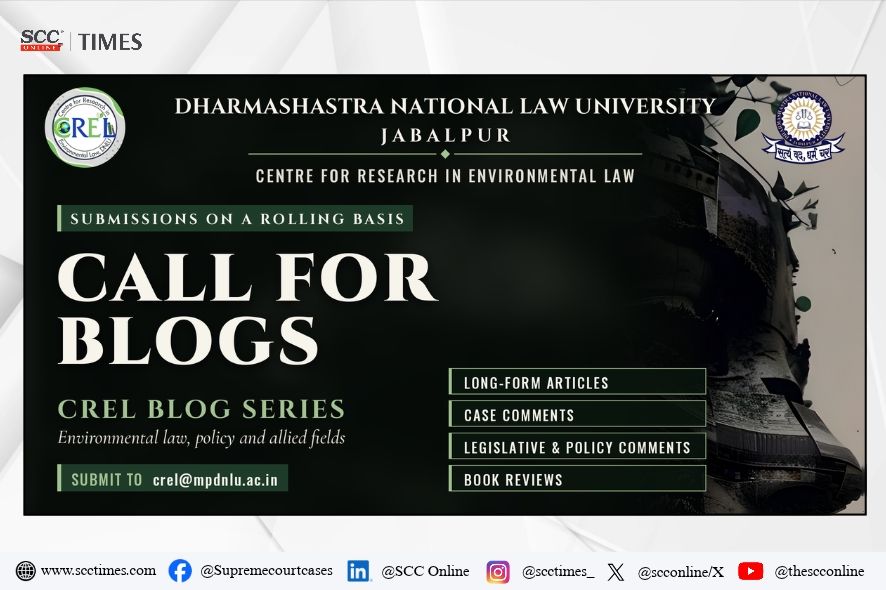
DNLU Jabalpur CREL Blog Submissions: Call for Environmental Law Papers
Summary
- The Centre for Research in Environmental Law (CREL) at DNLU Jabalpur is seeking submissions for its blog series.
- The blog focuses on contemporary issues in environmental law, policy, and allied fields.
- Submissions should be between 800 and 1,500 words in length.
- Students, academicians, legal practitioners, researchers, and policymakers are all eligible to contribute.
- Articles are accepted on a continuous, rolling basis.
What Happened
Lawyers specializing in environmental law or policy can leverage this opportunity to publish their insights, contribute significantly to academic discourse, and substantially enhance their professional profile by submitting articles to the CREL blog series.
The Centre for Research in Environmental Law (CREL), an integral and active component of Dharmashastra National Law University (DNLU) Jabalpur, has issued an ongoing invitation for contributions to its specialized blog series. This significant initiative aims to gather and disseminate diverse perspectives on current developments within environmental legal frameworks, policy discussions, and various related academic disciplines. The call for DNLU Jabalpur CREL blog submissions underscores a continuous commitment to fostering intellectual dialogue and broadly sharing knowledge in this increasingly critical and evolving area of law.
Scope of Contributions
The CREL blog series is specifically interested in articles that delve into contemporary challenges and advancements across environmental law, policy, and their interconnected fields. Prospective authors are encouraged to explore a wide array of subjects, ranging from legislative analysis and judicial interpretations to policy implications and emerging environmental concerns. Each submission is expected to be substantial, with a word count falling between 800 and 1,500 words, allowing for in-depth analysis and well-reasoned arguments on pertinent topics.
Who Can Participate
This open call for environmental law blog call for papers is designed to attract a broad spectrum of contributors from various professional and academic backgrounds. The Centre for Research in Environmental Law welcomes insights from students currently pursuing legal studies, established academicians, active legal practitioners, dedicated researchers, and influential policymakers. The flexible, rolling basis for submissions ensures that interested parties can contribute their work at any time, facilitating a dynamic and continuously updated platform for environmental discourse.
Significance for the Field
The establishment of this accessible platform by Dharmashastra National Law University Jabalpur carries considerable importance for the advancement of environmental legal scholarship and practical application. Lawyers specializing in environmental law or policy can leverage this opportunity to publish their insights, contribute significantly to academic discourse, and substantially enhance their professional profile by submitting articles to the CREL blog series. This initiative not only provides a valuable and accessible outlet for sharing expert opinions and cutting-edge research findings but also profoundly enriches the broader public and professional understanding of complex environmental issues. Such contributions have the potential to inform and influence future policy directions, legislative reforms, and judicial interpretations, thereby playing a crucial role in shaping environmental governance. The CREL blog series thus serves as a vital forum for engaging with pressing environmental concerns, offering a dedicated space for critical analysis, innovative solutions, and interdisciplinary dialogue from a diverse group of stakeholders.
Practical Implications
Lawyers specializing in environmental law or policy can leverage this opportunity to publish their insights, contribute to academic discourse, and enhance their professional profile by submitting articles to the CREL blog series.
Source
Source: Original reporting via SCC Times
How does this affect you?
Get an AI analysis of this article grounded in your jurisdictions, practice areas, and any policy documents you've uploaded to Wansom.
Finish Reading the Full Story and the Expert Analysis.
Wansom is AI and can make mistakes.