
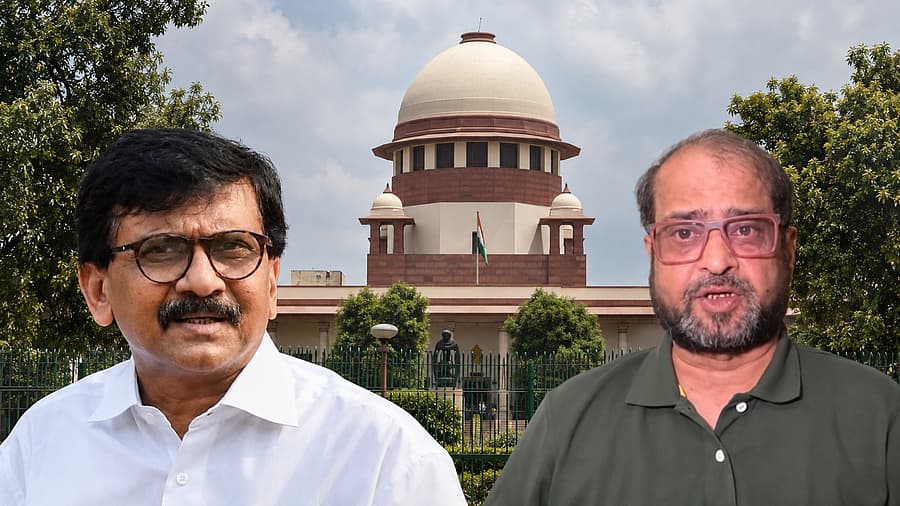
SC: Sanjay Raut, Nikhil Wagle Contempt Over CJI Surya Kant Remarks
Summary
- The Supreme Court has ordered Shiv Sena (UBT) MP Sanjay Raut to appear physically on November 17 in a criminal contempt case.
- Journalist Nikhil Wagle, also implicated in the case, will appear virtually after submitting an unconditional apology.
- The case, SCBA v. Nikhil Wagle & Anr., concerns public statements made against CJI Surya Kant and the higher judiciary.
- The Supreme Court Bar Association initiated the contempt petition with consent from Attorney General R Venkataramani under Section 15(1)(b) of the Contempt of Courts Act, 1971.
- A previous bench, including CJI Kant, had issued show-cause notices, noting the unfortunate nature of attacks on the judiciary by those who often seek its protection.
Supreme Court Directs Appearances in Contempt Case
This stance underscores the Supreme Court's readiness to initiate proceedings under the Contempt of Courts Act, 1971, even against those who frequently seek judicial relief.
The Supreme Court of India has issued a directive for Shiv Sena (UBT) Rajya Sabha MP Sanjay Raut to appear physically before it on November 17. This order pertains to a criminal contempt case initiated against him for public statements made against Chief Justice of India (CJI) Surya Kant and the broader higher judiciary. The case, formally known as SCBA v. Nikhil Wagle & Anr., underscores the serious view the apex court takes on remarks that could undermine judicial authority.
In the same proceedings, journalist Nikhil Wagle has been instructed to attend the upcoming hearing virtually. This direction from a Bench comprising Justices Aravind Kumar and Vipul M Pancholi followed the court's acknowledgment of an unconditional apology submitted by Wagle. The Bench emphasized the gravity of the matter, stating that given the magnitude of the issue involved, Wagle's virtual presence was necessary, while Raut's physical appearance was explicitly mandated.
Legal Framework and Case Origin
The criminal contempt case against Raut and Wagle originated from a petition filed by the Supreme Court Bar Association (SCBA). This petition was brought forth after receiving the necessary consent from Attorney General for India R Venkataramani, a procedural requirement under Section 15(1)(b) of the Contempt of Courts Act, 1971. This legal provision empowers the Supreme Court to initiate proceedings for criminal contempt based on such a reference.
The allegations revolve around remarks deemed to constitute contempt of court, specifically targeting the Chief Justice of India and the integrity of the higher judiciary. Such cases highlight the judiciary's role in safeguarding its institutional dignity and ensuring the proper administration of justice, free from undue influence or disparagement.
Judicial Concerns Over Public Criticism
The matter had previously come before a different Supreme Court Bench on October 16, which included CJI Surya Kant himself and Justice Joymalya Bagchi. During that hearing, show-cause notices were issued to both Wagle and Raut, signaling the court's initial assessment of the seriousness of their alleged actions. The Bench, led by CJI Kant, expressed profound concern regarding attacks on the judicial institution.
Critically, the Chief Justice's Bench observed that such criticisms were particularly unfortunate when emanating from individuals who frequently approach the courts seeking relief. The court noted that when personal liberty or other rights are jeopardized, these very individuals have historically turned to the judiciary for rescue, implying a perceived hypocrisy in their current conduct. This stance underscores the Supreme Court's readiness to initiate proceedings under the Contempt of Courts Act, 1971, even against those who frequently seek judicial relief.
Implications for Public Discourse
This development serves as a critical reminder for lawyers to advise clients, particularly public figures and media professionals, on the severe implications of making public statements that could be deemed contemptuous towards the judiciary. The Supreme Court's firm stance in this criminal contempt case India, involving prominent personalities like Sanjay Raut and Nikhil Wagle, reinforces the boundaries of free speech when it intersects with the need to protect judicial independence and authority.
The ongoing proceedings, particularly the specific directives for physical and virtual appearances, highlight the Supreme Court's commitment to addressing higher judiciary remarks contempt with appropriate legal action. It emphasizes the need for careful communication regarding judicial institutions and the potential legal ramifications for those who cross the line into what the court considers an attack on its fundamental role.
Practical Implications
This development serves as a critical reminder for lawyers to advise clients, particularly public figures and media professionals, on the severe implications of making public statements that could be deemed contemptuous towards the judiciary. It underscores the Supreme Court's readiness to initiate proceedings under the Contempt of Courts Act, 1971, even against those who frequently seek judicial relief, highlighting the need for careful communication regarding judicial institutions.
Source
How does this affect you?
Get an AI analysis of this article grounded in your jurisdictions, practice areas, and any policy documents you've uploaded to Wansom.
Finish Reading the Full Story and the Expert Analysis.
Wansom is AI and can make mistakes.