
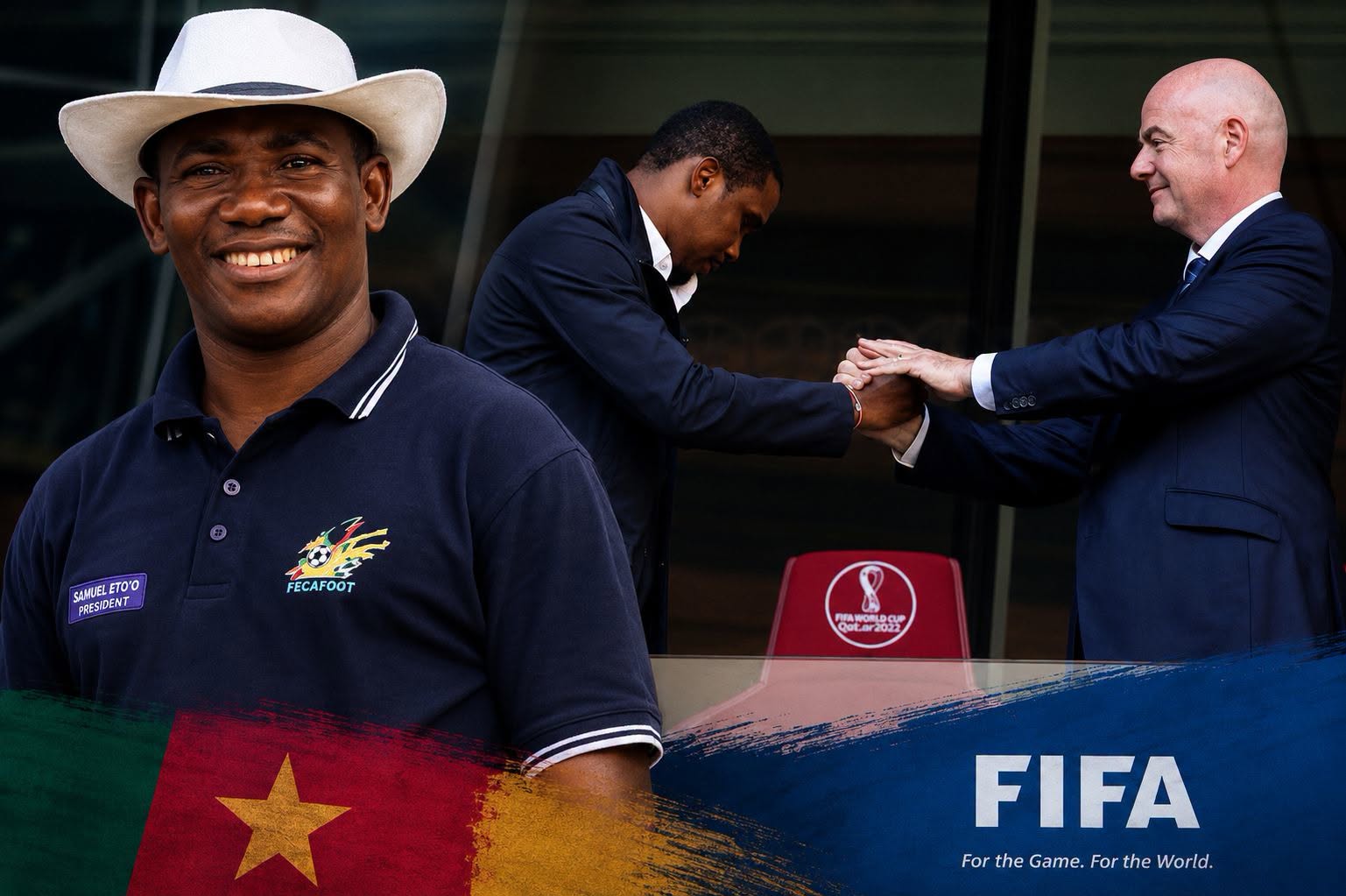
Samuel Nzoke Demands Eto'o FECAFOOT Resignation Amid Governance Row
Summary
- Sports analyst Samuel Nzoke has publicly demanded the immediate resignation of Samuel Eto'o from the presidency of the Fédération Camerounaise de Football (FECAFOOT).
- Nzoke accuses Eto'o of 'haute trahison' against Cameroon, alleging he prioritizes personal financial interests and geopolitical choices over national objectives.
- The criticism highlights concerns about Eto'o's alleged lack of state consultation on major decisions and the opaque management of FECAFOOT.
- Nzoke warns that relying on international organizations and market logic without national oversight risks the country losing control over its football future.
- The dispute underscores broader issues of sports governance in Cameroon, including accountability and the ethical conduct of national sports leaders.
Call for Resignation
Central to Samuel Nzoke's critique is the assertion that Samuel Eto'o has committed an act of 'haute trahison' against Cameroon.
Sports analyst Samuel Nzoke has publicly called for the immediate and unconditional resignation of Samuel Eto'o from his role as president of the Fédération Camerounaise de Football (FECAFOOT). This forceful demand stems from a series of significant criticisms regarding the governance and direction of the national football body under Eto'o's leadership, highlighting a growing dispute over the management of Cameroonian football.
Nzoke's primary contention is that Eto'o has steered national football towards geopolitical and commercial decisions that primarily serve his personal interests, rather than those of the federation or the Cameroonian state. This alleged prioritization of private deals over national objectives forms the bedrock of Nzoke's accusations, suggesting a fundamental misalignment of loyalties.
The analyst's declaration underscores a critical moment for sports governance in Cameroon, bringing to light concerns about leadership accountability and the ethical conduct of officials overseeing national institutions. The call for resignation signals a deep-seated dissatisfaction with the current trajectory of FECAFOOT, demanding a re-evaluation of its leadership.
Allegations of Disloyalty and Conflict
Central to Samuel Nzoke's critique is the assertion that Samuel Eto'o has committed an act of 'haute trahison' against Cameroon. Nzoke frames Eto'o's actions as a betrayal, claiming the FECAFOOT president 'bows to the North' only to 'trample' national interests 'in the South' by prioritizing private arrangements over the collective good. This severe accusation points to a perceived Eto'o conflict of interest Cameroon's football leadership.
Nzoke argues that while an individual leader is free to hold personal affiliations, a federation president lacks the authority to commit a nation's football to significant geopolitical and mercantile shifts without consulting the state. He views this as a major institutional blunder and a form of 'diplomatic sports dissidence,' where Eto'o seeks the benefits of national affiliation while sidestepping state consultation.
The analyst further suggests that Eto'o's conduct is driven by an 'hypertrophied ego' and vanity, using the nation and its institutions merely as a backdrop for personal aggrandizement. Nzoke alleges that Eto'o's pursuit of 'Western spotlights' and his willingness to resurrect a project previously abandoned by its originators exemplify a 'mercantile submission' that prioritizes personal image over the country's genuine sporting development.
Governance and Transparency Concerns
Beyond personal motivations, Nzoke raises serious questions about the broader sports governance Cameroon. He highlights the paradox where FIFA's statutes theoretically protect associative independence, yet the vast majority of substantial infrastructure, stadiums, and youth development programs rely heavily on Cameroonian taxpayer funds and state efforts. This reliance, Nzoke contends, makes Eto's alleged disregard for state consultation particularly problematic.
The analyst criticizes what he perceives as a 'double resignation' in Eto'o's approach, where public policy is effectively outsourced to a 'global technocracy of 'football business'' by relying on the generosity of international organizations. Nzoke argues that public policy cannot be externalized in this manner, emphasizing the need for national sovereign control over the sport's future, a key aspect of the Fédération Camerounaise de Football leadership dispute.
Furthermore, Nzoke explicitly points to 'chronic opacity' in FECAFOOT's management under Eto'o. He warns that such opaque practices, combined with a focus on financial gain, could lead to an authoritarian style of leadership, likening it to a 'Mobutu-like reign for the next three centuries.' This allegation of FECAFOOT opaque management raises significant concerns about accountability and financial oversight within the federation.
Nzoke contrasts Eto'o's alleged pursuit of new, market-driven projects, dictated by the 'over-financialization' of the game, with the wisdom of consolidating and improving existing structures. He asserts that blindly embracing market logic without a strong national anchor risks losing control of the 'real game,' especially if the state remains unconsulted on such pivotal decisions, echoing Samuel Eto'o FECAFOOT governance criticism.
Practical Implications
This situation underscores the critical importance of robust governance, transparency, and conflict of interest policies for leaders of national institutions, particularly those with significant public funding or national representation. Lawyers advising sports federations or similar public-facing entities should review their clients' internal controls and ethical frameworks to mitigate risks of public outcry and potential legal challenges related to perceived mismanagement or disloyalty to national interests.
Source
How does this affect you?
Get an AI analysis of this article grounded in your jurisdictions, practice areas, and any policy documents you've uploaded to Wansom.
Finish Reading the Full Story and the Expert Analysis.
Wansom is AI and can make mistakes.