
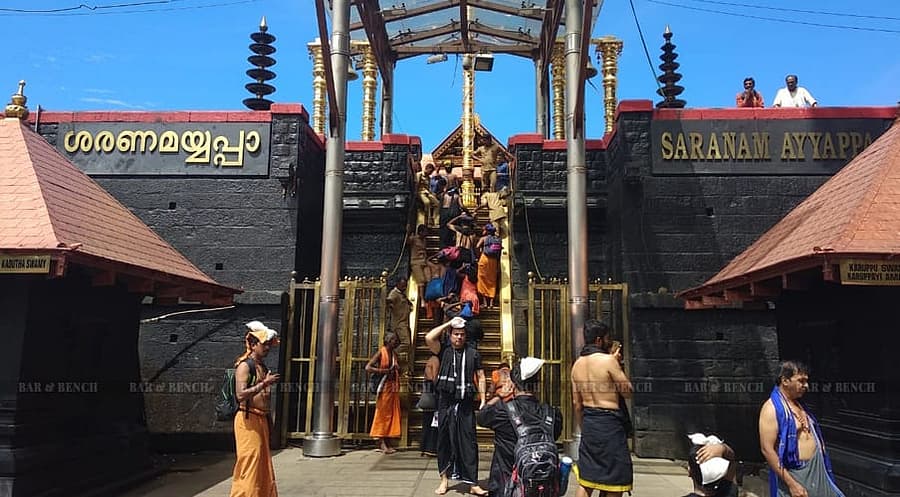
Supreme Court: Sabarimala Reference Case Verdict Date by December 18
Summary
- A nine-judge Constitution Bench of the Supreme Court is expected to deliver its verdict in the Sabarimala reference case by December 18.
- The case addresses seven significant legal questions concerning the scope of religious freedom in India.
- Justice BV Nagarathna, a member of the bench, indicated the verdict would likely be announced before the Court's Christmas vacation.
- This matter is linked to the Supreme Court's 2018 judgment that allowed women of all ages to enter the Sabarimala Temple.
- In 2019, review petitions led the Court to refer broader questions on religious freedoms to a larger bench rather than deciding the original matter.
Impending Verdict on Sabarimala Reference Case
Lawyers specializing in constitutional law, human rights, or those advising religious organizations should closely monitor this impending religious freedom India Supreme Court ruling.
The Supreme Court of India is poised to deliver a significant ruling in the Sabarimala reference case, with a nine-judge Constitution Bench expected to announce its decision by December 18 of this year. This crucial `Sabarimala reference case verdict date` coincides with the Court's closure for the Christmas vacation period, as indicated by Justice BV Nagarathna, a member of the bench.
Justice Nagarathna's remark came during proceedings related to petitions challenging a High Court decision concerning the Knanaya Catholic community's alleged practice of expelling members who do not adhere to endogamous marriage customs. The impending `Sabarimala Supreme Court judgment` is anticipated to address seven expansive legal questions that delve into the fundamental `scope of religious freedom India`.
The nine-judge bench tasked with this complex matter includes Chief Justice of India Surya Kant, alongside Justices BV Nagarathna, MM Sundresh, Ahsanuddin Amanullah, Aravind Kumar, Augustine George Masih, Prasanna B Varale, R Mahadevan, and Joymalya Bagchi. Their collective decision will carry substantial weight for the interpretation of constitutional rights in India.
Historical Context and Legal Evolution
The current reference case stems from the Supreme Court's landmark 2018 verdict, which permitted women of all ages to enter the Sabarimala Temple in Kerala. That `Sabarimala women entry case` judgment effectively overturned a long-standing custom that had restricted the entry of women of menstruating age into the revered hilltop shrine.
Following the 2018 decision, numerous review petitions were filed. In November 2019, the Supreme Court issued a judgment on these review petitions. However, instead of definitively ruling on the initial verdict, the Court opted to refer the broader constitutional questions to a larger bench. This referral framed seven specific legal points concerning religious freedoms in India, setting the stage for the current `nine-judge bench Sabarimala` proceedings.
Broader Implications for Religious Freedom
The forthcoming `Sabarimala reference case verdict date` is not merely about the specific temple but represents a pivotal moment for the `scope of religious freedom India`. The seven questions framed by the Supreme Court aim to clarify the boundaries of religious practices and individual rights within the constitutional framework, potentially redefining how religious institutions operate and how personal beliefs are protected.
Lawyers specializing in constitutional law, human rights, or those advising religious organizations should closely monitor this impending `religious freedom India Supreme Court` ruling. The decision by the bench, which includes `Justice BV Nagarathna Sabarimala`, is expected to establish crucial precedents that could significantly impact the legal landscape governing religious institutions and practices across the nation, thereby redefining constitutional rights.
Practical Implications
Lawyers practicing constitutional law, human rights, or advising religious organizations should closely monitor the impending Supreme Court verdict in the Sabarimala reference case. This ruling will establish crucial precedents on the scope of religious freedom in India, potentially redefining constitutional rights and impacting the legal framework governing religious institutions and practices.
Source
How does this affect you?
Get an AI analysis of this article grounded in your jurisdictions, practice areas, and any policy documents you've uploaded to Wansom.
Finish Reading the Full Story and the Expert Analysis.
Get the latest legal & regulatory intelligence in India
Wansom is AI and can make mistakes.