
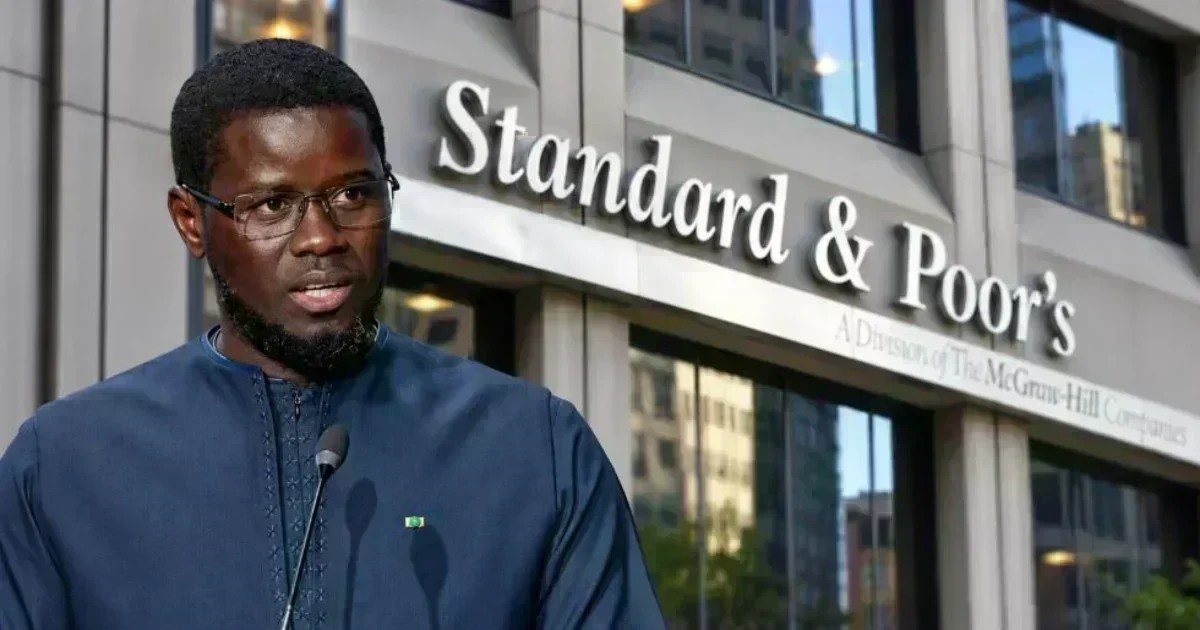
S&P: Dégrade Note Sénégal Devises CFA to 'CC'/'CCC', Default 'Extremely Probable'
Summary
- S&P downgraded Senegal's foreign currency debt to "CC" and local currency debt to "CCC" on September 4, 2026.
- The rating agency views Senegal's debt treatment plan as a restructuring operation, placing the nation two notches from default.
- Both ratings carry a negative outlook, indicating a high probability of further downgrades in the coming months.
- Senegal's public debt is projected to reach 132% of GDP by the end of 2024, following data revisions.
- The downgrade follows a new $2.2 billion IMF staff-level agreement and comes after a previous S&P downgrade in November 2025.
What Happened
S&P considers a distressed debt exchange or a default on commercial external foreign currency debt to be 'extremely probable'.
The international credit rating agency Standard & Poor’s (S&P) has significantly lowered Senegal's sovereign debt rating, signaling heightened financial risk for the West African nation. On September 4, 2026, S&P announced a downgrade of Senegal's foreign currency debt from "CCC+" to "CC" and its local currency debt, denominated in CFA francs, to "CCC." This decision underscores ongoing concerns regarding Dakar's capacity to meet its financial obligations and marks a continuation of warnings issued by the agency.
This latest downgrade follows a previous reduction in Senegal's rating on November 14, 2025, when S&P moved the country's foreign currency debt from "B-" to "CCC+." That earlier adjustment was the second such downgrade within the year 2025. S&P attributed these prior revisions to a shrinking budgetary margin for maneuver, stemming from increased financing requirements and a growing reliance on shorter-term maturities.
Both the newly assigned "CC" and "CCC" ratings are accompanied by a negative outlook, indicating S&P's assessment that there is a considerable risk of further downgrades in the coming months. Critically, S&P has stated that a distressed debt exchange or a default on commercial external foreign currency debt is considered "extremely probable." This places Senegal's credit standing just two notches above a full default, according to information reported by Senenews.
Legal and Regulatory Context
The recent S&P dégrade note Sénégal devises CFA arrives shortly after Senegal reached a staff-level agreement with the International Monetary Fund (IMF), which still requires approval from IMF management and the Executive Board, and unveiled its Plan de traitement de la dette du Sénégal (PTDS), or Senegal Debt Treatment Plan. Despite these developments, S&P views the PTDS as a debt restructuring operation, a classification that typically precedes or accompanies significant financial distress. The new IMF agreement, spanning 36 months, is valued at $2.2 billion, equivalent to approximately 1,300 billion CFA francs, and was intended to provide crucial financial support.
Underpinning these concerns is Senegal's substantial public debt burden. Following a revision of public debt and deficit data, the nation's public debt is projected to reach 132% of its Gross Domestic Product (GDP) by the close of 2024. This figure aligns with earlier findings from the Court of Accounts, which had previously determined that Senegal's actual indebtedness was considerably higher than official reports indicated, pushing the debt-to-GDP ratio beyond 100%. S&P had previously cautioned that the absence of a new IMF program would directly impede Dakar's ability to finance its needs.
Further complicating the debt landscape, Dakar is engaged in negotiations under the G20 common framework for debt treatment. However, a significant portion of Senegal's public debt, specifically its CFA franc-denominated obligations which constitute nearly one-third of the total, remains outside the scope of this G20 mechanism. This exclusion adds a layer of complexity to any comprehensive debt resolution efforts and highlights the unique challenges posed by the country's currency arrangements. It also recalls the suspension of a previous $1.8 billion IMF aid program in 2023, which was halted following the discovery of discrepancies in public financial figures.
Why It Matters
The negative outlook accompanying Senegal's downgraded ratings signifies a persistent and elevated risque défaut paiement Sénégal and further financial deterioration. S&P has explicitly warned that another downgrade could occur within the next six months if financing conditions continue to worsen or if the debt treatment plan is expanded to include loans denominated in CFA francs. This potential expansion could significantly broaden the scope of affected creditors and financial instruments.
Senegal faces substantial annual refinancing requirements, which are estimated to consume between 25% and 29% of its GDP over the next three years. This high demand for refinancing is partly driven by the government's reliance on short-term domestic borrowing, which can create liquidity pressures and increase vulnerability to market fluctuations. The ability of the Senegalese state to honor its commitments, particularly concerning its Sénégal dette souveraine S&P, is contingent upon several critical factors identified by S&P.
These factors include the effective implementation of the restructuration dette Sénégal PTDS, sustained support from its creditors, and a durable reduction in its overall financing needs. For investors and businesses operating in or with exposure to Senegal, this S&P perspective négative Sénégal signals a significantly increased sovereign risk. The notation financière Sénégal FMI context, coupled with the recent downgrade, underscores the urgency for stakeholders to assess their exposure to potential debt restructuring or default scenarios.
Practical Implications
This S&P downgrade signals significantly increased sovereign risk for businesses and investors in Senegal. Legal and compliance teams must review existing contracts, financing agreements, and investment portfolios for potential exposure to debt restructuring, default, or adverse changes in the regulatory and economic environment, advising clients on risk mitigation strategies.
Source
How does this affect you?
Get an AI analysis of this article grounded in your jurisdictions, practice areas, and any policy documents you've uploaded to Wansom.
Finish Reading the Full Story and the Expert Analysis.
Wansom is AI and can make mistakes.