
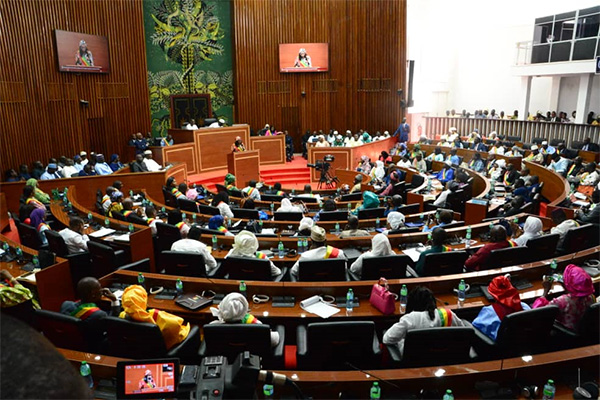
Sénégal Assemblée Nationale: DPG Procédure Clarifiée Pour Le Premier Ministre
Summary
- The Bureau of the National Assembly in Sénégal clarified the procedure for the Prime Minister's General Policy Statement (DPG).
- This clarification pertains to a DPG scheduled during an extraordinary session commencing September 1, 2026, following a Prime Ministerial correspondence dated August 24, 2026.
- The DPG is constitutionally mandated by Article 55 and further detailed in Article 109 of the National Assembly's Internal Rules.
- The DPG itself is not subject to a vote of confidence or a motion of censure, which are distinct procedures outlined in Article 55 of the Constitution and Articles 110-111 of the Internal Rules.
- This process enhances government accountability, transparency, and parliamentary oversight by allowing the Prime Minister to present the government's program and objectives for debate.
Parliamentary Clarification on Prime Minister's Statement
The General Policy Statement serves as a vital mechanism for government accountability and transparency, allowing the Prime Minister to articulate the administration's program and objectives before the legislative body.
The Bureau of the National Assembly in Sénégal recently issued a communiqué providing essential clarifications regarding the procedure for the Prime Minister's General Policy Statement (DPG). This procedural guidance comes in anticipation of an extraordinary parliamentary session scheduled to commence on September 1, 2026. The need for these detailed explanations arose following a correspondence from the Prime Minister himself, dated August 24, 2026, which prompted the legislative body to delineate the precise steps involved in this significant parliamentary event.
The communiqué from the Bureau de l'Assemblée nationale Sénégal aims to ensure a clear and orderly process for the upcoming declaration. This proactive measure by the parliamentary leadership underscores the importance of established protocols for high-level governmental presentations, particularly within the context of a specially convened session. The clarification addresses the formal framework for the Prime Minister's engagement with the legislature, setting expectations for all parties involved in the DPG procédure Assemblée nationale.
The Legal Framework for the DPG
The General Policy Statement, or Déclaration de politique générale Sénégal, is a constitutionally mandated exercise, specifically outlined in Article 55 of the nation's foundational legal text. Further procedural specifics for the DPG are meticulously detailed within the Règlement intérieur Assemblée nationale Sénégal, spanning Article 109. These internal rules govern the conduct of parliamentary business and ensure a structured approach to governmental accountability.
It is crucial to understand that the DPG procédure Premier ministre Sénégal, as defined by these provisions, is distinct from a vote of confidence or a motion of censure; the statement itself does not automatically trigger such a vote. While the Prime Minister retains the option to request a vote of confidence following the DPG and its subsequent debate, this constitutes a separate parliamentary action. The procedure for a vote of confidence is independently established by Article 55 of the Constitution and further elaborated in Articles 110 to 111 of the National Assembly's Internal Rules, underscoring the procedural separation between the two mechanisms.
Enhancing Accountability and Transparency
The General Policy Statement serves as a vital mechanism for government accountability and transparency, allowing the Prime Minister to articulate the administration's program and objectives before the legislative body. This formal presentation provides a critical opportunity for deputies to engage in a substantive debate, question the government's direction, and hold it responsible for its policies.
By clearly defining the Procédure DPG Premier ministre Sénégal, the National Assembly reinforces its oversight role and strengthens the democratic governance framework. The process facilitates informed public debate on national priorities and governmental actions, ensuring that the executive branch remains answerable to the elected representatives of the people. This clarification by the Bureau Assemblée nationale Sénégal communiqué therefore underscores the importance of established parliamentary protocols in fostering a robust and transparent political system.
Practical Implications
Lawyers advising on public law, constitutional matters, or government relations in Senegal should be aware of these clarified parliamentary procedures for the Prime Minister's General Policy Statement, as they define the formal framework for legislative engagement and accountability.
Source
Source: Original reporting via {source}
How does this affect you?
Get an AI analysis of this article grounded in your jurisdictions, practice areas, and any policy documents you've uploaded to Wansom.
Finish Reading the Full Expert Analysis.
Wansom is AI and can make mistakes.