
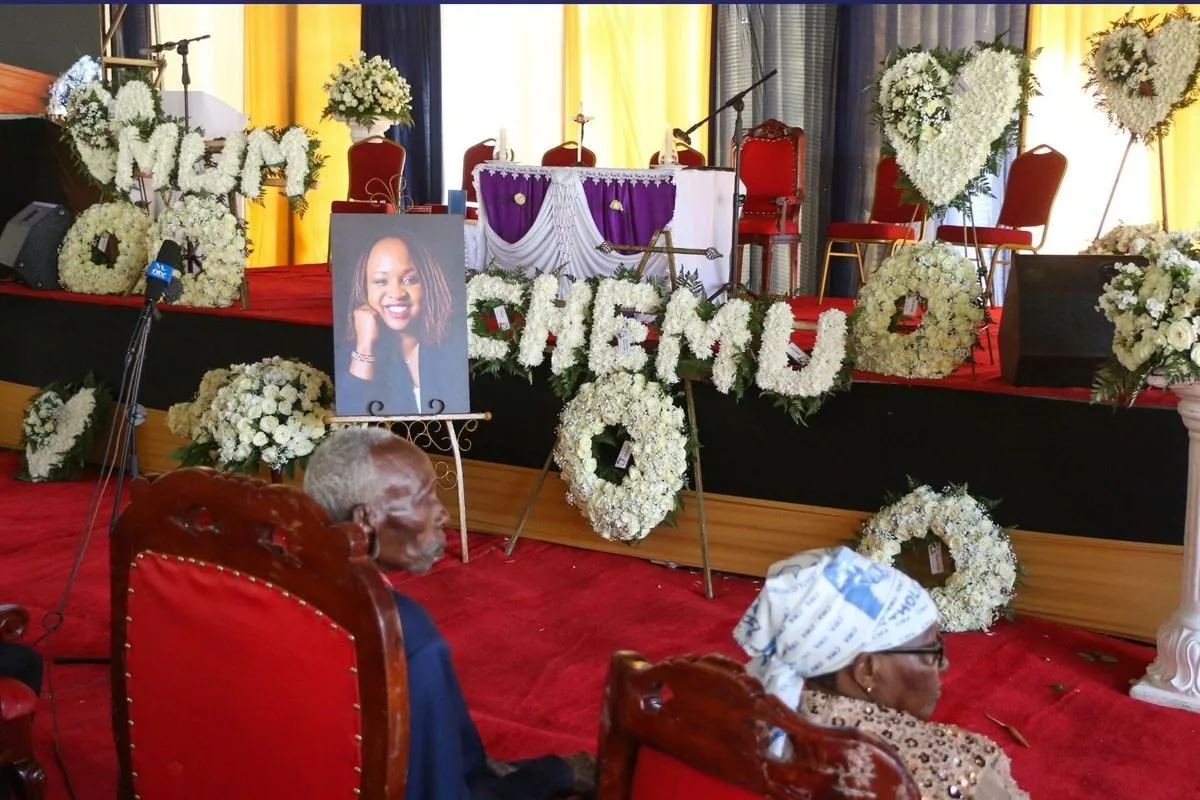
Milimani Court: Rosemary Chemutai Buried Despite Interim Order
Summary
- KCB executive Rosemary Chemutai was buried in Kericho County despite an interim court order prohibiting her interment without her husband's consent.
- Her husband, Kevin Migwe Kimwatu, filed an urgent application asserting his spousal rights to participate in burial decisions based on their 13-year marriage and four children.
- The dispute escalated after a KCB Bank letter, based on employment records, authorized Rosemary's sister and eldest son as next of kin for funeral arrangements, which Kimwatu argued could not override his spousal rights.
- Reports indicate the court order was not served on the family before the burial, raising questions about the enforcement of interim directives in sensitive family matters.
- The Milimani Commercial Magistrate's Court is expected to hear the case further, despite the burial having already taken place, to address the underlying legal questions of burial authority.
Disputed Burial Proceeds Despite Court Order
This burial proceeded just hours after a Milimani Commercial Magistrate’s Court issued an interim order explicitly prohibiting her interment without the involvement and consent of her husband, Kevin Migwe Kimwatu.
Rosemary Chemutai Koech-Kimwatu, a KCB Bank executive, was interred at her parents’ home in Chepseon, Kericho County, on a Friday night, August 28 or 29. This burial proceeded just hours after a Milimani Commercial Magistrate’s Court issued an interim order explicitly prohibiting her interment without the involvement and consent of her husband, Kevin Migwe Kimwatu. Reports suggest that the court order, issued by Senior Principal Magistrate Agnes Mwangi, had not been served on the family prior to the burial, allowing funeral arrangements to continue.
The court’s directive specifically barred Rosemary’s family, KCB Bank, and any other parties from removing her remains from Lee Funeral Home or proceeding with the burial without her husband’s participation. This interim measure was intended to preserve the status quo pending a full hearing of Kimwatu’s application. The core of the dispute revolves around the final resting place for Rosemary, with her biological family having planned for burial at their home in Chepseon, while her husband sought to have her buried at his ancestral home in Matasia, Ngong, Kajiado County.
Kevin Migwe Kimwatu initiated legal action after learning of his wife's family's burial plans, which excluded him. He contends that his 13-year marriage to Rosemary, solemnized at St Austin’s Catholic Church in Nairobi in August 2013, and their four children, grant him the right to be involved in decisions concerning her final rites. He has accused Rosemary’s parents, Paul and Beatrice Koech, and her sister, Judy Koech-Oyamo, of deliberately excluding him from funeral committees and preparations following her death on August 21.
Spousal Rights Versus Family Wishes
The legal challenge brought by Kevin Migwe Kimwatu underscores a fundamental tension in Kenyan family law regarding burial rights. While Kimwatu acknowledges a period of marital difficulties, including a four-month separation, he maintains that their marriage remained legally intact and that they had reconciled, with Rosemary planning to return home before her passing. Conversely, case documents and reports indicate that the family's account points to significant domestic and financial challenges preceding Rosemary’s death, presenting a complex backdrop to the dispute.
Kimwatu's application to the Milimani Commercial Magistrate's Court was certified as urgent, leading to the interim orders that were ultimately disregarded. The court has yet to issue a final determination on who holds the ultimate authority to decide Rosemary’s burial arrangements. Despite the interment, the parties are still expected to appear before the Milimani Commercial Magistrate’s Court on Monday, August 31, to address the ongoing legal proceedings.
KCB's 'Next of Kin' Policy Under Scrutiny
A significant point of contention emerged when Kevin Migwe Kimwatu visited Lee Funeral Home on August 26 to inquire about burial arrangements. There, he was presented with a letter from KCB Bank, dated August 25, which authorized Rosemary’s sister, Judy Koech-Oyamo, and her eldest son, Charles Migwe Kimwatu, to liaise with the funeral home regarding the release, collection, and burial arrangements for Rosemary’s remains. This authorization stemmed from KCB’s employment records, which listed these two individuals as Rosemary’s next of kin.
Kimwatu strongly argued that an employer’s internal next-of-kin records cannot supersede his rights as a surviving spouse. His legal representatives have criticized KCB for involving itself in what they assert is a private family dispute, contending that employment records identifying a next of kin do not confer authority upon an employer to dictate the location or manner of an employee’s burial. While KCB’s letter was explicitly framed around funeral and mortuary arrangements, rather than the deceased’s estate or succession matters, its role in the escalating conflict has brought employer 'next of kin' policies into sharp focus.
Implications for Interim Order Enforcement
This case highlights the significant practical challenges inherent in enforcing interim court orders, particularly within highly sensitive and emotionally charged family disputes over burial rights in Kenya. The fact that Rosemary Chemutai’s burial proceeded despite a clear judicial directive underscores the difficulties faced when such orders are not promptly served or are otherwise disregarded by parties involved. It brings to the forefront the complexities legal practitioners navigate when advising clients on spousal burial rights in Kenya, often balancing legal entitlements against deeply held family traditions and wishes.
The ongoing legal proceedings, even after the burial, emphasize that the fundamental question of who possesses the ultimate authority to determine a deceased person's final resting place remains unresolved. This incident also serves as a critical reminder for organizations to review their 'next of kin' policies, ensuring they do not inadvertently create legal exposure or overstep boundaries in private family matters, especially when such records are interpreted as granting authority beyond administrative convenience.
Practical Implications
This case highlights the practical challenges in enforcing interim court orders in sensitive family disputes over burial rights in Kenya, requiring lawyers to advise clients on the complexities of spousal rights versus family wishes. For compliance officers, it underscores the need to review 'next of kin' policies to ensure employer records do not inadvertently create legal exposure or overstep boundaries in private family matters.
Source
How does this affect you?
Get an AI analysis of this article grounded in your jurisdictions, practice areas, and any policy documents you've uploaded to Wansom.
Finish Reading the Full Story and the Expert Analysis.
Wansom is AI and can make mistakes.