
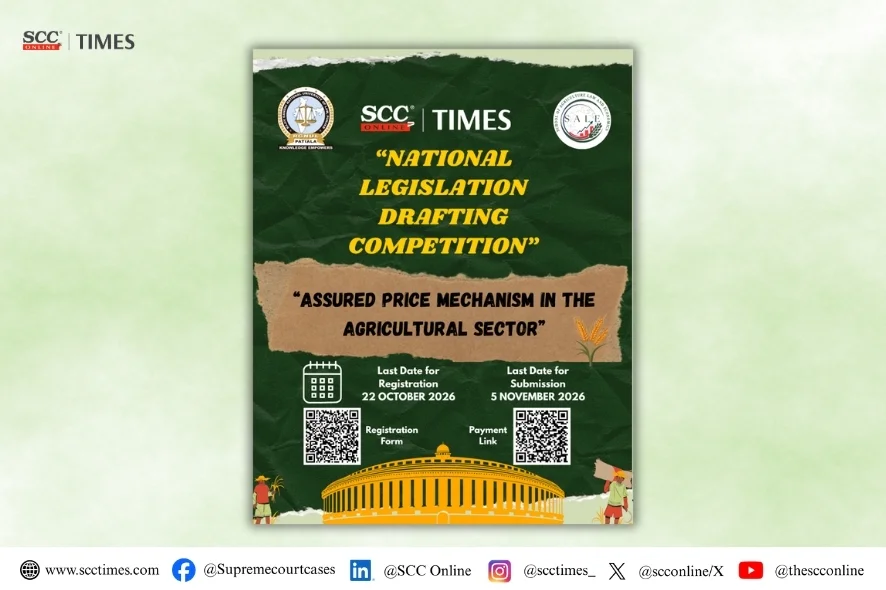
RGNUL: Legislation Drafting Competition 2026 Focuses on Agricultural Law
Summary
- RGNUL's School of Agricultural Law and Economics is hosting the National Legislation Drafting Competition 2026.
- The competition's theme is an 'Assured Price Mechanism in the Agricultural Sector,' aiming to expand guaranteed price assurance beyond current MSP for paddy and wheat.
- Participants are challenged to draft statutory frameworks that encourage crop diversification, reduce water-intensive crop dependence, address farmer debt, and promote environmental sustainability.
- The competition is open to undergraduate and postgraduate law students across India, with submissions due by September 22, 2026.
- This initiative highlights academic and future legal professional engagement with critical agricultural policy reform in India.
Event Overview
This law student drafting competition India represents a significant academic endeavor, signaling a growing interest among future legal professionals in reforming agricultural policy and addressing critical socio-economic and environmental concerns within the sector.
The Rajiv Gandhi National University of Law (RGNUL), Punjab, through its specialized School of Agricultural Law and Economics (SALE), has announced the National Legislation Drafting Competition 2026. This significant event invites law students to develop a comprehensive statutory framework centered on an 'Assured Price Mechanism in the Agricultural Sector'. The competition specifically seeks to expand the concept of guaranteed price assurance beyond its current limited application, which primarily covers paddy and wheat under the existing Minimum Support Price (MSP) system.
Established by the Punjab State Legislature in 2006, RGNUL has rapidly ascended to prominence, receiving Bar Council of India approval in July 2006 and becoming the first National Law University (NLU) to achieve an 'A' grade NAAC accreditation in May 2015. The institution, granted autonomous status by the UGC in 2018, was ranked 17th in the NIRF Law Rankings 2026. Its School of Agricultural Law and Economics functions as a Centre of Excellence, dedicated to interdisciplinary research and teaching that integrates legal, economic, and policy perspectives to address complex challenges within the agricultural sector.
Addressing Critical Policy Challenges
The core objective of the RGNUL legislation drafting competition 2026 is to foster innovative legislative solutions that tackle pressing issues in Indian agriculture. Participants are tasked with designing a framework that not only broadens price assurance but also actively encourages crop diversification, thereby reducing the prevalent dependence on water-intensive crops. This initiative directly confronts the challenges of agricultural debt and farmer distress, aiming to provide sustainable pathways for economic stability.
Beyond immediate economic relief, the competition emphasizes the promotion of long-term environmental sustainability and the creation of rural employment opportunities. By focusing on an Assured Price Mechanism agricultural sector, the event highlights the need for a more robust and inclusive policy approach that extends beyond the traditional Minimum Support Price expansion India has seen, pushing for a holistic transformation of the agricultural landscape.
Competition Mechanics and Significance
The National Legislation Drafting Competition RGNUL is open to both undergraduate (3-year or 5-year B.A. LL.B.) and postgraduate (LL.M.) law students enrolled in any recognized law college across India. Participation can be individual or in teams of up to two authors, with cross-institutional teams also permitted. The competition operates on an online submission basis, making it accessible nationwide, with no requirement for offline presence during the drafting phase. The deadline for both registration and submission is September 22, 2026. Authors of the top 10 papers will be invited to present their work virtually.
Submissions must adhere to strict formatting guidelines, including a word count between 10,000 and 12,000 words, excluding cover page and footnotes, and must use either OSCOLA (4th Edition) or Bluebook (20th/21st Edition) citation styles uniformly. A crucial anonymity requirement mandates that drafts contain no personal details, only an assigned Team Code. This law student drafting competition India represents a significant academic endeavor, signaling a growing interest among future legal professionals in reforming agricultural policy and addressing critical socio-economic and environmental concerns within the sector.
Practical Implications
While a student competition, this event signals growing academic and future legal professional interest in reforming India's agricultural policy, particularly regarding assured price mechanisms and crop diversification. Lawyers advising clients in the agricultural sector should monitor these discussions for potential future legislative changes impacting market dynamics, subsidies, and environmental regulations.
Source
How does this affect you?
Get an AI analysis of this article grounded in your jurisdictions, practice areas, and any policy documents you've uploaded to Wansom.
Finish Reading the Full Story and the Expert Analysis.
Get the latest legal & regulatory intelligence in India
Wansom is AI and can make mistakes.