
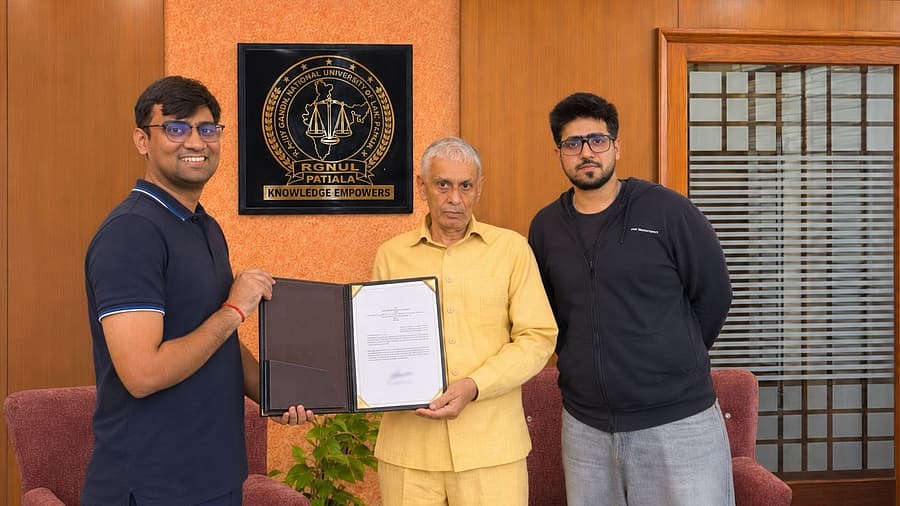
RGNUL Adopts 8rney Legal AI: Enhancing Legal Education
Summary
- The Rajiv Gandhi National University of Law (RGNUL) has adopted 8rney, an agentic legal AI workspace.
- The platform is now available to RGNUL students, researchers, and faculty members for various academic and research purposes.
- 8rney's specialized Academic Mode supports all stages of legal projects, from framing research questions to drafting papers and dissertations.
- RGNUL's Vice-Chancellor, Professor (Dr.) Jai S. Singh, stressed the importance of students mastering AI tools before entering the legal profession.
- The adoption aims to enhance rigorous research, writing, and moot court preparation while maintaining legal reasoning and analysis as central to education.
RGNUL Integrates Advanced Legal AI
Recognizing the transformative impact of artificial intelligence on the legal profession, Professor Singh highlighted the imperative for students to master these tools well before they embark on their professional careers.
The Rajiv Gandhi National University of Law, Punjab (RGNUL), has officially adopted 8rney, an advanced agentic legal AI workspace, making it available to its entire academic community. This significant move means that students, researchers, and faculty members at the institution will now have access to sophisticated artificial intelligence tools designed to enhance various aspects of legal scholarship and practice preparation. The integration of 8rney underscores a commitment to modernizing legal education and equipping future professionals with cutting-edge resources.
This strategic implementation by RGNUL adopts 8rney legal AI for a broad spectrum of academic and practical applications. The platform is specifically intended to support critical functions such as in-depth legal research, the development of academic writing skills, the completion of coursework assignments, and rigorous preparation for moot court competitions. By providing these capabilities, RGNUL aims to foster a more dynamic and technologically proficient learning environment for its constituents.
Comprehensive Support Through Academic Mode
Central to RGNUL's deployment of this technology is 8rney’s specialized "Academic Mode," a tailored workspace specifically developed for law schools. This mode offers comprehensive support to both students and researchers throughout the entire lifecycle of a legal project. Its functionalities span from the initial stages of framing a precise research question to the intricate processes of locating and meticulously analyzing relevant legal materials.
Furthermore, the Academic Mode 8rney facilitates the crucial steps of developing robust legal arguments and provides assistance in the drafting and structuring of various academic outputs. This includes everything from detailed papers and extensive dissertations to standard assignments, ensuring a streamlined and efficient workflow. Beyond student use, faculty members are also empowered to leverage this sophisticated tool for their own independent research endeavors, thereby extending its utility across the institution's scholarly activities.
Cultivating AI Proficiency in Legal Education
Professor (Dr.) Jai S. Singh, the Vice-Chancellor of RGNUL, articulated the strategic vision behind this significant RGNUL legal tech adoption. He emphasized that rigorous research and persuasive advocacy have consistently formed the bedrock of legal education within the university, both in traditional classroom settings and during intensive moot court preparations. Recognizing the transformative impact of artificial intelligence on the legal profession, Professor Singh highlighted the imperative for students to master these tools well before they embark on their professional careers.
The Vice-Chancellor further explained that with the introduction of 8rney, students and faculty now possess advanced instruments that bolster the rigor of their research, refine their writing capabilities, and enhance their readiness for moot court challenges. Crucially, he affirmed that while these technological aids provide substantial support, the core principles of legal reasoning and analytical thought will remain at the absolute center of the university's pedagogical approach, ensuring a balanced integration of technology and fundamental legal skills in Indian legal education.
Shaping the Future Legal Workforce
The introduction of an 8rney agentic legal workspace at RGNUL signifies a broader trend towards the increasing integration of artificial intelligence tools within legal education across India. This development suggests that future legal professionals emerging from institutions like RGNUL will enter the workforce already proficient in leveraging AI-powered solutions for tasks ranging from sophisticated research to efficient document drafting. Such proficiency is poised to become a standard expectation in the evolving legal landscape.
This shift carries significant implications for law firms and legal departments. They should anticipate a new generation of lawyers who are not only adept at traditional legal skills but also highly competent in utilizing advanced technological platforms. This trend will likely influence hiring strategies, placing a premium on candidates with demonstrated AI literacy and adaptability. The co-founders of 8rney, Aryaman Singh and Abhimanyu Dhull, have thus introduced a tool that is set to play a pivotal role in shaping the capabilities of the next wave of legal practitioners.
Practical Implications
This development signals the increasing integration of AI tools into legal education in India, indicating that future legal professionals will enter practice with proficiency in AI-powered research and drafting. Lawyers and firms should anticipate a workforce increasingly adept at leveraging such technologies, potentially influencing hiring strategies and the demand for AI literacy within existing teams.
Source
How does this affect you?
Get an AI analysis of this article grounded in your jurisdictions, practice areas, and any policy documents you've uploaded to Wansom.
Finish Reading the Full Story and the Expert Analysis.
Get the latest legal & regulatory intelligence in India
Wansom is AI and can make mistakes.