
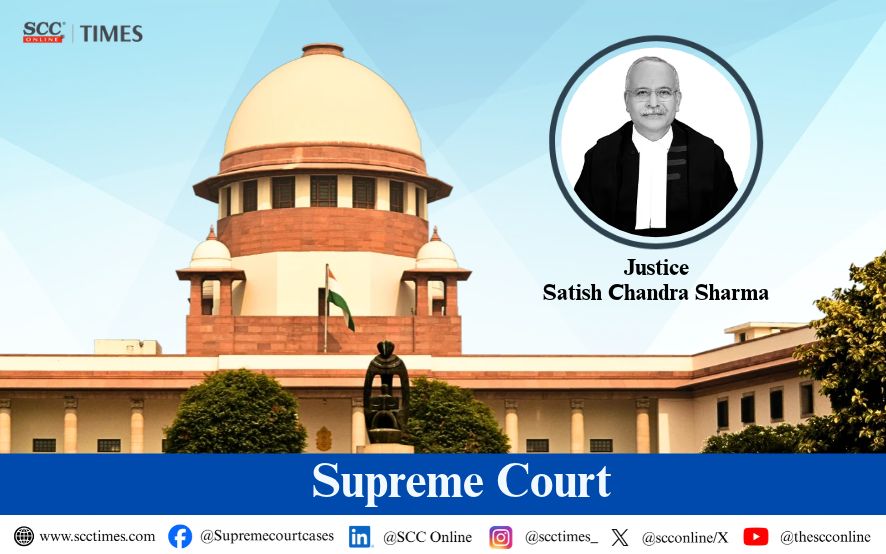
Justice Satish Chandra Sharma: Supreme Court Retirement Set for November 2026
Summary
- Justice Satish Chandra Sharma is scheduled to retire from the Supreme Court of India on November 29, 2026.
- He will have served nearly 19 years on the Bench by the time of his retirement.
- His distinguished career included leading the Delhi and Telangana High Courts, following service on the Madhya Pradesh High Court.
- Justice Sharma's judicial philosophy is noted for its balance between individual rights and accountability.
- His retirement is expected to influence the future composition and jurisprudential direction of the Supreme Court.
Upcoming Retirement
A defining characteristic of Justice Satish Chandra Sharma's judicial philosophy has been his consistent endeavor to strike a delicate equilibrium between individual rights and the imperative of accountability.
Justice Satish Chandra Sharma is set to conclude his distinguished tenure on the Supreme Court of India, with his retirement scheduled for November 29, 2026. This date will mark the culmination of nearly 19 years of dedicated service on the Bench, a period during which he has contributed significantly to the nation's legal framework. His impending departure represents a notable event in the ongoing evolution of the Indian judiciary.
The retirement of a Supreme Court Justice, particularly one with such extensive experience, invariably prompts reflection on their contributions and the future direction of the court. Justice Sharma's long career, spanning almost two decades, underscores the depth of experience and legal insight he brought to the highest echelons of the Indian judicial system.
Distinguished Judicial Career
Justice Sharma's judicial journey began with his appointment to the Madhya Pradesh High Court, where he laid the foundation for his reputation as a meticulous and thoughtful jurist. His capabilities and leadership qualities were further recognized through his subsequent elevations to lead two prominent High Courts. He first assumed the role of Chief Justice of the Telangana High Court, guiding its operations and jurisprudence.
Following his successful tenure in Telangana, Justice Sharma was appointed to lead the Delhi High Court as its Chief Justice. In these significant leadership positions, he was instrumental in shaping the judicial administration and legal interpretations within these crucial jurisdictions, consistently demonstrating a commitment to the principles of justice and fairness that characterize his judicial record.
Judicial Philosophy and Impact
A defining characteristic of Justice Satish Chandra Sharma's judicial philosophy has been his consistent endeavor to strike a delicate equilibrium between individual rights and the imperative of accountability. This approach has been evident across his notable judgments, which have often navigated complex legal questions by carefully weighing competing interests to arrive at balanced outcomes. His contributions to the Indian judiciary are frequently cited for their pragmatic yet principled stance.
His extensive body of work reflects a deep understanding of constitutional principles and statutory interpretations, contributing to a rich tapestry of precedents. The impact of Justice Satish Chandra Sharma's judgments extends beyond the immediate parties, influencing subsequent legal discourse and providing guidance for lower courts on a range of critical issues.
Future Implications for the Court
The upcoming Justice Satish Chandra Sharma Supreme Court retirement on November 29, 2026, will undoubtedly create a significant void within the court's composition. His departure, alongside other Supreme Court of India retirements in 2026, will necessitate new appointments that could subtly, or even overtly, influence the jurisprudential direction of the court in the coming years.
Legal practitioners and scholars will continue to analyze Justice Satish Chandra Sharma's judicial record and his significant judgments, as these precedents will remain relevant for ongoing and future cases. Understanding his judicial philosophy is crucial for anticipating potential shifts in legal interpretations and for strategizing in areas where his influence has been particularly strong.
Practical Implications
Lawyers should be aware of Justice Satish Chandra Sharma's significant judgments and judicial philosophy, as his retirement from the Supreme Court may influence the future composition and jurisprudential direction of the court, potentially impacting ongoing or future cases that relied on his precedents.
Source
How does this affect you?
Get an AI analysis of this article grounded in your jurisdictions, practice areas, and any policy documents you've uploaded to Wansom.
Finish Reading the Full Story and the Expert Analysis.
Get the latest legal & regulatory intelligence in India
Wansom is AI and can make mistakes.