
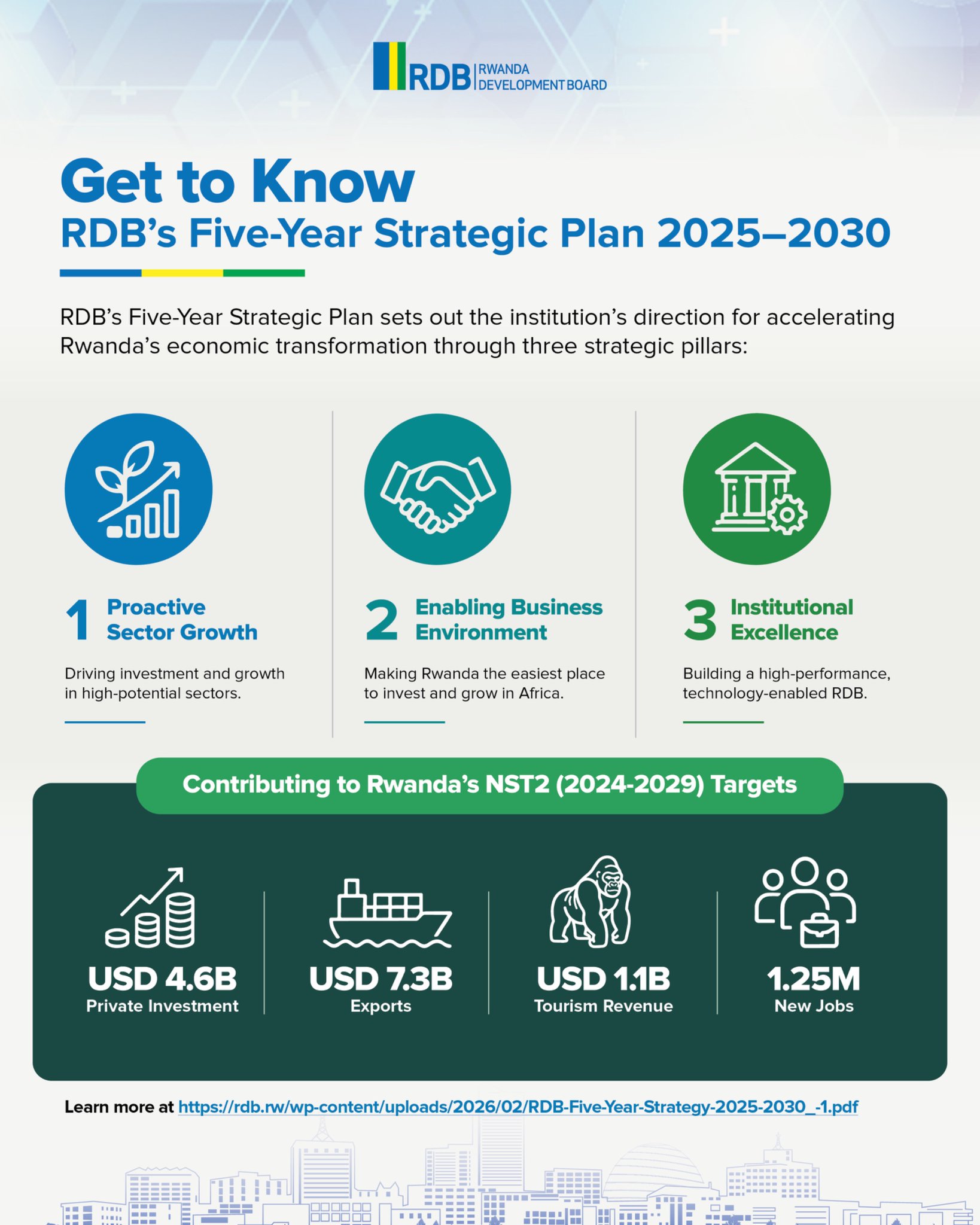
RDB: US$13 Billion RDB Five-Year Strategy 2025-2030 Rwanda Unveiled
Summary
- The Rwanda Development Board has released a US$13 billion Five-Year Strategy for 2025–2030.
- The strategy marks a significant shift in Rwanda's economic focus from promotion to production.
- Key objectives include ensuring factories become operational and local companies access global markets.
- The plan also aims to increase tourist spending and secure productive employment for young people.
- This blueprint is central to Rwanda's next phase of economic transformation.
What Happened
This strategic redirection from promotion to production is expected to translate directly into a wave of new legislative initiatives, updated regulatory frameworks, and targeted investment incentives across critical sectors.
The Rwanda Development Board (RDB) recently unveiled its ambitious RDB Five-Year Strategy 2025-2030 Rwanda, a comprehensive US$13 billion blueprint designed to steer the nation's next phase of economic transformation. Released on Thursday, this strategic document signals a pivotal shift in the country's economic development approach, moving decisively from a focus on mere promotion to a robust emphasis on tangible production. This new direction underscores a commitment to fostering a more self-reliant and industrially capable economy.
This significant policy pivot is not merely about attracting foreign capital but fundamentally reshaping the domestic economic landscape. The strategy posits that Rwanda's future prosperity hinges on several critical pillars. These include ensuring that newly established factories become fully operational, empowering local enterprises to successfully penetrate global markets, and significantly increasing the spending contributions from the tourism sector. Furthermore, a central tenet of this forward-looking Rwanda Development Board 2025-2030 plan is the imperative to secure productive employment opportunities for the nation's youth, thereby harnessing demographic dividends for sustainable growth.
Strategic Imperatives
The Rwanda economic transformation blueprint articulates a clear vision for the country's economic future, identifying key areas that require intensive development and strategic intervention. At its heart, the plan prioritizes the operationalization of manufacturing facilities, recognizing that a vibrant industrial base is essential for value creation and job generation. This focus extends beyond mere establishment, emphasizing the need for these factories to contribute actively to the national output.
Moreover, the strategy places considerable weight on enhancing the competitiveness and reach of Rwandan businesses. It specifically targets the integration of local companies into international supply chains and global marketplaces, aiming to elevate their presence beyond national borders. Concurrently, the plan seeks to maximize the economic impact of the tourism sector, striving for increased expenditure from visitors to bolster foreign exchange earnings and support related industries. A crucial social and economic objective embedded within this framework is the creation of meaningful and productive jobs for young people, addressing unemployment and fostering a skilled workforce capable of driving future innovation and growth.
Legal and Regulatory Implications
The unveiling of the RDB Five-Year Strategy 2025-2030 Rwanda carries profound implications for the country's legal and regulatory environment, signaling an imminent RDB investment policy shift. This strategic redirection from promotion to production is expected to translate directly into a wave of new legislative initiatives, updated regulatory frameworks, and targeted investment incentives across critical sectors. Industries such as manufacturing, international trade, and employment are particularly poised for significant policy adjustments designed to facilitate the strategy's ambitious goals.
Legal professionals and compliance officers operating within or considering engagement with the Rwandan market should closely monitor these impending developments. The Rwanda industrialization strategy, as outlined in the RDB strategic plan 2025-2030, will likely introduce new opportunities for investment and business expansion, but also potential compliance burdens as regulations evolve to support the new economic priorities. Understanding these shifts will be crucial for advising clients on navigating the changing investment landscape, ensuring adherence to new legal requirements, and capitalizing on emerging sectoral advantages. This proactive approach will be essential for successful engagement with Rwanda's transforming economy.
Practical Implications
This strategy signals Rwanda's economic priorities, which will likely translate into new legislation, regulatory frameworks, and investment incentives across key sectors like manufacturing, trade, and employment. Lawyers and compliance officers should monitor these developments to advise clients on emerging opportunities, potential compliance burdens, and changes in the investment landscape.
Source
How does this affect you?
Get an AI analysis of this article grounded in your jurisdictions, practice areas, and any policy documents you've uploaded to Wansom.
Finish Reading the Full Story and the Expert Analysis.
Get the latest legal & regulatory intelligence in Rwanda
Wansom is AI and can make mistakes.