
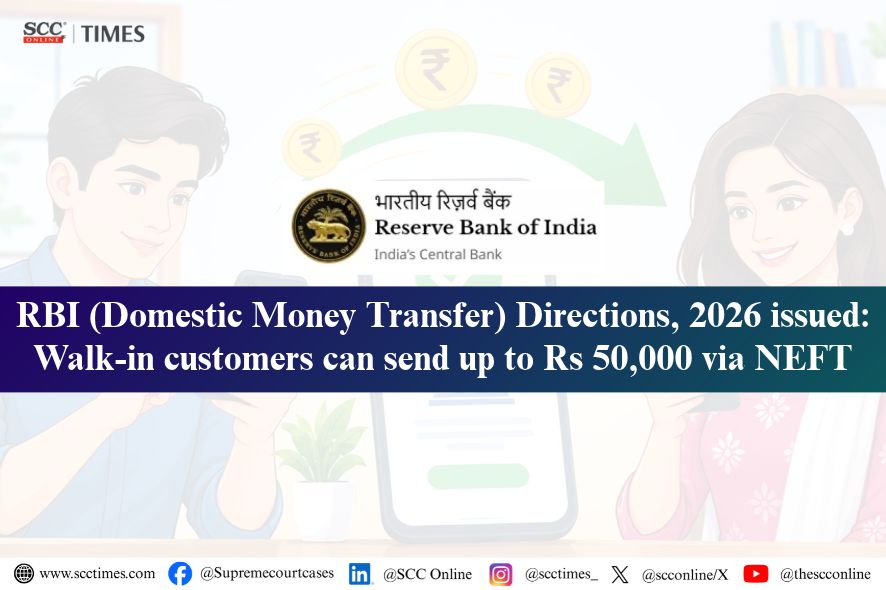
RBI: Domestic Money Transfer Directions 2026 Allow Rs 50,000 NEFT for Walk-Ins
Summary
- The Reserve Bank of India has issued the RBI (Domestic Money Transfer) Directions, 2026.
- These directions consolidate existing instructions for Domestic Money Transfer (DMT) operations.
- The new framework prescribes transaction limits, monitoring requirements, and regulatory safeguards.
- Its primary objective is to facilitate small-value fund transfers through formal banking channels.
- Walk-in customers are now permitted to send up to Rs 50,000 via NEFT under these new rules.
Introduction of New Regulations
A notable provision within these newly established regulations permits walk-in customers to initiate fund transfers up to a maximum of Rs 50,000 using the National Electronic Funds Transfer (NEFT) system.
The Reserve Bank of India has officially released the RBI (Domestic Money Transfer) Directions, 2026, marking a significant update to the regulatory landscape governing fund transfers within the country. This new directive aims to streamline and consolidate various existing guidelines related to Domestic Money Transfer (DMT) operations, providing a unified framework for financial institutions. The issuance underscores the central bank's commitment to enhancing the efficiency and accessibility of financial services for all citizens, ensuring a more coherent approach to financial transactions.
A notable provision within these newly established regulations permits walk-in customers to initiate fund transfers up to a maximum of Rs 50,000 using the National Electronic Funds Transfer (NEFT) system. This specific allowance is designed to cater to individuals who may not hold traditional bank accounts or possess comprehensive identity and address documentation, thereby expanding their access to formal banking channels for essential transactions. The RBI DMT Directions 2026 are poised to impact how financial entities manage and monitor these types of transactions, emphasizing both security and inclusion.
Comprehensive Regulatory Framework
The core objective behind the RBI (Domestic Money Transfer) Directions, 2026, is to foster the secure and efficient movement of small-value funds across India's financial system. By consolidating disparate instructions into a single, comprehensive document, the Reserve Bank of India seeks to provide clarity and consistency for all stakeholders involved in domestic money transfers. This consolidation is expected to simplify compliance efforts for financial institutions while simultaneously bolstering consumer protection and reducing operational complexities.
Beyond mere consolidation, the new framework introduces specific requirements concerning transaction limits, robust monitoring mechanisms, and essential regulatory safeguards. These measures are strategically implemented to prevent misuse of the system while ensuring that legitimate small-value transfers can be processed smoothly. The emphasis on formal banking channels is particularly crucial for integrating segments of the population that have historically faced barriers to financial inclusion, offering them a reliable and regulated avenue for their monetary needs and fostering greater trust in the financial system.
Empowering Walk-in Customers
A pivotal aspect of the RBI Domestic Money Transfer Directions 2026 is the explicit provision allowing walk-in customers to utilize the NEFT system for transfers up to Rs 50,000. This particular rule addresses a long-standing challenge for individuals who might not possess the standard proofs of identity or address typically required for opening full-fledged bank accounts. By setting this specific NEFT walk-in customer limit, the RBI is actively working to bridge gaps in financial access, making financial services more inclusive.
This initiative is especially beneficial for migrant workers, daily wage earners, and others in similar circumstances who frequently need to send money to their families but lack the necessary documentation for conventional banking services. The Reserve Bank of India fund transfer rules are thus tailored to facilitate these critical small-value transfers, ensuring they occur within a regulated environment that still prioritizes security and oversight. The introduction of these Domestic Money Transfer regulations India represents a forward step in broadening financial inclusion, ensuring that even those without extensive documentation can participate in the formal economy.
Practical Implications
Compliance officers and legal counsel for financial institutions must review and update their internal policies and procedures to align with the new RBI (Domestic Money Transfer) Directions, 2026, particularly regarding the Rs 50,000 NEFT limit for walk-in customers and the prescribed regulatory safeguards for identity and address verification.
Source
How does this affect you?
Get an AI analysis of this article grounded in your jurisdictions, practice areas, and any policy documents you've uploaded to Wansom.
Finish Reading the Full Story and the Expert Analysis.
Get the latest legal & regulatory intelligence in India
Wansom is AI and can make mistakes.