
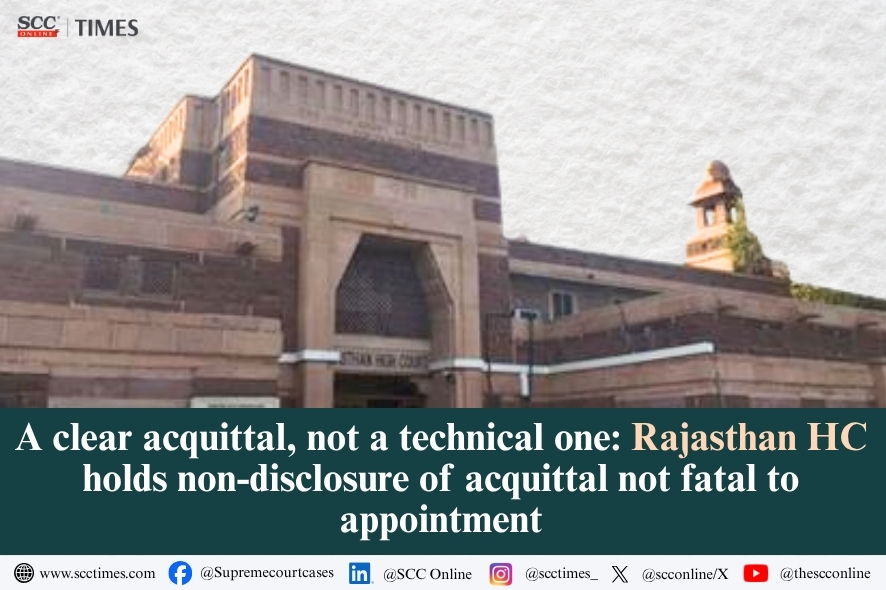
Rajasthan High Court: Avtar Singh Acquittal Appointment Non-Disclosure Unlawful
Summary
- The Rajasthan High Court ruled that rejecting a candidate solely for not disclosing prior criminal proceedings, where they were acquitted, was unlawful.
- The petitioner had been clearly acquitted of charges before the recruitment process began, with no pending cases against them.
- The court cited the Avtar Singh case, emphasizing that non-disclosure of a "clear acquittal" is not fatal to an appointment.
- This decision clarifies that employers cannot automatically disqualify candidates for non-disclosure if the acquittal was substantive and occurred before the application.
Rajasthan High Court Overturns Candidature Rejection
The ruling emphasizes that a prior acquittal, especially when clear and preceding the application, should not automatically be a barrier to public service.
The Rajasthan High Court recently delivered a significant ruling, determining that the rejection of a candidate's application based solely on the non-disclosure of past criminal proceedings, where the individual had been acquitted, was unlawful. This decision directly impacts the criteria for public employment eligibility, particularly concerning background checks and disclosure requirements for applicants. The court's pronouncement underscores a crucial distinction in how prior legal entanglements should be assessed during the hiring process.
The petitioner in this case faced disqualification from a public appointment after authorities cited their failure to reveal previous criminal charges. However, the court noted that the petitioner had been fully acquitted of these charges well before the recruitment process even began. Crucially, at the time of their application, no criminal proceedings were pending against them. This specific factual matrix led the Rajasthan High Court to conclude that the employer's decision to reject the candidature on this singular ground was inconsistent with established legal principles. The ruling emphasizes that a prior acquittal, especially when clear and preceding the application, should not automatically serve as a barrier to public service.
The Precedent of Avtar Singh and Acquittal Nuances
Central to the Rajasthan High Court's judgment was the precedent set by the `Avtar Singh case`, a landmark ruling that guides courts on issues of non-disclosure in public employment. The `Avtar Singh case disclosure appointment` principles were invoked to clarify that not all instances of non-disclosure are equally detrimental to a candidate's prospects. The recent decision reinforces the idea that the nature of the acquittal is paramount; it must be a "clear acquittal," rather than merely a "technical one."
A clear acquittal implies a finding of innocence on the merits of the case, whereas a technical acquittal might arise from procedural issues or lack of evidence without a substantive determination of guilt or innocence. The Rajasthan High Court's application of the `Avtar Singh acquittal appointment` framework suggests that employers must delve deeper than a mere checkmark on a disclosure form. The ruling provides important guidance for `service law criminal background check` procedures, indicating that a blanket policy of rejecting candidates for non-disclosure of a past, clear acquittal may not withstand legal scrutiny.
Implications for Public Employment Eligibility
This ruling by the Rajasthan High Court carries substantial implications for individuals seeking `public employment eligibility` across India and for the agencies responsible for hiring. It clarifies that an `acquitted candidate appointment India` cannot be arbitrarily denied simply because past criminal proceedings, which resulted in a clear acquittal, were not disclosed. The judgment effectively places a higher burden on employers to assess the actual impact of prior legal history, rather than relying on a strict interpretation of non-disclosure.
For candidates, this means that a prior, clear acquittal should not be an insurmountable obstacle, even if inadvertently or intentionally not disclosed. For employers, it necessitates a more nuanced approach to `non-disclosure prior criminal acquittal` situations, moving beyond a simple checklist to consider the substance of the judicial outcome. The decision reinforces the principle that an individual who has been cleared of charges should not face perpetual prejudice in their pursuit of public service, provided the acquittal was definitive and occurred before the application process.
Practical Implications
This ruling clarifies that employers cannot automatically reject candidates solely for not disclosing a prior *acquittal*, especially if the acquittal was clear and occurred before the recruitment process. Lawyers should advise clients on their rights regarding disclosure of past criminal proceedings and be prepared to challenge rejections based on this precedent.
Source
Source: Original reporting via SCC Times
How does this affect you?
Get an AI analysis of this article grounded in your jurisdictions, practice areas, and any policy documents you've uploaded to Wansom.
Finish Reading the Full Story and the Expert Analysis.
Wansom is AI and can make mistakes.