
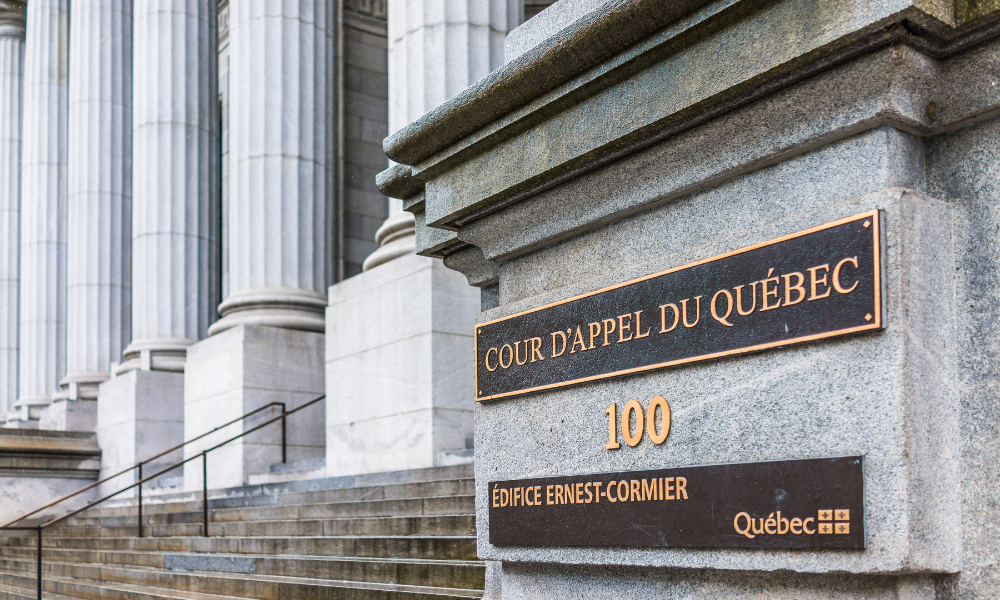
Quebec Court of Appeal: Upholds Void Power of Attorney in Estate Fraud
Summary
- The Quebec Court of Appeal dismissed an appeal by N. Floyd, who orchestrated a scheme to defraud K. Matsuba of over $2 million from an estate.
- The court upheld the annulment of a power of attorney and a gift letter, finding Matsuba's consent was vitiated by Floyd's fraud and deceit.
- Floyd was ordered to pay Matsuba over $2 million in material, moral, and punitive damages.
- The Court of Appeal granted the appeals of the notary and the professional liability insurer, dismissing Matsuba's proceedings against them.
- This ruling clarifies the court's stance on annulling fraudulent estate documents and the limits of professional liability when fraud is primarily perpetrated by a third party.
The Scheme to Defraud an Heir
The Quebec Court of Appeal decisively dismissed Floyd's appeal, imposing costs against him.
The Quebec Court of Appeal recently upheld a lower court's decision to annul a power of attorney and a gift letter, confirming a finding of significant estate fraud. The case, identified as Litvack c. Matsuba (Estate of Myers), 2026 QCCA 1147, centered on the estate of B. Myers, who passed away in January 2018, leaving assets valued at more than $2 million. His sole heir was K. Matsuba, with whom he had resided for two decades.
Following Myers' death, Matsuba expressed concerns about potential litigation from Myers' daughters regarding the will. N. Floyd, a friend of the deceased, offered to assist Matsuba in safeguarding the estate's assets. Within a year, Floyd, purportedly acting under a power of attorney signed by Matsuba, gained control over the majority of the estate's holdings. This included orchestrating the transfer of $1,250,444.25, representing the proceeds from the sale of an immovable property belonging to the estate, directly into his own account via an officiating notary. Floyd further induced Matsuba to sign a letter, which he presented as a gift of all funds held in Matsuba's accounts to himself. When Matsuba later requested the return of the money, Floyd refused, asserting that the gift could not be revoked.
Matsuba initiated legal action against Floyd in April 2020. The Quebec Superior Court responded by granting a Mareva injunction and issuing seizures before judgment to freeze Myers' banking and trading accounts. Approximately one year later, Matsuba expanded her legal efforts, bringing proceedings against the notary involved in the property transfer and a professional liability insurer. On May 30, 2024, Justice David Roberge of the Superior Court partially ruled in Matsuba's favor against Floyd, declaring both the power of attorney and the gift letter null and void. Floyd was ordered to pay Matsuba $2,071,886.17 in material damages, $75,000 for moral damages, and $50,000 in punitive damages. The Superior Court also affirmed the validity of the Mareva injunction and seizures, and held Floyd, the notary, and the insurer solidarily liable for $1,250,444.25.
Appellate Court Upholds Fraud Findings Against Perpetrator
Floyd, along with the notary and the Chambre des notaires du Québec (represented by the insurer), subsequently appealed the Superior Court's judgment. The Quebec Court of Appeal decisively dismissed Floyd's appeal, imposing costs against him. The appellate court declined to overturn the trial judge's factual determinations, noting the absence of a complete record, including evidentiary transcripts from the original trial proceedings. Crucially, the Court of Appeal found no reversible error in the trial judge's decision to annul the power of attorney and mandate the restitution of all appropriated funds, citing the pervasive fraud that had vitiated Matsuba's consent.
The appellate panel specifically rejected Floyd's contention that the power of attorney signed by Matsuba was valid, agreeing with the trial judge's finding that Floyd had exaggerated the risk of estate litigation to manipulate Matsuba. Furthermore, the court saw no basis to interfere with the declaration that the gift letter was null and void. This decision was grounded in the deceitful tactics employed by Floyd, which had similarly vitiated Matsuba's consent. The court noted that Matsuba had been led to believe the gift letter would protect her from litigation by Myers' daughters, rather than transfer all estate assets to Floyd. The Court of Appeal also affirmed the material damages award, the moral damages award—despite acknowledging it was at the higher end, given Matsuba's mental anguish and social humiliation—and the punitive damages award, recognizing its preventive purpose and the severe nature of the interference.
Clarifying Notary and Insurer Liability
While firmly rejecting Floyd's appeal, the Quebec Court of Appeal took a different stance regarding the notary and the professional liability insurer. The appellate court granted their respective appeals, thereby dismissing Matsuba's legal proceedings against them. This outcome means that the notary and the insurer were not held liable for the damages, reversing the Superior Court's initial solidary judgment against them. The Court of Appeal ordered Matsuba to pay costs on appeal to the notary and insurer, while no costs were awarded at the first instance.
This aspect of the ruling provides important clarification on the scope of notary liability in cases where the primary fraud is perpetrated by a third party. The appellate court's decision to exonerate the notary and insurer suggests a nuanced approach to professional responsibility, distinguishing between direct involvement in fraudulent acts and circumstances where a notary's actions, while facilitating a transaction, are not deemed to be the direct cause of the fraud or a result of their own reviewable error in the context of the primary fraudster's deceit.
Implications for Estate Planning and Fraud Prevention
This judgment from the Quebec Court of Appeal underscores the judiciary's commitment to protecting vulnerable individuals from estate fraud and deceit. The decision to void a power of attorney and annul a gift letter due to vitiated consent serves as a critical precedent, particularly in cases involving significant asset transfers where undue influence or misrepresentation is suspected. It reinforces the principle that genuine, informed consent is paramount for the validity of such legal instruments, especially when dealing with elderly or susceptible clients.
The ruling also offers valuable insights for legal professionals involved in estate planning. Lawyers advising on these matters, particularly those concerning vulnerable clients or substantial asset transfers, should be acutely aware of the court's willingness to overturn instruments obtained through fraudulent means. For notaries and their professional liability insurers, the granting of their appeals provides guidance on the limits of their liability, suggesting that their responsibility may be mitigated when the fraud is primarily orchestrated by a third party, rather than stemming from their own professional misconduct. The case highlights the ongoing challenge of combating estate fraud in Quebec and the robust legal mechanisms available to address it, including the use of a Mareva injunction to freeze assets.
Practical Implications
This ruling clarifies the Quebec Court of Appeal's stance on annulling powers of attorney and gift letters obtained through fraud and deceit in estate matters, emphasizing the importance of genuine consent. Lawyers advising on estate planning, particularly concerning vulnerable clients or significant asset transfers, should note the court's willingness to overturn such instruments. For notaries and professional liability insurers, the case provides guidance on the limits of their liability when fraud is primarily perpetrated by a third party, as their appeals were granted.
Source
How does this affect you?
Get an AI analysis of this article grounded in your jurisdictions, practice areas, and any policy documents you've uploaded to Wansom.
Finish Reading the Full Story and the Expert Analysis.
Wansom is AI and can make mistakes.