
US Legal Firms: Probabilistic AI Verification Tax Creates Hidden Costs
Summary
- Most AI tools in legal are probabilistic, offering "best guesses" that create a "verification tax" for complex matters.
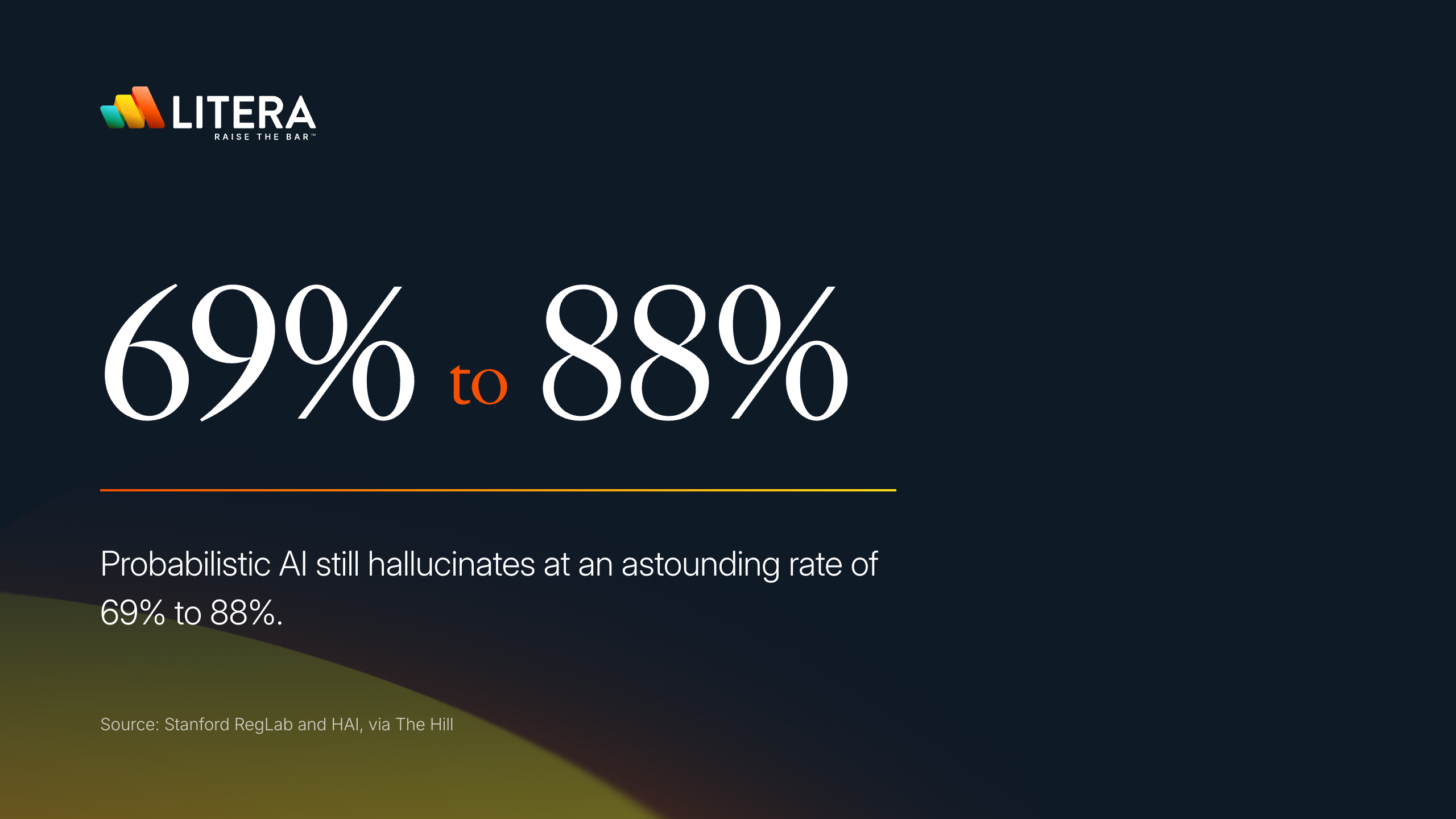
- Probabilistic AI exhibits high hallucination rates, ranging from 69% to 88%, leading to significant trust issues among lawyers and clients.
- Deterministic AI, based on fixed rules, provides consistent and accurate outputs, making it suitable for tasks requiring absolute precision.
- While probabilistic AI aids open-ended tasks, deterministic AI is crucial for exact, checkable legal work where accuracy is paramount.
- The fragmentation of AI "point solutions" forces lawyers to switch contexts, diminishing efficiency and increasing the risk of errors in complex legal workflows.
The Challenge of Probabilistic AI in Legal
The prevalence of AI hallucination rates legal contexts is striking, with probabilistic models exhibiting error rates ranging from 69% to 88%.
Artificial intelligence has undeniably accelerated numerous legal processes, yet its application to the most intricate and high-stakes legal matters often introduces unforeseen complications, negating potential speed advantages. The fundamental issue stems from the nature of most contemporary AI tools, which operate on a probabilistic model. These systems are designed to predict a likely answer, essentially offering an educated guess rather than a definitive truth.
While such estimations may suffice for routine operations, relying on a "best guess" for critical tasks like detailed contract reviews or comparative analyses carries significant risks. A single overlooked risk, an erroneous detail, or a missing amendment can have profound repercussions for clients, transactional integrity, and overall professional trust. This inherent uncertainty in Probabilistic AI verification tax legal contexts necessitates a critical re-evaluation of its deployment.
The Hidden Cost of Uncertainty: The 'Verification Tax'
The reliance on probabilistic AI introduces a substantial, often hidden, financial burden known as the "verification tax." When legal professionals cannot confidently discern the accuracy of AI-generated content, they are compelled to meticulously review every line. This leads to countless hours spent re-examining AI-produced drafts, diligently searching for hallucinated clauses, and correcting errors introduced by general-purpose models rather than identified by them.
The prevalence of AI hallucination rates legal contexts is striking, with probabilistic models exhibiting error rates ranging from 69% to 88%. This alarming inaccuracy contributes directly to widespread Legal AI trust issues; indeed, 39% of lawyers report that a lack of confidence in AI results is a primary barrier to its adoption. Furthermore, client perception mirrors this skepticism, with only 6% of clients currently believing their vendors deliver quality enhanced by AI. This creates a paradox for legal firms: either avoid AI for sensitive work, losing any efficiency gains, or use it and then invest heavily in re-checking, effectively erasing the very cost savings AI promised.
Deterministic AI: Precision for Complex Legal Matters
The "verification tax" is not a flaw in a specific tool but an intrinsic characteristic of how probabilistic AI functions. However, the legal tech landscape offers alternatives. Deterministic AI legal applications operate on fixed rules, ensuring that the same input consistently yields the same correct output. Unlike probabilistic models that estimate, rules-based systems compute answers for defined tasks, such as precisely identifying changes between contract versions. This means asking the system twice will always produce an identical result, establishing a clear distinction in Legal AI trust issues.
While probabilistic models are trained to *sound* correct, deterministic engines are engineered to *be* correct for any task with a definable answer. One provides a strong opinion; the other delivers a verifiable fact. Both AI types have their place: probabilistic models excel in open-ended tasks like search and summarization where a single correct answer doesn't exist, while deterministic engines are the safer choice for exact, checkable work where even being "close" is unacceptable. The most robust systems strategically combine both, applying the appropriate AI for the specific task at hand, especially for complex legal matters AI accuracy.
Overcoming Fragmentation for Integrated Legal Workflows
Beyond the choice between probabilistic and deterministic approaches, the legal sector faces another significant challenge: fragmentation. Many current AI tools are designed as "point solutions," each addressing only a single step in a broader legal matter. One tool might draft, another review contracts, a third compare versions, and a fourth manage transactions. This forces lawyers handling complex deals to constantly switch between multiple platforms and logins, leading to a loss of context and introducing additional costs.
This "context-switching" is precisely what AI was intended to eliminate. However, because no single tool provides a holistic view of an entire matter, the burden of ensuring accuracy falls back on the lawyer, who must manually stitch together outputs and identify gaps. This scenario often presents inefficiency disguised as innovation. The critical question for legal firms should not be how quickly an AI completes one step, but whether a platform can manage every stage of the most intricate matter, from initial draft to final closing, with integrated workflows designed to advance the deal effectively and with a consistent standard of Rules-based AI legal tech accuracy.
Practical Implications
Lawyers and compliance officers must critically evaluate legal AI tools, understanding the inherent risks like the 'verification tax' and hallucination rates associated with probabilistic AI, especially for complex, high-stakes matters. Prioritize deterministic AI for tasks requiring absolute accuracy to ensure client trust and avoid re-checking inefficiencies.
Source
How does this affect you?
Get an AI analysis of this article grounded in your jurisdictions, practice areas, and any policy documents you've uploaded to Wansom.
Wansom is AI and can make mistakes.