
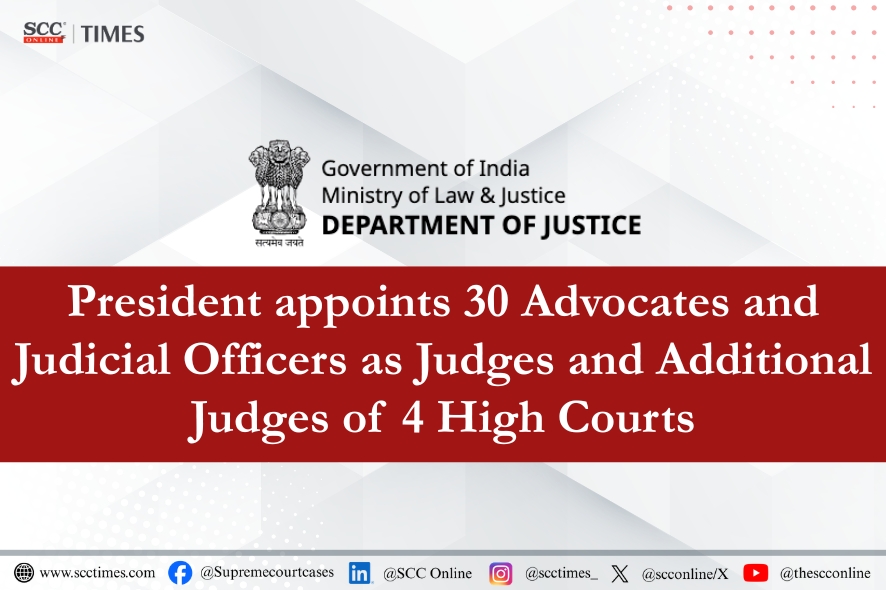
President Appoints Judges to Madras Calcutta Karnataka and Madhya Pradesh High Courts
Summary
- The President has appointed 30 Advocates and Judicial Officers as Judges and Additional Judges of four High Courts. [13, 28, 32, 35, 36]
- 15 new judges will be added to the Madras High Court, 8 additional judges to the Calcutta High Court, 6 additional judges to the Karnataka High Court, and 1 additional judge to the Madhya Pradesh High Court. [13, 19, 32, 35, 36]
- The appointments were notified through separate Gazette notifications dated 7 August 2026. [13, 28, 32, 35, 36]
- The new judicial officers are expected to impact case scheduling and strategy for lawyers in these jurisdictions.
New Appointments to High Courts
The President has appointed 30 Advocates and Judicial Officers as Judges and Additional Judges of four High Courts, including 15 Judges for the Madras High Court, 8 Additional Judges for the Calcutta High Court, 6 Additional Judges for the Karnataka High Court, and 1 Additional Judge for the Madhya Pradesh High Court. [13, 19, 32, 35, 36]
The President has made significant changes to the judiciary in India by appointing 30 Advocates and Judicial Officers as Judges and Additional Judges of four High Courts. This move is expected to have a substantial impact on the availability of counsel in these jurisdictions, potentially influencing case scheduling and strategy for lawyers. The appointments were notified through separate Gazette notifications dated 7 August 2026. [13, 28, 32, 35, 36]
The Madras High Court will see 15 new judges, while the Calcutta High Court will have 8 additional judges, the Karnataka High Court 6 additional judges, and the Madhya Pradesh High Court 1 additional judge appointed to their benches. [13, 19, 32, 35, 36] This influx of new judicial officers is likely to lead to a shift in the dynamics of these courts, with potential implications for the administration of justice.
Legal Context
The appointment of Advocates and Judicial Officers as Judges and Additional Judges is a crucial aspect of the Indian judiciary's functioning. These appointments are made by the President on the recommendation of the Collegium, which comprises the Chief Justice of India and other senior judges. [14, 15, 16, 23] The process involves a thorough evaluation of the candidates' suitability for the position, taking into account their experience, expertise, and track record.
The appointments to the High Courts are governed by the High Court Judges (Salaries and Conditions of Service) Act, 1954, which outlines the terms and conditions of service for judges. [25, 26, 31, 33, 34] The President's decision to appoint these individuals is also subject to the approval of the Parliament, ensuring that the appointments are in line with the country's laws and regulations.
Why It Matters
The new appointments to the High Courts have significant implications for the administration of justice in India. The influx of new judicial officers is likely to lead to a shift in the dynamics of these courts, potentially influencing case scheduling and strategy for lawyers. Moreover, the availability of counsel in these jurisdictions may be impacted, affecting access to justice for litigants.
Lawyers practicing in these jurisdictions should take note of these developments and adjust their strategies accordingly. The appointments also highlight the importance of the Collegium's role in recommending candidates for appointment as judges, ensuring that the judiciary remains independent and impartial.
Practical Implications
Lawyers should note these new appointments, which may impact the availability of counsel in these jurisdictions and potentially influence case scheduling and strategy.
Source
Source: Original reporting via SCC Times
How does this affect you?
Get an AI analysis of this article grounded in your jurisdictions, practice areas, and any policy documents you've uploaded to Wansom.
Wansom is AI and can make mistakes.