
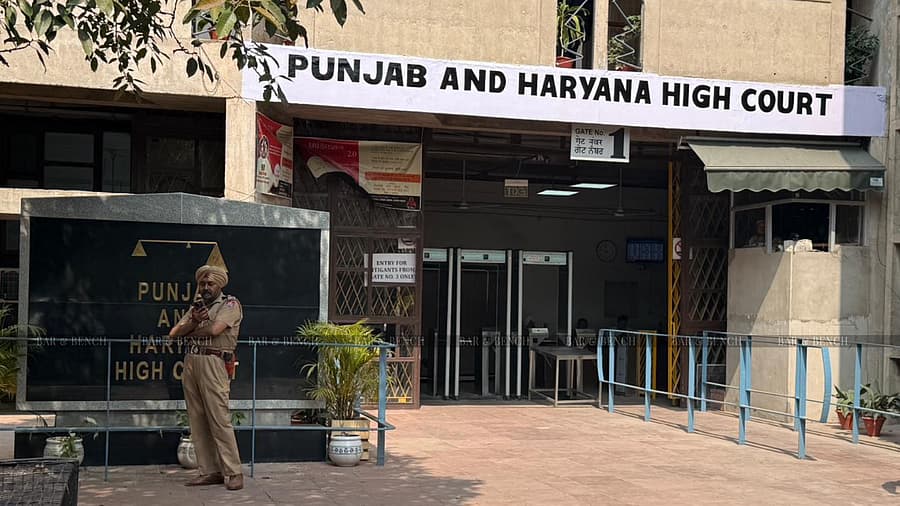
P&H High Court: Beant Singh Family Retains Government House
Summary
- The Punjab and Haryana High Court allowed the family of former Chief Minister Beant Singh to retain a government house in Chandigarh.
- This decision was based on an official assessment of security threats faced by the Beant Singh family, despite their lack of official position.
- The High Court ruled the case was distinguishable from general Supreme Court directives regarding former public functionaries vacating government accommodation.
- Beant Singh, a former CM, was assassinated in a bomb attack in 1995, after which the government house was allotted to his family.
- The ruling establishes a precedent for making exceptions to government housing rules in cases of officially assessed severe security risks.
Recent Judicial Decision
The High Court emphasized that this particular case was 'of its own kind' and 'clearly distinguishable,' thereby placing it outside the usual scope of the apex court's pronouncements.
The Punjab and Haryana High Court recently issued a significant ruling concerning the continued occupancy of a government residence in Chandigarh by the family of former Chief Minister Beant Singh. A Division Bench, comprising Chief Justice Ashwani Kumar Mishra and Justice Rohit Kapoor, rejected an application that sought to challenge the family's right to remain in the property. This decision specifically allows Beant Singh's son, Tej Parkash Singh, and other family members to retain the government house, despite their current lack of official public office. The case, formally known as Court on its own motion v UT Chandigarh, centered on the unique circumstances surrounding the family's situation.
The High Court's determination was heavily influenced by an official assessment from the Chandigarh administration, which highlighted ongoing security threats faced by the family. This crucial factor distinguished their case from typical scenarios involving former public functionaries. The court concluded that the established directives from the Supreme Court, which generally mandate the vacation of government accommodation by individuals no longer holding office, could not be applied rigidly in this instance, given the severe and officially recognized security risks.
Legal Framework and Exceptional Circumstances
The legal landscape regarding the retention of state-provided housing by former public officials is typically governed by clear directives from the Supreme Court, aimed at preventing undue privilege and ensuring efficient use of public resources. These guidelines generally stipulate that individuals, once they cease to hold their official positions, must vacate government accommodation. However, the Punjab and Haryana High Court found the situation of the Beant Singh family to be an exceptional one, warranting a departure from these standard rules.
The court explicitly stated that the Supreme Court's general directions could not, by themselves, compel the family to vacate the residence. This was a direct consequence of the Chandigarh administration's assessment, which confirmed the persistent and serious security concerns surrounding the family. The High Court emphasized that this particular case was 'of its own kind' and 'clearly distinguishable,' thereby placing it outside the usual scope of the apex court's pronouncements. This ruling sets a precedent for situations where demonstrable and officially verified security threats can create an exception to otherwise stringent rules on government housing.
Background of the Allotment
The background to this long-standing occupancy traces back to a tragic event in Punjab's history. Beant Singh, a prominent Congress leader, served as the Chief Minister of Punjab from 1992 until his assassination on August 31, 1995. His life was cut short in a devastating bomb attack that occurred outside the Punjab Secretariat in Chandigarh, an incident that also claimed the lives of several other individuals.
In the immediate aftermath of this profound tragedy, the government house in question was allotted to his family as a measure of support and security. This initial allotment, made under extraordinary circumstances following the assassination of a sitting Chief Minister due to extremist violence, underscores the unique nature of the family's connection to the residence. The continued need for this accommodation, as assessed by the Chandigarh administration, is directly linked to the enduring security implications stemming from the circumstances of Beant Singh's death and his role during a turbulent period in the state. The former CM Beant Singh residence has thus remained a focal point of security considerations for his family for decades.
Significance of the Ruling
This ruling by the Punjab Haryana High Court carries significant implications, particularly for cases involving high-profile individuals who may face severe and officially recognized security threats. It establishes a clear precedent that while Supreme Court directions on government housing are generally binding, an exception can be made when an administrative assessment confirms a grave security risk. The court's emphasis on the 'distinguishable' nature of this case highlights that such exceptions are not to be taken lightly but must be grounded in concrete, verifiable threats.
The decision reinforces the idea that judicial bodies can exercise discretion in applying broad legal principles when faced with unique and compelling factual matrices, especially those involving the safety and security of individuals. For legal practitioners, this case provides a valuable reference point for arguing exceptional circumstances in matters concerning state-provided resources for individuals facing demonstrable dangers, moving beyond a strict interpretation of rules that might not fully account for extraordinary security needs. The Punjab Haryana High Court security threat housing decision underscores the judiciary's role in balancing administrative efficiency with individual safety.
Practical Implications
This ruling establishes a precedent where severe security threats, officially assessed, can justify an exception to general Supreme Court directives on former public functionaries retaining government accommodation. Lawyers should note this for cases involving high-profile individuals facing demonstrable security risks who seek to retain state-provided resources, as it provides a basis for arguing exceptional circumstances.
Source
How does this affect you?
Get an AI analysis of this article grounded in your jurisdictions, practice areas, and any policy documents you've uploaded to Wansom.
Finish Reading the Full Story and the Expert Analysis.
Get the latest legal & regulatory intelligence in India
Wansom is AI and can make mistakes.