
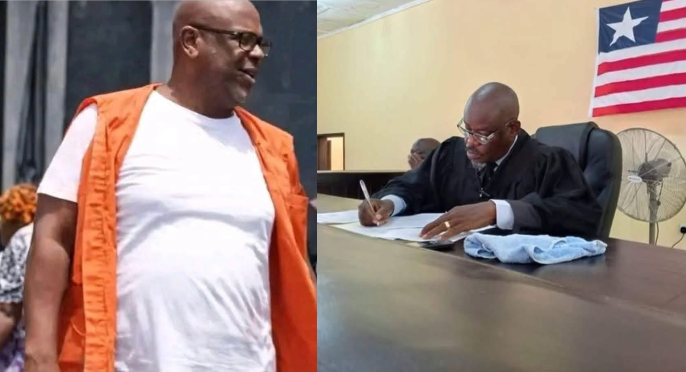
Peter Bon Jallah: Motion Filed to Overturn Contradictory Conviction
Summary
- Judge Wesseh Alphonsus Wesseh Sr. convicted Peter Bon Jallah of statutory rape and kidnapping but acquitted him of gang rape.
- Jallah's lawyers filed a motion for a new trial, arguing the split verdict is contradictory and cannot logically stand.
- The defense contends that if evidence for gang rape during a three-day confinement was insufficient, the kidnapping charge based on the same confinement is invalid.
- The motion also challenges Criminal Court E's jurisdiction over the kidnapping charge, as it is a specialized sexual offenses court.
- Jallah, a former national security aide, was remanded to prison, and no sentence has yet been imposed.
Initial Verdict and Immediate Challenge
This case could establish a significant legal precedent regarding contradictory verdicts and jurisdictional boundaries in Liberia.
A Liberian judge recently delivered a split verdict in a high-profile case involving Peter Bon Jallah, a 63-year-old former special assistant to the director of Liberia's National Security Agency (NSA). On Friday, October 23, Judge Wesseh Alphonsus Wesseh Sr. found Jallah guilty of statutory rape and kidnapping, while simultaneously acquitting him of gang rape. This contradictory outcome immediately prompted a legal challenge from Jallah's defense team.
Just four days after the verdict, on Tuesday, October 27, at 11:12 a.m., Jallah's lawyers filed a motion for a new trial at Criminal Court E in Monrovia. The filing, received by Acting Clerk of Court Abraham Richards, directly asks the presiding judge to set aside his own verdict. The core of their argument is that the two parts of the ruling—a conviction for some charges and an acquittal for others stemming from the same alleged events—are fundamentally inconsistent and cannot logically stand together.
The Prosecution's Case and Trial Details
The legal proceedings against Jallah began following his arrest on January 7, 2026, after the mother of a 16-year-old boy, who performed paid chores at Jallah's residence, lodged a complaint with the police Women and Children Protection Section. A grand jury subsequently indicted Jallah and two unidentified men in February on charges of gang rape, statutory rape, and kidnapping. The indictment detailed alleged abuse occurring at Jallah's home on November 29 and December 24, 2025. Further allegations included Jallah luring the boy with football boots on January 1, 2026, driving him to a building off Camp Johnson Road in central Monrovia, and holding him there for three days where he and two other men allegedly abused him; the two other men were never brought before the court.
Jallah, who consistently denied all accusations, opted for a judge trial instead of a jury. The court ultimately acquitted him of gang rape, citing insufficient evidence presented by the prosecution. However, he was convicted of statutory rape and kidnapping. Following the conviction, Jallah was remanded to Monrovia Central Prison, awaiting a pre-sentence report from the Ministry of Justice's Bureau of Probation Services, with no sentence yet imposed.
During the trial, the prosecution presented 13 regular witnesses and six rebuttal witnesses, while the defense called eight witnesses, including Jallah himself, along with three subpoenaed witnesses from the Ministry of Gender, Children and Social Protection, Orange Liberia, and the John F. Kennedy Medical Center. Key evidence included testimony from Pascal Bavugirije of the Rwanda Forensic Institute, who analyzed exhibits sent from Liberia and confirmed DNA profiles from four clothing items matched Jallah's reference sample, though material from the alleged scene yielded a mixed profile from unknown individuals. The boy testified in August about three assaults, and his police statement was admitted despite defense objections. Investigators also informed the court that phone records placed Jallah near an alleged scene, contradicting his claim of no contact with the boy.
Core Arguments of the Motion to Overturn
The motion for a new trial, signed by Counsellor G. Wiefueh Alfred Sayeh of the Law Offices of Sayeh & Sayeh, outlines four primary claims challenging the verdict. The first central argument asserts that the kidnapping conviction directly contradicts the acquittal on the gang rape charge. The defense highlights that the kidnapping charge is predicated on the alleged three-day confinement of the boy at a building off Camp Johnson Road—the very same incident central to the gang rape accusation.
According to the motion, if the court determined there was insufficient evidence to prove gang rape occurred at that specific location, it logically cannot simultaneously conclude that the boy was unlawfully held there. This inconsistency leads the defense to describe the conviction as being “contrary to the weight of the evidence.” A second significant claim advanced by the defense challenges the jurisdiction of Criminal Court E over the kidnapping charge, arguing that as Liberia's specialized court for sexual offenses, it lacks the authority to adjudicate kidnapping as a standalone offense.
Implications for Liberian Jurisprudence
This motion represents the first formal test of a verdict that, by the court's own admission, stated its conclusions without detailing the specific weight given to each witness and exhibit. The defense is actively leveraging this gap in the court's record to argue for a new trial. The outcome of this motion could have substantial implications for the Liberian legal system.
This case could establish a significant legal precedent regarding contradictory verdicts and jurisdictional boundaries in Liberia. It will also scrutinize the scope of specialized courts and the standards by which judicial findings are expected to be consistent and thoroughly reasoned, particularly in complex criminal matters involving multiple charges and intricate evidence.
Practical Implications
Lawyers in Liberia should observe the specific legal arguments advanced to challenge a conviction based on perceived contradictory verdict elements and jurisdictional limitations of specialized courts. This case highlights potential grounds for motions for a new trial or appeals, particularly concerning the interpretation of evidence and the scope of a court's authority in complex criminal matters.
Source
How does this affect you?
Get an AI analysis of this article grounded in your jurisdictions, practice areas, and any policy documents you've uploaded to Wansom.
Finish Reading the Full Story and the Expert Analysis.
Wansom is AI and can make mistakes.