
Liberia House Orders Government Salary Review Amid Public Outcry
Summary
- The Liberian House of Representatives has ordered a comprehensive review of government salaries and benefits.
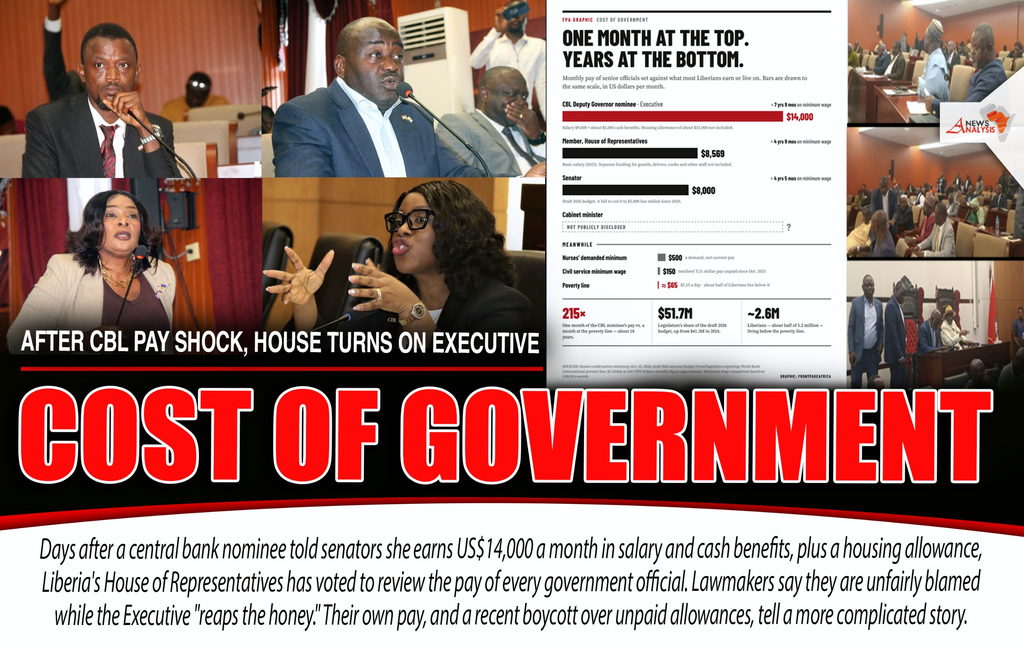
- This action was prompted by the public disclosure of Central Bank of Liberia nominee Euphemia Swen-Monmia's monthly compensation package, totaling approximately US$14,000 in salary and cash benefits, plus a US$15,000 housing allowance.
- Lawmakers claim they are unfairly blamed for the national wage bill, arguing that executive officials and state-owned enterprise heads earn significantly more than their own salaries.
- The legislative review committees are tasked with reporting their findings within two weeks.
- Liberia, a nation of 5.2 million people still recovering from civil war, faces these debates while half its population lives below the poverty line.
Legislative Action on Public Sector Wages
The ensuing controversy centers not on her qualifications, but on the revelation that compensation at the highest levels of Executive agencies is substantial and typically not made public.
The Liberian House of Representatives has initiated a comprehensive review of salaries and benefits across all government branches. This decision, reached through a unanimous vote, mandates the House's Ways, Means and Finance, and Public Accounts committees to scrutinize the compensation packages of public officials and report their findings within a fortnight. Representative Alex S. Noah of Sinoe County introduced the motion that led to this directive.
This legislative move follows closely on the heels of a rare public disclosure regarding a senior official's earnings, which intensified public discontent over the operational costs of the government in one of the world's most impoverished nations. Lawmakers, during their debate, contended that they are unfairly blamed for the country's substantial wage bill, asserting that ministers and leaders of state-owned enterprises receive significantly higher remuneration.
Unveiling Executive Compensation
The catalyst for the House's action was the testimony of Euphemia G.T. Swen-Monmia, President Joseph Boakai's nominee for Deputy Governor for Economic Policy at the Central Bank of Liberia (CBL). During her confirmation hearing before the Senate Committee on Banking and Currency on October 22, Swen-Monmia openly detailed her compensation, a practice uncommon among Liberian officials. She disclosed a monthly salary of US$9,000, supplemented by approximately US$5,000 in additional cash benefits each month. Furthermore, her housing allowance is projected to be around US$15,000.
Having served in an acting capacity since August 12, Swen-Monmia's annual salary and cash benefits alone total approximately US$168,000, excluding the housing component. This figure starkly contrasts with the government's minimum monthly wage of US$150 for civil servants; an individual earning this minimum would need more than seven and a half years of continuous employment to match Swen-Monmia's earnings for a single month. While Swen-Monmia is a seasoned central banker who joined the CBL in 2010 as a management trainee and advanced to director of its Financial Markets Department, the ensuing controversy centers not on her qualifications, but on the revelation that compensation at the highest levels of Executive agencies is substantial and typically not made public.
Lawmakers' Grievances and the Public Wage Bill
Although no specific mention of Swen-Monmia's testimony occurred during the House's debate, the timing and the focus on officials earning over US$5,000 monthly indicate that her disclosure provided fresh impetus for the legislative body. Members of the House frequently feel unfairly characterized as the primary contributors to Liberia's official pay debate. Several representatives characterized their own compensation as minimal when compared to that of Executive officials, arguing that their extensive constituent responsibilities warrant greater remuneration.
Representative Moima Briggs-Mensah of Bong County highlighted the challenges faced by lawmakers, noting that a US$2,000 budget allocation intended for constituent school scholarships often fails to materialize. She also pointed out the absence of insurance and Social Security benefits for legislators, contrasting this with the provisions enjoyed by Executive officials. Similarly, Representative Anthony Williams of Maryland County asserted that lawmakers are unjustly criticized by the public, while essential benefits like fuel deliveries are often delayed by months. Williams specifically demanded that state enterprises provide transparent disclosures of their gross and net pay and benefits to the House of Representatives.
The National Financial Landscape
The claims made by lawmakers regarding their compensation levels are juxtaposed against available financial data. According to the draft 2026 budget, Senators each receive US$8,000 per month. A legislative proposal introduced by Senator Abraham Darius Dillon in 2020, aiming to reduce this senatorial salary to US$5,000, has remained stalled for several years. For House members, the basic monthly salary in 2025 was approximately US$8,569, supplemented by additional funds designated for support staff including security guards, drivers, and cooks.
The overall expenditure for the legislature has also seen an increase. The draft 2026 budget allocates US$51.7 million to the legislative branch, a rise from US$41.3 million in 2025. This financial context is particularly significant for Liberia, a West African nation of approximately 5.2 million people, which is still in the process of rebuilding after a 14-year civil war that concluded in 2003. The country's national budget surpassed US$1 billion for the first time this year, yet roughly half of its population continues to live below the poverty line.
Practical Implications
Lawyers advising Liberian government agencies or officials should anticipate potential legislative changes or increased scrutiny regarding executive compensation and benefits, possibly leading to new disclosure requirements or salary caps. This development signals a heightened focus on public sector wage bills and transparency, which could impact future employment contracts or compliance obligations for high-ranking positions.
Source
How does this affect you?
Get an AI analysis of this article grounded in your jurisdictions, practice areas, and any policy documents you've uploaded to Wansom.
Finish Reading the Full Story and the Expert Analysis.
Wansom is AI and can make mistakes.