
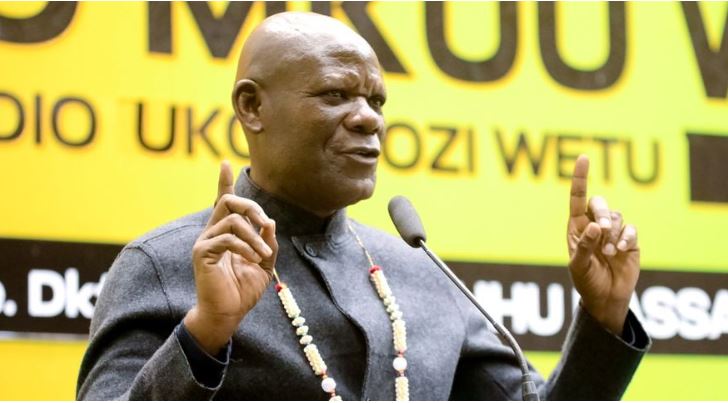
PCCB arraigns CWT president in economic sabotage case
Abstract
The President of the Tanzania Teachers’ Union (CWT), Suleiman Ikomba, along with seven other current and former union leaders, has been arraigned before the Dodoma Resident Magistrate’s Court on charges of corruption, criminal conspiracy, and economic sabotage. This high-profile case highlights Tanzania's ongoing efforts to combat financial misconduct, particularly within public and quasi-public institutions. The charges, brought by the Prevention and Combating of Corruption Bureau (PCCB), underscore the severe legal ramifications under the Economic and Organised Crime Control Act and the Prevention and Combating of Corruption Act, drawing attention to the legal framework governing such serious offences in the country.
Introduction
In a significant development for anti-corruption efforts in Tanzania, Suleiman Ikomba, the President of the Tanzania Teachers’ Union (CWT), recently appeared before the Dodoma Resident Magistrate’s Court. He joined seven other current and former union leaders who are facing grave charges of alleged corruption, criminal conspiracy, and economic sabotage. This arraignment by the Prevention and Combating of Corruption Bureau (PCCB) signals a continued robust stance by Tanzanian authorities against financial misconduct, particularly when it involves leaders of influential public sector organizations. The case has garnered considerable attention, not only due to the prominence of the accused but also because of the serious nature of the charges, which carry substantial penalties under Tanzanian law.
Background
The legal framework underpinning the charges against the CWT leaders is primarily found in three key pieces of legislation in Tanzania: the Economic and Organised Crime Control Act, the Prevention and Combating of Corruption Act, and the Penal Code. Economic sabotage offences are predominantly governed by the Economic and Organised Crime Control Act, Chapter 200 R.E. 2023, which defines such acts as those committed without lawful excuse and for a purpose prejudicial to the economic safety or interests of Tanzania, or likely to damage, hinder, or interfere with a necessary service or its operation. This Act also established the Corruption and Economic Crimes Division of the High Court to handle such matters. Corruption offences, on the other hand, fall under the Prevention and Combating of Corruption Act, 2007, Chapter 329 R.E. 2023, which created the Prevention and Combating of Corruption Bureau (PCCB) as an independent public body tasked with preventing, investigating, and prosecuting corruption. Lastly, criminal conspiracy is addressed in the Penal Code, Chapter 16 R.E. 2023, specifically sections 384 to 386, which criminalize agreements between two or more persons to commit an unlawful act.
Analysis
The charges of economic sabotage, corruption, and criminal conspiracy against the CWT leaders represent a multi-faceted legal challenge. Economic sabotage is considered a severe economic offence in Tanzania, often involving significant financial losses or disruption to essential services. While the Economic and Organised Crime Control Act establishes a specialized division of the High Court for these crimes, Resident Magistrate's Courts frequently handle the initial arraignments and preliminary stages of such cases. A crucial procedural aspect for economic offences is that the Director of Public Prosecutions (DPP) must provide consent for prosecutions to proceed. This requirement ensures a level of oversight in bringing such serious charges, although the PCCB itself has powers to investigate and prosecute corruption offences, subject to the DPP's directions for most cases.
Corruption charges under the Prevention and Combating of Corruption Act encompass a broad range of illicit activities, including soliciting, accepting, or obtaining any advantage without lawful consideration. The PCCB's mandate is to investigate and recommend prosecutions, playing a central role in Tanzania's anti-corruption strategy. However, the need for DPP consent for many corruption cases has been a subject of discussion regarding the PCCB's full prosecutorial independence. The inclusion of criminal conspiracy charges, as outlined in the Penal Code, implies that the prosecution alleges an agreement among the accused to commit the primary offences of corruption and economic sabotage. The actus reus for conspiracy is the agreement itself, meaning the prosecution does not necessarily need to prove that the intended crime was fully executed, only that an unlawful agreement existed.
The arraignment before the Resident Magistrate's Court indicates that the case is in its preliminary stages. Such courts have jurisdiction to hear mentions and grant bail, depending on the nature and value of the property involved in the alleged economic offence. For instance, bail conditions for economic offences can be stringent, often requiring substantial cash deposits or reliable guarantors, especially if the value of the property exceeds a certain threshold. The complexity of these charges, involving multiple defendants and overlapping statutory provisions, suggests a potentially lengthy and intricate legal process. The case will likely involve detailed investigations into financial transactions and organizational conduct, with the PCCB playing a leading role in gathering evidence.
Conclusion
The arraignment of the CWT president and other union leaders on charges of economic sabotage, corruption, and criminal conspiracy underscores the Tanzanian government's commitment to upholding accountability and combating financial malfeasance, even within influential public sector bodies. For legal practitioners, this case highlights the intricate interplay between the Economic and Organised Crime Control Act, the Prevention and Combating of Corruption Act, and the Penal Code, particularly concerning the procedural requirements for prosecution, such as the DPP's consent. Defence counsel will need to meticulously navigate the elements of each charge, the admissibility of evidence gathered by the PCCB, and the specific bail provisions applicable to economic offences.
As this high-profile case progresses, it will be crucial to observe how the courts interpret and apply these statutes, especially concerning the thresholds for economic sabotage and the evidentiary standards for conspiracy. The outcome could set important precedents for governance within unions and other public institutions, reinforcing the message that no individual is above the law. Practitioners should closely monitor developments, as they may offer valuable insights into the evolving landscape of anti-corruption and economic crime enforcement in Tanzania.
Citations
- 1.The Prevention and Combating of Corruption Act, 2007, Cap 329 R.E. 2023
- 2.The Economic and Organised Crime Control Act, Cap 200 R.E. 2023
- 3.The Penal Code, Cap 16 R.E. 2023
How does this affect you?
Get an AI analysis of this article grounded in your jurisdictions, practice areas, and any policy documents you've uploaded to Wansom.
Wansom is AI and can make mistakes.