
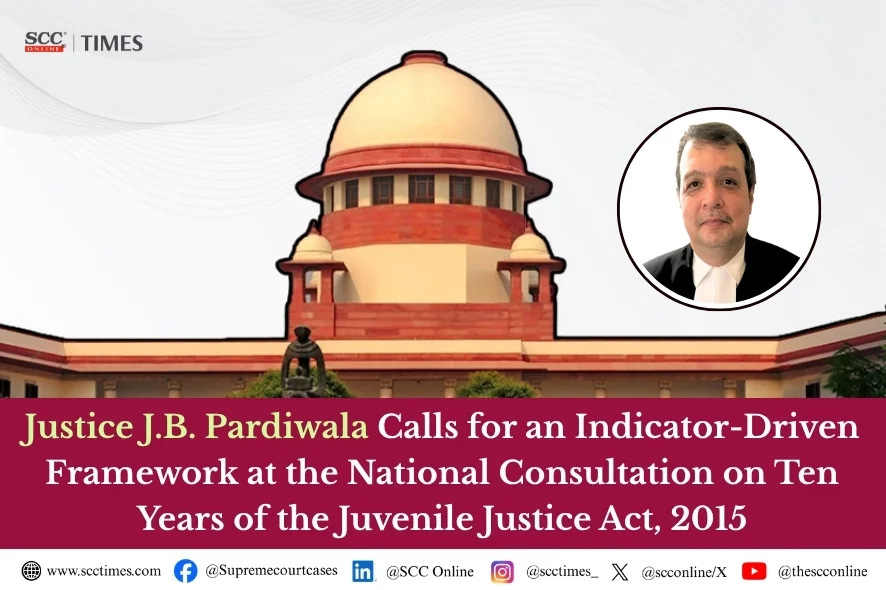
Justice Pardiwala: Advocates Indicator Framework for Juvenile Justice Act 2015
Summary
- Justice J.B. Pardiwala called for an indicator-driven framework at a national consultation on the Juvenile Justice Act, 2015.
- The two-day National Annual Stakeholders Consultation on Ten Years of the Juvenile Justice (Care and Protection of Children) Act, 2015, concluded at the Supreme Court of India.
- The consultation highlighted the need for measurable accountability, prevention, de-institutionalisation, and stronger child protection systems.
- The event marked a decade since the enactment of the Juvenile Justice (Care and Protection of Children) Act, 2015.
- The discussions signal a potential shift towards more data-driven and accountable approaches in India's juvenile justice system.
What Happened
Justice J.B. Pardiwala's advocacy for an indicator-driven framework signals a crucial move towards more data-centric and accountable approaches in evaluating the efficacy of child protection measures under the Juvenile Justice (Care and Protection of Children) Act, 2015.
A significant two-day National Annual Stakeholders Consultation, focusing on the decade since the enactment of the Juvenile Justice (Care and Protection of Children) Act, 2015, recently concluded at the Supreme Court of India. This high-level gathering brought together key figures to assess the impact and future direction of child protection laws in the country, marking a crucial milestone in India's juvenile justice landscape.
During the consultation, Justice J.B. Pardiwala of the Supreme Court of India delivered a pivotal address, advocating strongly for the implementation of an indicator-driven framework. This proposed framework aims to introduce a more systematic and quantifiable approach to evaluating the effectiveness and reach of the Juvenile Justice Act, 2015, ensuring that its objectives are met with measurable outcomes.
Beyond Justice Pardiwala's specific call, the consultation also highlighted several other critical areas for reform and improvement. Discussions centered on the urgent need for enhanced measurable accountability across the juvenile justice system, the development of robust prevention strategies to safeguard children, a concerted push towards de-institutionalisation of child care, and the overarching goal of establishing stronger, more resilient child protection systems throughout India.
Legal Context
The Juvenile Justice (Care and Protection of Children) Act, 2015, serves as the cornerstone of India's legal framework for addressing children in conflict with the law and those in need of care and protection. Enacted to replace previous legislation, the Act introduced significant reforms aimed at ensuring the best interests of the child, emphasizing rehabilitation, social reintegration, and a child-friendly approach to justice.
Justice J.B. Pardiwala's advocacy for an indicator-driven framework signals a crucial move towards more data-centric and accountable approaches in evaluating the efficacy of child protection measures under the Juvenile Justice (Care and Protection of Children) Act, 2015. Such a framework would provide concrete metrics to assess the performance of various stakeholders, identify implementation gaps, and ensure that the Act's provisions are translated into tangible improvements in children's lives, rather than relying solely on anecdotal evidence or process-oriented compliance.
The calls for measurable accountability and de-institutionalisation juvenile justice India are particularly pertinent to the Act's foundational principles. While the Act promotes non-institutional care, its effective implementation often faces challenges. Emphasizing de-institutionalisation seeks to reduce reliance on institutional facilities, promoting family-based and community-based care options, which are generally considered more beneficial for a child's holistic development. Measurable accountability, in turn, would ensure that these progressive objectives are not just aspirational but are actively pursued and their success rigorously tracked.
Why It Matters
The National Annual Stakeholders Consultation Juvenile Justice, particularly with the Supreme Court's involvement and Justice J.B. Pardiwala's prominent role, underscores a growing commitment at the highest levels to critically review and enhance the implementation of the Juvenile Justice Act, 2015. The focus on an indicator-driven framework suggests a future where policy decisions and resource allocation in child protection India will be increasingly guided by empirical data and demonstrable results.
This shift towards measurable accountability child protection India holds significant implications for all entities involved in child welfare, from government agencies and non-governmental organizations to legal professionals. An indicator-driven approach would necessitate clearer objectives, standardized reporting, and transparent evaluation mechanisms, fostering a culture of continuous improvement and ensuring that interventions are genuinely impactful for vulnerable children.
The emphasis on prevention and de-institutionalisation juvenile justice India reflects an evolving understanding of best practices in child protection. These discussions at the consultation highlight a collective desire to move beyond reactive measures, focusing instead on proactive strategies to prevent children from entering the justice system and to provide them with supportive, family-like environments rather than institutional care. This comprehensive approach aims to fortify the entire child protection ecosystem, making it more responsive, effective, and child-centric.
Practical Implications
Lawyers practicing juvenile justice or child protection law in India should closely monitor potential policy shifts or new guidelines emerging from this consultation, particularly regarding measurable accountability and de-institutionalisation, as these could significantly impact compliance requirements for institutions and strategies for cases involving children under the JJ Act, 2015.
Source
How does this affect you?
Get an AI analysis of this article grounded in your jurisdictions, practice areas, and any policy documents you've uploaded to Wansom.
Finish Reading the Full Story and the Expert Analysis.
Get the latest legal & regulatory intelligence in India
Wansom is AI and can make mistakes.